Article
What Is El Niño and How Would SRM Affect It?
The Pacific Ocean phenomenon known as El Niño results in elevated global temperatures and varied regional climate impacts. Could sunlight reflection methods (SRM), or solar geoengineering, have an impact on this key climate cycle?
Photo: ZUMA Press Wire via Reuters Connect

Key takeaways
- The El Niño–Southern Oscillation (ENSO) is a cyclical climate phenomenon where sea surface temperatures in part of the Pacific Ocean rise and fall, which in turn has impacts on global temperatures and regional climate.
- The effect of climate change on ENSO is debated, but as the planet warms, the temperature and rainfall extremes associated with El Niño and La Niña are expected to intensify.
- While climate model studies suggest stratospheric aerosol injection (SAI) could have a limited effect on ENSO, marine cloud brightening (MCB) deployed in certain locations could substantially reduce El Niño strength.
Starting early in 2026, scientists began warning that a critical climate event was on the way: an El Niño, potentially among the strongest such events ever recorded. What is El Niño, why is it important, and how might SRM affect it?
The climate phenomenon is part of the El Niño–Southern Oscillation, or ENSO. This is a recurring, cyclical climate pattern in which the surface temperature of part of the central and eastern Pacific Ocean rises and falls. It has three states: El Niño, when those waters are particularly warm; La Niña, when they are cooler; and neutral, when temperatures lie between those extremes. In general, the ocean surface in this region can warm or cool by up to 3°C.
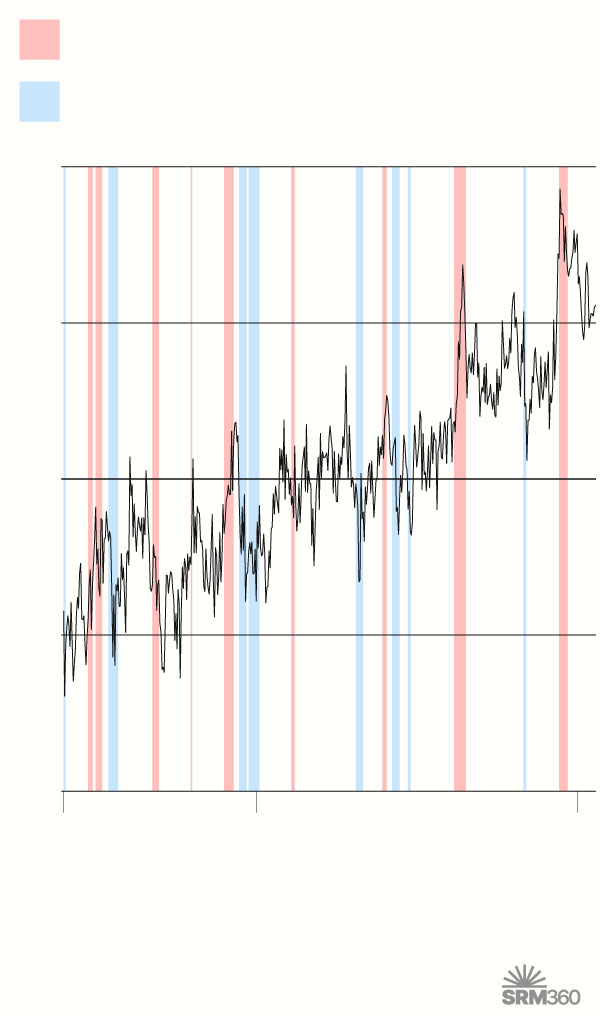
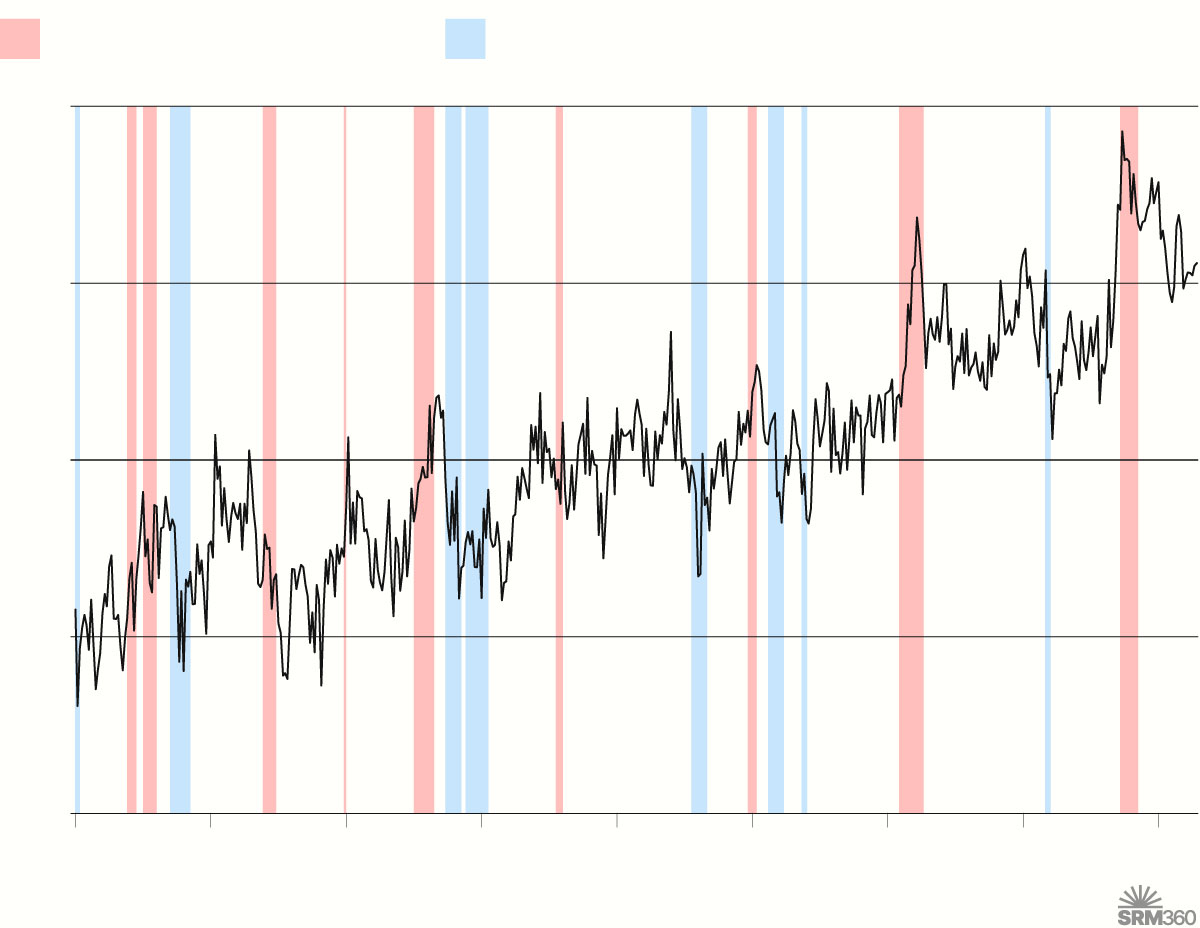
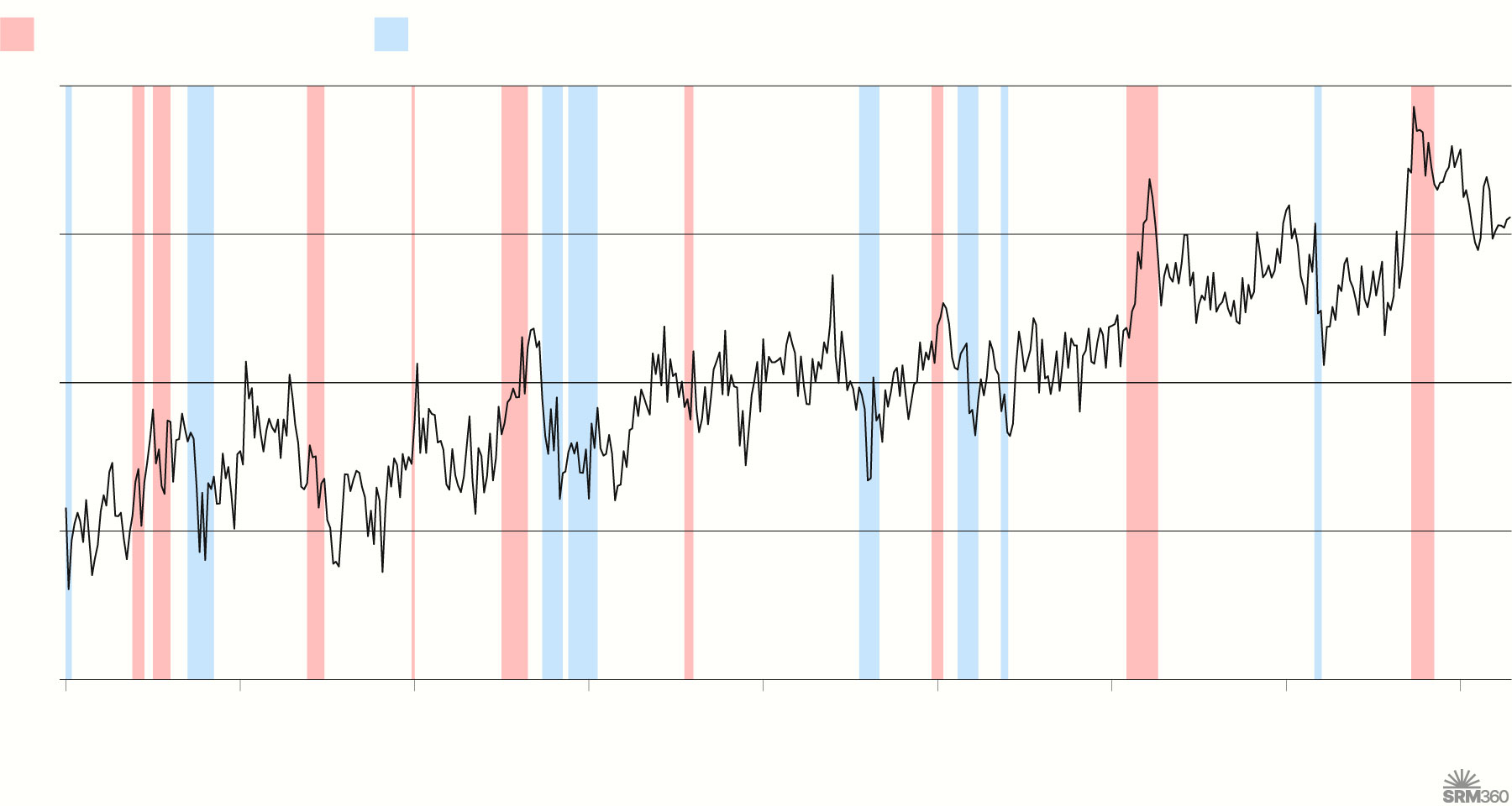
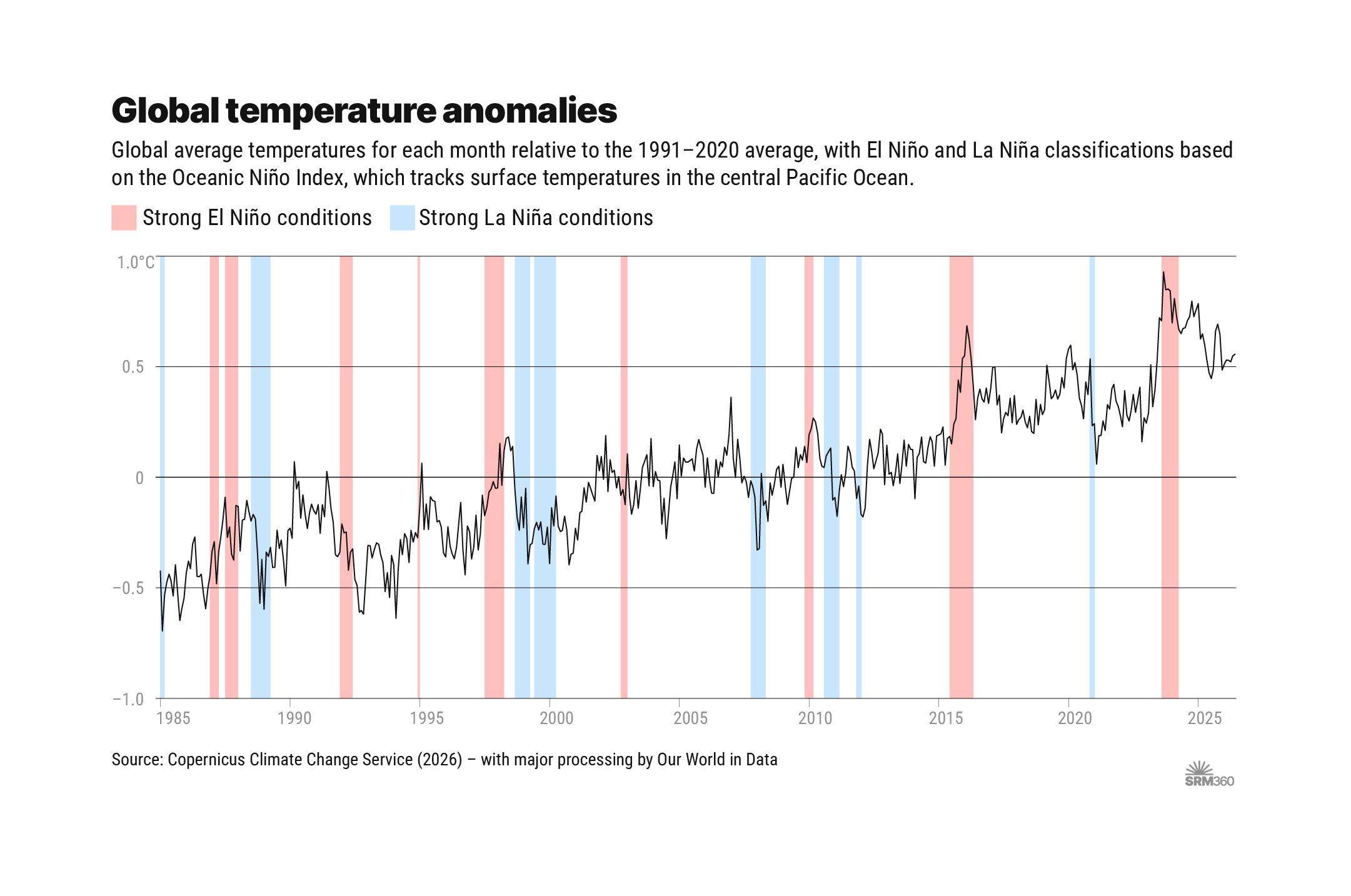
Part of an irregular cycle that can occur every two to seven years, these temperature shifts can last for several months or longer and have a significant influence on the global climate. On average, El Niño tends to raise global temperatures, while La Niña turns the global thermostat down. Historically, strong El Niño events have helped contribute to record-breaking global temperatures, for example in 2015–2016.
Global temperature anomalies
Global average temperatures for each month relative to the 1991–2020 average, with El Niño and La Niña classifications based on the Oceanic Niño Index, which tracks surface temperatures in the central Pacific Ocean.
Strong El Niño conditions
Strong La Niña conditions
1.0°C
0.5
0
–0.5
–1.0
1985
2000
2025
Source: Copernicus Climate Change Service (2026) – with major processing by Our World in Data
Strong El Niño conditions
Strong La Niña conditions
1.0
°C
0.5
0
–0.5
–1.0
1985
'90
'95
'00
'05
'10
'15
'20
'25
Source: Copernicus Climate Change Service (2026) – with major processing by Our World in Data
Strong El Niño conditions
Strong La Niña conditions
°C
1.0
0.5
0
–0.5
–1.0
1985
1990
1995
2000
2005
2010
2015
2020
2025
Source: Copernicus Climate Change Service (2026) – with major processing by Our World in Data
These El Niño events now occur in a different world than decades and centuries ago. The world has warmed around 1.4°C since the Industrial Revolution began, largely due to the burning of fossil fuels. With a warmer baseline, each El Niño now raises temperatures to higher highs than they did before. Global warming has also amplified the temperature and rainfall extremes that come with El Niño, making them stronger and more dangerous.1
While climate models do not agree on many aspects of how ENSO might change in a warming world, they do suggest that temperatures in that part of the Pacific may become more variable, meaning that more extreme El Niño and La Niña events may become more frequent and intense.2,3
All this spells danger for upcoming El Niño events. With a large El Niño on the way, experts think that 2027 is likely to be the warmest year on record – surpassing 2024 when 1.5°C of warming was eclipsed for the first time.
Regional climate and weather variation
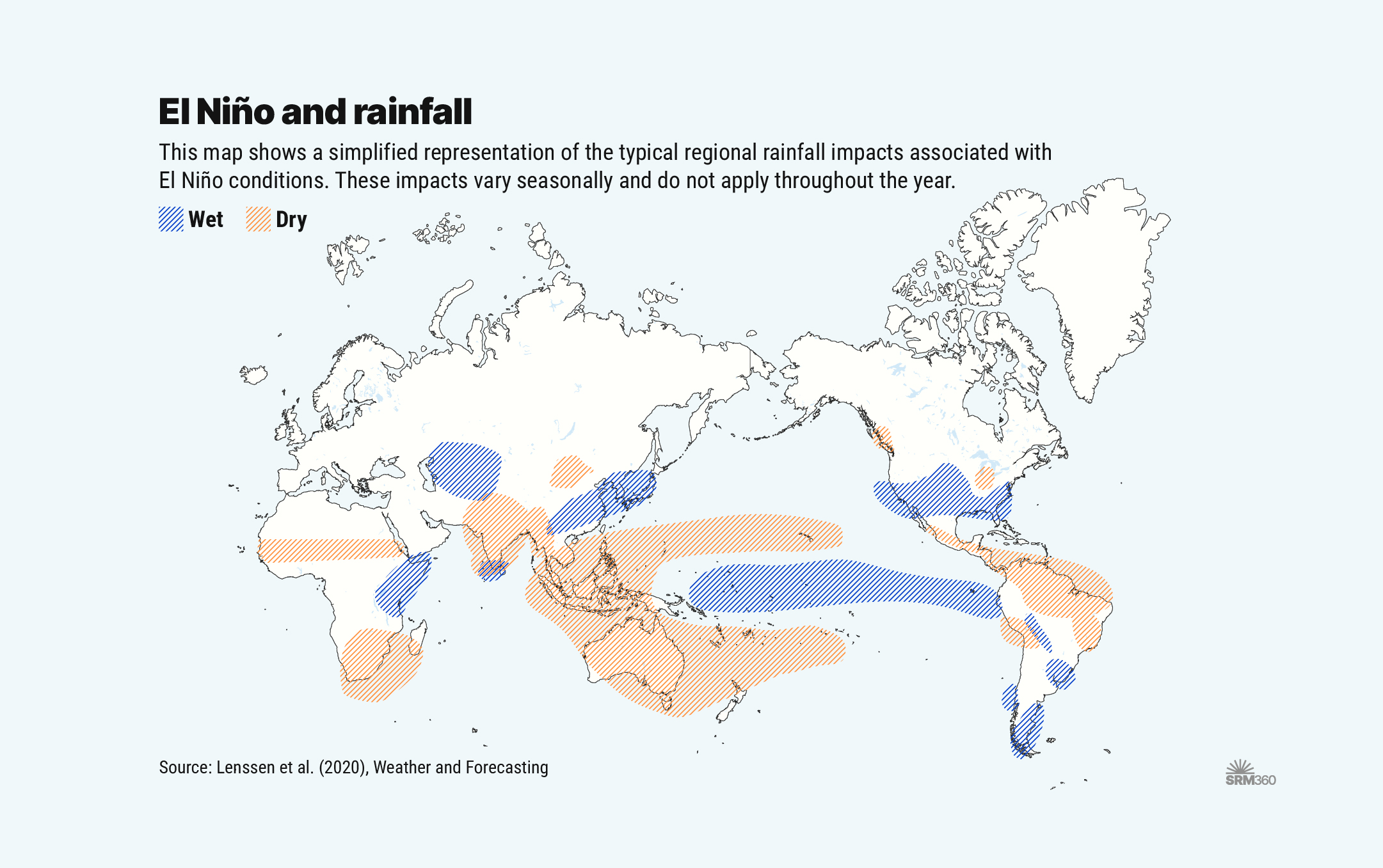
There are regional impacts as well that stretch beyond temperatures. For example, during La Niña, the southern United States tends to be drier than usual, with lower-than-average temperatures across the northern part of the country; during El Niño, the opposite is true, with wetter conditions dominating in the south and warmer temperatures in the north.4
In Australia, El Niño can bring hotter, drier weather, increasing the risk of fires. The same is true in Southeast Asia, where strong El Niño events have been associated with prolonged dry conditions, potentially affecting agriculture in the region.5 El Niño also generally suppresses India’s summer monsoons,6 though it can actually increase extreme daily rainfall, again causing major issues for agriculture.7
El Niño also tends to reduce hurricane activity in the Atlantic basin, but can increase it in the Pacific; the reverse is true for La Niña, tamping down on Pacific cyclone activity while enhancing it in the Atlantic. In general, the cycle’s far-reaching and varying effects demonstrate how connected the world’s oceans, atmosphere, and overall climate really are.
El Niño and rainfall
This map shows a simplified representation of the typical regional rainfall impacts associated with El Niño conditions. These impacts vary seasonally and do not apply throughout the year.
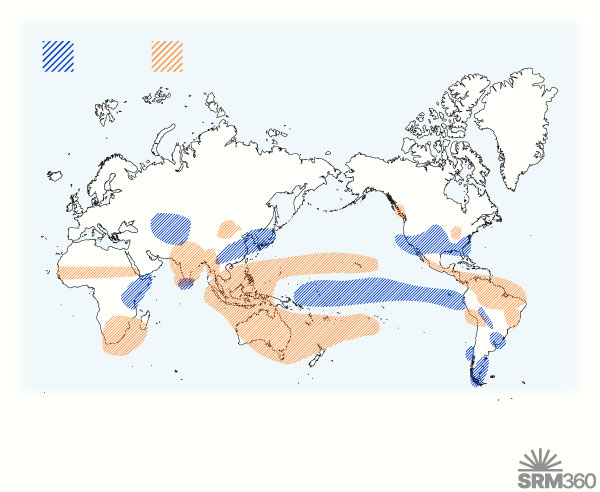
Wet
Dry
Source: Lenssen et al. (2020), Weather and Forecasting
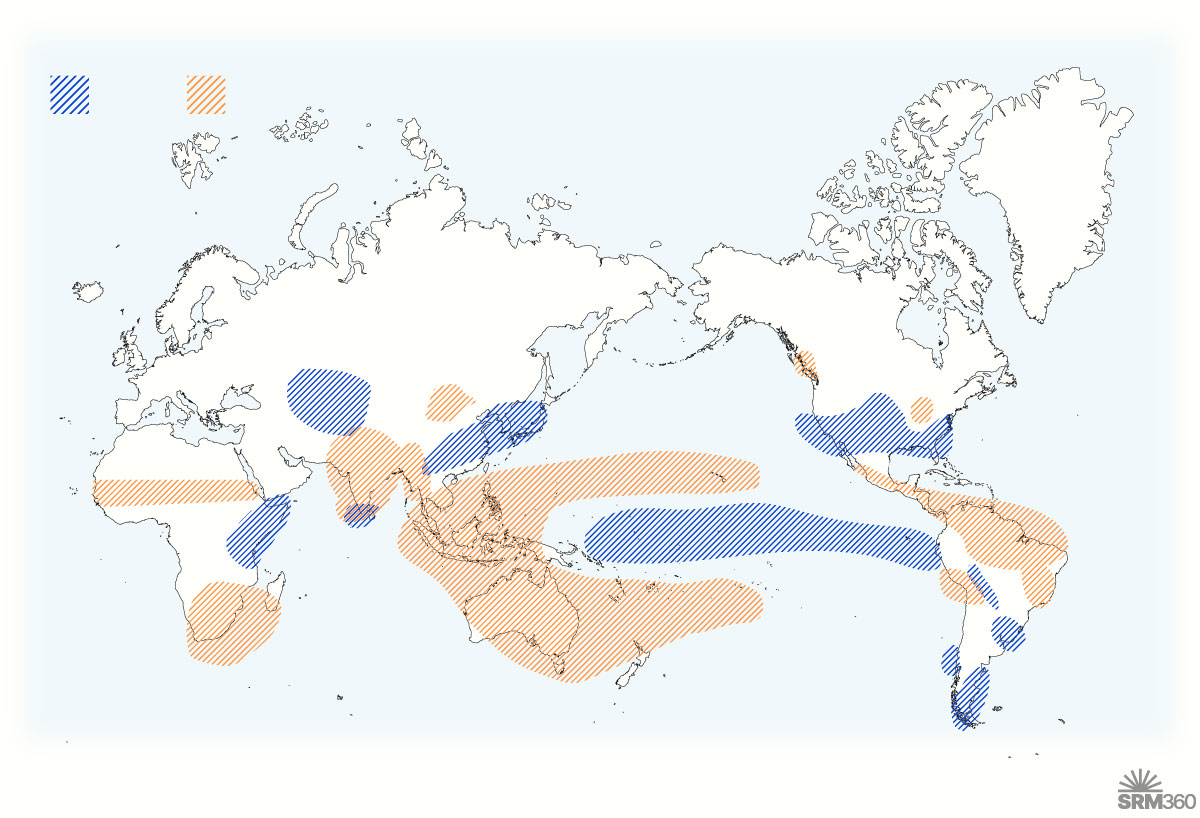
Wet
Dry
Source: Lenssen et al. (2020), Weather and Forecasting
SRM and ENSO
What effect would SRM have on ENSO, if it were ever deployed? The answer depends strongly on the type of SRM used.
The most commonly studied approach, stratospheric aerosol injection (SAI), would involve sending millions of tonnes of tiny reflective particles into the upper atmosphere in order to reflect a small amount of sunlight back into space. Though many questions about this remain, there is little doubt that it would have an overall cooling effect on global temperatures8 – that means that the warmer temperatures associated with an El Niño would likely be cooler under SAI, since the baseline would be lower.
Beyond that, modelling research has found that an SAI deployment would not have a significant impact on ENSO, though only a limited range of deployment scenarios have been explored.9,10 The increasing frequency of El Niño and La Niña events seen due to warming might be offset slightly by SAI, but otherwise research generally suggests no clear trend.
Marine cloud brightening (MCB), however, is a different story. This idea, involving spraying tiny sea-salt particles into low-lying clouds over the oceans to make them more reflective, could potentially have a major impact on ENSO. One study found that if MCB were deployed over the subtropical eastern Pacific Ocean, it could reduce ENSO amplitude by around 60 percent.10 It would do this by drying the atmosphere over that area of the ocean and intensifying the trade winds, which would dramatically reduce the “air-sea feedback processes” that operate during ENSO and limit its magnitude. Another study (not yet peer-reviewed) showed that the location of an MCB deployment is critical in determining its impacts, with potential to create both El Niño- and La Niña-like temperature anomalies.11
Further research on this idea found that it could, in theory, be used intentionally as a tool to suppress potentially dangerous El Niño events. Deploying targeted MCB over the relevant part of the Pacific when the event is building up could reduce its magnitude significantly, potentially reducing some of the associated impacts in other parts of the world.12 This sort of seasonal intervention, however, might have some unintended consequences, including hastening and strengthening a subsequent La Niña even after the MCB deployment is stopped.
That potential, though, offers a demonstration of how the details of climate interventions – which approach, where, at what magnitude, and so on – could have widely varying impacts on the global and regional climate. The idea that it may be possible to use targeted SRM to “improve” a specific climate change impact – in this case, to reduce increasingly intense and potentially damaging El Niño events – raises many questions regarding human effects on the world and how they should be managed.
Open questions
- How dangerous might future El Niño events become in a warmer world?
- How might SAI affect the climate extremes associated with El Niño events?
- If MCB could be used to suppress El Niño events, how could decisions over this be made given the far-reaching regional consequences – and who would make them?

Endnotes
- Estrada F, Perron P, Yamamoto Y. (2025). Synergies between observed warming and ENSO episodes on extreme events. Annals of the New York Academy of Sciences. 1554(1):95-109. https://doi.org/10.1111/nyas.70122
- Fredriksen HB, Berner J, Subramanian AC, Capotondi A. (2020). How does El Niño–Southern Oscillation change under global warming—A first look at CMIP6. Geophysical Research Letters. 47(22):e2020GL090640. https://doi.org/10.1029/2020GL090640
- Cai W, Ng B, Wang G, et al. (2022). Increased ENSO sea surface temperature variability under four IPCC emission scenarios. Nature Climate Change. 12(3):228-31. https://doi.org/10.1038/s41558-022-01282-z
- Lenssen NJ, Goddard L, Mason S. (2020). Seasonal forecast skill of ENSO teleconnection maps. Weather and Forecasting. 35(6):2387-406. https://doi.org/10.1175/WAF-D-19-0235.1
- Faranda D, Sato Y, Dong C, et al. (2025). El Niño and droughts in Southeast Asia: A stochastic-chaotic modeling approach. Physical Review E. 111(6):064209. https://doi.org/10.1103/physreve.111.064209
- Nair PJ, Chakraborty A, Varikoden H, et al. (2018). The local and global climate forcings induced inhomogeneity of Indian rainfall. Scientific Reports. 8(1):6026. https://doi.org/10.1038/s41598-018-24021-x
- Hill SA, Meyers DZ, Sobel AH, et al. (2025). More extreme Indian monsoon rainfall in El Niño summers. Science. 389(6766):1220-4. https://doi.org/10.1126/science.adg5577
- Kravitz B, MacMartin DG. (2020). Uncertainty and the basis for confidence in solar geoengineering research. Nature Reviews Earth & Environment. 1(1):64-75. https://doi.org/10.1038/s43017-019-0004-7
- Rezaei A, Karami K, Tilmes S, Moore JC. (2023). Changes in global teleconnection patterns under global warming and stratospheric aerosol intervention scenarios. Atmospheric Chemistry and Physics. 23(10):5835-50. https://doi.org/10.5194/acp-23-5835-2023
- Xing C, Stevenson S, Fasullo J, et al. (2025). Subtropical marine cloud brightening suppresses the El Niño–Southern Oscillation. Earth’s Future. 13(8):e2025EF006522. https://doi.org/10.1029/2025EF006522
- Narenpitak P, Kongkulsiri S, Tomkratoke S, et al. (2026). Marine Cloud Brightening and Precipitation Responses in the Tropical Pacific Ocean. [Preprint]. https://doi.org/10.22541/essoar.15005398/v1
- Wan JS, Fasullo JT, Rosenbloom N, et al. (2026). Targeted marine cloud brightening weakens subsequent El Niño. Science Advances. 12(28):eadx3012. https://doi.org/10.1126/sciadv.adx3012