
Facts and Myths
Under the Lens
We review the evidence to address some common claims about sunlight reflection methods (SRM), also known as solar geoengineering.
“Large-scale SRM is already being deployed” – FALSE
Copy link to this section

Large-scale SRM has never been deployed.
- Large-scale SRM deployment would be a major operation with observable infrastructure and detectable changes to the planet.
- There have been a few small-scale outdoor experiments, but these have been far smaller than what would be needed to noticeably affect the global climate.
The chemtrails conspiracy theory falsely points to aircraft contrails as evidence of ongoing SRM deployment.1 Contrails, or condensation trails, form when jet exhausts interact with certain atmospheric conditions, leaving cloud-like streaks across the sky.2
Weather modification also gets confused for SRM.1 Many countries pursue weather modification efforts like cloud seeding, which aim to influence local weather – usually enhancing rain or snowfall.3 SRM is distinct from weather modification, focused on changing long-term climate outcomes at a much larger scale.3
While some small-scale SRM outdoor experiments have taken place, no large-scale SRM deployment has begun, and it would be easy to detect if it did.
The most researched and feasible SRM approach is stratospheric aerosol injection (SAI), which would use high-flying jets to create a global layer of tiny reflective particles in the upper atmosphere.4 Cooling the planet by 1°C would require hundreds of jets each flying hundreds of times per year.5
It would not be possible to keep such a large-scale SAI programme secret. The flight activity would be detected,6 and existing satellites could detect aerosol injections in the stratosphere before they could produce a significant climate impact.7
Large-scale deployment of other SRM approaches like marine cloud brightening would also be detectable through the large fleets required for deployment and the resulting changes to clouds.8
While there have been a limited number of small-scale outdoor SRM experiments, these have all had little to no environmental impact and are far smaller than what would be needed to noticeably affect the global climate.9
Learn more
Outdoor Experiments Tracker
Endnotes:
- Buck HJ, Shah P, Yang JZ, Arpan L. (2025). Public concerns about solar geoengineering research in the United States. Communications Earth & Environment. 6(1):609. https://doi.org/10.1038/s43247-025-02595-5
- Singh DK, Sanyal S, Wuebbles DJ. (2024). Understanding the role of contrails and contrail cirrus in climate change: a global perspective. Atmospheric Chemistry and Physics. 24(16):9219-62. https://doi.org/10.5194/acp-24-9219-2024
- World Meteorological Organization. (2025). WMO Statement on Weather Modification. https://wmo.int/content/wmo-statement-weather-modification
- Parson EA, Keith DW. (2024). Solar geoengineering: History, methods, governance, prospects. Annual Review of Environment and Resources. https://doi.org/10.1146/annurev-environ-112321-081911
- Smith W. (2020). The Cost of Stratospheric Aerosol Injection Through 2100. Environmental Research Letters 15: 114004. https://doi.org/10.1088/1748-9326/aba7e7
- Smith W, Wagner G. (2018). Stratospheric Aerosol Injection Tactics and Costs in the First 15 Years of Deployment, Environmental Research Letters 13: 124001. https://doi.org/10.1088/1748-9326/aae98d
- Lange A, Niemeier U, Rozanov A, von Savigny C. (2025). Investigating the ability of satellite occultation instruments to monitor possible geoengineering experiments. Atmospheric Chemistry and Physics. 25(19):11673-88. https://doi.org/10.5194/acp-25-11673-2025
- Latham J, Bower K, Choularton T, et al. (2012). Marine cloud brightening. Philosophical Transactions of the Royal Society A: Mathematical, Physical and Engineering Sciences. 370(1974):4217-62. https://doi.org/10.1098/rsta.2012.0086
- SRM360. (2025). Outdoor SRM Experiments. SRM360.org. https://srm360.org/article/outdoor-srm-experiments/
“SRM could undermine emissions cuts” – TRUE
Copy link to this section
SRM has the potential to undermine emissions cuts.
Experts agree that emissions cuts would remain essential if SRM were deployed. Nevertheless, powerful actors could see SRM as a reason to slow down efforts to reduce emissions.
SRM may be able to reduce many risks from climate change, but it would be a poor substitute for emissions cuts as it would bring new risks and side effects. A common concern is that advancing SRM could undermine efforts to cut emissions, known as “mitigation displacement” or “moral hazard”.
SRM would be inexpensive to deploy compared to the investments needed for large-scale emissions cuts or carbon removal.1 This could incentivise policymakers to weaken efforts to cut emissions, and those with a vested interest in fossil fuels might exaggerate the potential of SRM to rationalise continued emissions.2
However, several studies using surveys and games have found that people’s support for emissions cuts tends not to be significantly affected by SRM.3,4 Some studies even found that SRM increases rather than reduces support for emissions cuts,5,6 though others show that results depend strongly on how SRM is presented and framed.7
These studies may not provide much insight into the long-term politics of SRM, though. Public opinion can shift dramatically over time as policy debates evolve, and political decisions are often driven by factors beyond public opinion.8
SRM’s potential effect on emissions is not only difficult to predict – it would also be difficult to determine in retrospect.2 This is because of the lack of a “counterfactual” – an alternative reality without SRM to compare to. Similar concerns were raised around adaptation, but we can’t know whether the growing attention to adaptation has reduced efforts to cut emissions or not.2
Learn more
Mitigation Displacement: Could SRM Undermine Emissions Cuts?
Endnotes:
- Moreno-Cruz J, McEvoy DM, McGinty M, Cherry TL. (2025). The economics and governance of solar geoengineering. Review of Environmental Economics and Policy. 19(1):1-24. https://doi.org/10.1086/733652
- McLaren D. (2016). Mitigation deterrence and the “moral hazard” of solar radiation management. Earth’s Future. 4(12):596-602. https://doi.org/10.1002/2016EF000445
- Andrews TM, Delton AW, Kline R. (2022). Anticipating moral hazard undermines climate mitigation in an experimental geoengineering game. Ecological Economics. 196:107421. https://doi.org/10.1016/j.ecolecon.2022.107421
- Schoenegger P, Mintz-Woo K. (2024). Moral hazards and solar radiation management: Evidence from a large-scale online experiment. Journal of Environmental Psychology. 95:102288. https://doi.org/10.1016/j.jenvp.2024.102288
- Cherry TL, Kallbekken S, Kroll S, McEvoy DM. (2021). Does solar geoengineering crowd out climate change mitigation efforts? Evidence from a stated preference referendum on a carbon tax. Climatic Change. 165(1):6. https://doi.org/10.1007/s10584-021-03009-z
- Cherry TL, Kroll S, McEvoy DM, et al. (2023). Climate cooperation in the shadow of solar geoengineering: an experimental investigation of the moral hazard conjecture. Environmental politics. 32(2):362-70. https://doi.org/10.1080/09644016.2022.2066285
- Merk C, Wagner G. (2024). Presenting balanced geoengineering information has little effect on mitigation engagement. Climatic Change. 177(1):11. https://doi.org/10.1007/s10584-023-03671-5
- Parson EA, Keith DW. (2024). Solar geoengineering: History, methods, governance, prospects. Annual Review of Environment and Resources. 49. https://doi.org/10.1146/annurev-environ-112321-081911
“SRM would make emissions cuts unnecessary” – FALSE
Copy link to this section

SRM would not make emissions cuts unnecessary.
- SRM could not fully counteract the effects of greenhouse gases and would have its own risks and side effects.
- SRM might play a useful role in limiting climate risks, but without emissions cuts there is no sustainable solution to the climate crisis.
Climate change is caused by greenhouse gas build-up – mainly CO2 – trapping heat and warming the planet. SRM may be able to help by reflecting a small portion of sunlight back to space, cooling the planet. This might help to reduce many impacts of climate change,1 but SRM has shortfalls and risks that mean it cannot replace emissions cuts.
SRM would offer only a short-lived cooling effect, while CO2 persists in the environment for centuries.2 And it wouldn’t stop ocean acidification, which threatens marine life.3
SRM also couldn’t fully counteract the effects of greenhouse gases on the climate. Rainfall patterns would still change significantly, and some regions may see greater changes under SRM than under climate change alone.4
And SRM approaches would also have environmental side effects of their own. For example, stratospheric aerosol injection (SAI) using sulphates would add to acid rain5 and air pollution, while slowing the recovery of the ozone hole – though these harms may be outweighed by the benefits of reduced temperatures.6
Using SRM to maintain temperatures without cutting emissions would require deploying more and more SRM – amplifying side effects and risks. And if deployment suddenly stopped, temperatures would spike rapidly.7
At best, SRM could temporarily reduce some climate impacts while emissions cuts scale up.8
Learn more
What Is SRM?
Endnotes:
- The Royal Society. (2025). Solar Radiation Modification Policy Briefing. https://royalsociety.org/news-resources/projects/solar-radiation-modification/
- Archer D, Eby M, Brovkin V, et al. (2009). Atmospheric lifetime of fossil fuel carbon dioxide. Annual review of earth and planetary sciences. 37(1):117-34. https://doi.org/10.1146/annurev.earth.031208.100206
- Roberts KE, Rohr T, Raven MR, et al. (2026). Potential impacts of climate interventions on marine ecosystems. Reviews of Geophysics, 64, e2024RG000876. https://doi.org/10.1029/2024RG000876
- Ricke K, Wan JS, Saenger M, Lutsko NJ. (2023). Hydrological Consequences of Solar Geoengineering. Annual Review of Earth and Planetary Sciences. 51(Volume 51, 2023):447–70. https://doi.org/10.1146/annurev-earth-031920-083456
- Visioni D, Slessarev E, Macmartin DG, et al. (2020). What goes up must come down: Impacts of deposition in a sulfate geoengineering scenario. Environmental Research Letters; 15. https://doi.org/10.1088/1748-9326/ab94eb
- Harding A, Vecchi GA, Yang W, Keith DW. (2024). Impact of solar geoengineering on temperature-attributable mortality. Proceedings of the National Academy of Sciences. 121(52):e2401801121. https://doi.org/10.1073/pnas.2401801121
- Parker A, Irvine PJ. (2018). The risk of termination shock from solar geoengineering. Earth’s Future. 6(3):456-67. https://doi.org/10.1002/2017EF000735
- Parson EA, Keith DW. (2024). Solar geoengineering: History, methods, governance, prospects. Annual Review of Environment and Resources. 49. https://doi.org/10.1146/annurev-environ-112321-081911
“Fossil fuel interests fund SRM” – FALSE*
Copy link to this section

There is no evidence of fossil fuel interests – individuals or organisations heavily involved in fossil fuels – funding SRM research.
Our SRM Funding Tracker is the most comprehensive analysis available of who’s funding solar geoengineering work. Across all the funding we analysed, we found no fossil fuel money. Many non-profits working on SRM explicitly state that they wouldn’t accept such funding.
*That said, we couldn’t confidently identify the source of about $1 million (less than 1% of total funding analysed). And it’s possible some funding remained undetected. So, while we found no evidence of fossil fuel involvement, we can’t rule it out completely.
“SRM is banned under international law” – FALSE
Copy link to this section

SRM is not banned under international law.
- While there are international laws relevant to SRM, none amount to an outright ban.
- SRM deployment would still likely face legal challenges, as countries might argue it conflicts with certain legal principles.
International law comes in two main forms: treaties between agreeing countries, and customary international law (consistent practices countries accept as being legally required).
Several treaties have some relevance to SRM, but none amount to a ban. The main ones are:
- The Environmental Modification Convention, which would prohibit the hostile use of SRM but not peaceful uses;1
- The Convention on Biological Diversity, which invites governments to consider prohibiting SRM activities that may affect biodiversity, but does not itself prohibit SRM;2
- The London Protocol, which prohibits specific “marine geoengineering” activities but does not currently apply to SRM.3
While no treaties ban SRM at any scale, countries may argue that large-scale tests or deployment would conflict with certain principles of customary international law – particularly the “no-harm rule”.4 This requires countries to take steps to reduce environmental harms to each other and could apply to SRM, since it could pose significant risks to countries other than the deployer(s).
However, customary international law can lack detail and be open to interpretation.5 The UN International Law Commission, whose work to some degree reflects this body of law, did not recommend a prohibition on SRM in its Draft Guidelines on the Protection of the Atmosphere.6 Instead, it states that such activities “should only be conducted with prudence and caution, and subject to any applicable rules of international law”.6
While customary international law could present legal obstacles to SRM, it doesn’t amount to an outright ban. That said, some countries may support one. The Mexican government has said it would rally countries to ban SRM,7 and African ministers have called for a global “non-use agreement”.8
Learn more
Does International Law Prohibit SRM?
Endnotes:
- Convention on the prohibition of military or any other hostile use of environmental modification techniques. (1976). https://treaties.un.org/pages/ViewDetails.aspx?src=IND&mtdsg_no=XXVI-1&chapter=26&clang=_en
- Convention on Biological Diversity. (2010). Decision X/33. https://www.cbd.int/decision/cop?id=12299
- London Protocol. (2013). Resolution LP.4(8). https://wwwcdn.imo.org/localresources/en/KnowledgeCentre/IndexofIMOResolutions/LCLPDocuments/LP.4(8).pdf
- United Nations Environment Programme. (n.d.) No Harm Rule. https://leap.unep.org/en/knowledge/glossary/no-harm-rule
- Hakimi M. (2020). Making Sense of Customary International Law. 118. Michigan Law Review. 1487. https://doi.org/10.36644/mlr.118.8.making
- International Law Commission. (2021). Guideline 7 in Draft guidelines on the protection of the atmosphere, with commentaries. https://legal.un.org/ilc/texts/instruments/english/commentaries/8_8_2021.pdf
- Garrison C. (2023). Insight: How two weather balloons led Mexico to ban solar geoengineering. Reuters. https://www.reuters.com/business/environment/how-two-weather-balloons-led-mexico-ban-solar-geoengineering-2023-03-27/
- AMCEN. (2025). Tripoli Declaration. https://wedocs.unep.org/handle/20.500.11822/48291
Would SAI would disproportionately harm poorer regions?
Copy link to this section

SAI has the potential to disproportionately benefit poorer regions.
Climate change has disproportionate impacts on poorer regions – they’re generally more vulnerable, less able to adapt, and more dependent on climate-sensitive livelihoods.1 Many poorer countries are also closer to the equator, with already hot climates, and are expected to suffer greater harms as the world warms.1
By reducing temperatures globally, stratospheric aerosol injection (SAI) could produce disproportionate benefits for hotter, poorer regions, including reductions in temperature-related deaths2 and other climate impacts like agricultural losses.3
However, SAI would produce uneven changes in regional rainfall and water availability.4 For example, it could decrease the risk of droughts in some poorer regions, while increasing it in others.5
SAI could also have side effects, such as delaying ozone recovery and adding to air pollution, though these harms may be small compared to the benefits of reduced temperatures.2
Irresponsible SAI deployment – like in just one hemisphere or with abrupt abandonment – could cause severe harms,6 likely felt more strongly by poorer regions. But careful, moderate deployment could help reduce changes to most climate hazards in most regions.7
Learn more
Could SRM Help Reduce Climate Risks?
Endnotes:
- IPCC. (2022). Climate Change 2022: Impacts, Adaptation and Vulnerability. Contribution of Working Group II to the Sixth Assessment Report of the Intergovernmental Panel on Climate Change. Cambridge University Press. http://doi.org/10.1017/9781009325844
- Harding A, Vecchi GA, Yang W, et al. (2024). Impact of solar geoengineering on temperature-attributable mortality. Proceedings of the National Academy of Sciences, 121(52). https://doi.org/10.1073/pnas.2401801121
- Fan Y, Tjiputra J, Muri H, et al. (2021). Solar geoengineering can alleviate climate change pressures on crop yields. Nature Food. 2(5):373-81. https://doi.org/10.1038/s43016-021-00278-w
- Ricke K, Wan JS, Saenger M, et al. (2023). Hydrological consequences of solar geoengineering. Annual review of earth and planetary sciences. 51(1):447-70. https://doi.org/10.1146/annurev-earth-031920-083456
- Fu W, Yue X, Tian C, et al. (2025). Unequal socioeconomic exposure to drought extremes induced by stratospheric aerosol injection. Atmospheric Chemistry and Physics. 25(20):13103-21. https://doi.org/10.5194/acp-25-13103-2025
- Tang A, Kemp L. (2021). A fate worse than warming? Stratospheric aerosol injection and global catastrophic risk. Frontiers in Climate. 3:720312. https://doi.org/10.3389/fclim.2021.720312
- Irvine PJ, Keith DW. (2020). Halving warming with stratospheric aerosol geoengineering moderates policy-relevant climate hazards. Environmental Research Letters. 15(4):044011. http://doi.org/10.1088/1748-9326/ab76de
“Public opposition to SRM is stronger in the Global South than in the Global North” – FALSE
Copy link to this section
Public opposition to SRM is not stronger in the Global South than in the Global North.
Researchers have surveyed public opinion on SRM and compared findings across regions. While most people globally are unfamiliar with SRM, studies consistently find that the public in the Global South tend to be modestly more open to it than those in the Global North.1–3
Key factors that could explain this difference: the Global South is generally younger and more exposed to climate harms.1,4 Younger people will likely suffer more harms from climate change and tend to be more open to new technologies.5
The surveys also found differences in concerns about SRM. Respondents in the Global South were more concerned with power imbalances and SRM’s potential to undermine emissions cuts, while those in the Global North emphasised unintended consequences and harms to humans and nature.1
Public opinion on SRM is likely to shift as the field develops and emerges more clearly into public consciousness, and will depend heavily on how it’s framed in media coverage.6
Learn more
Global Surveys Challenge Assumptions on Public Opinion of SRM
Endnotes:
- Baum CM, Fritz L, Low S, Sovacool BK. (2024). Public perceptions and support of climate intervention technologies across the Global North and Global South. Nature Communications. 15(1):2060. https://doi.org/10.1038/s41467-024-46341-5
- Contzen N, Perlaviciute G, Steg L, et al. (2024). Public opinion about solar radiation management: A cross-cultural study in 20 countries around the world. Climatic Change. 177(4):65. https://doi.org/10.1007/s10584-024-03708-3
- Sugiyama M, Asayama S, Kosugi T. (2020). The north–south divide on public perceptions of stratospheric aerosol geoengineering?: a survey in six Asia-Pacific countries. Environmental Communication. 14(5):641-56. https://doi.org/10.1080/17524032.2019.1699137
- Fritz L, Baum CM, Brutschin E, et al. (2024). Climate beliefs, climate technologies and transformation pathways: Contextualizing public perceptions in 22 countries. Global Environmental Change. 87:102880. https://doi.org/10.1016/j.gloenvcha.2024.102880
- Sovacool BK, Evensen D, Baum CM, et al. (2024). Demographics shape public preferences for carbon dioxide removal and solar geoengineering interventions across 30 countries. Communications Earth & Environment. 5(1):642. https://doi.org/10.1038/s43247-024-01800-1
- Bolsen T, Palm R, Luke RE. (2023). Public response to solar geoengineering: how media frames about stratospheric aerosol injection affect opinions. Climatic Change. 176(8):112. https://doi.org/10.1007/s10584-023-03575-4
Could SRM could be used as a weapon?
Copy link to this section

SRM is poorly suited to being used as a weapon.
It can’t be precisely targeted to cause predictable harm in a certain region. However, it could shift climate conditions in ways that affect many countries, potentially raising geopolitical tensions.
A weapon is something designed or used for inflicting damage – usually physical. While SRM could cause harm, its effects would be so uncertain and imprecise that it would be a poor choice for inflicting harm on a specific target.
SRM could potentially help reduce many of the impacts of climate change, but it might also be used in more selfish or disruptive ways.1 It wouldn’t allow for influence over specific weather events – instead, it would change long-term climate outcomes in ways that would affect many or all countries.2
Stratospheric aerosol injection, the most researched SRM proposal, is inherently global – its effects can’t be confined to a certain country.3 Regional SRM approaches, like marine cloud brightening, could offer more influence over local impacts, but they would still have indirect, remote effects across the planet and are currently poorly understood.4
Compared to existing weaponry, SRM lacks many of the crucial qualities that would make it a useful weapon. Nevertheless, it could potentially be deployed to advance the interests of some over others or in a deliberately disruptive way, which could raise geopolitical tensions.1
Learn more
Could SRM Be Weaponised?
Endnotes:
- Corry O, McLaren D, Kornbech N. (2024). Scientific models versus power politics: How security expertise reframes solar geoengineering. Review of International Studies. 1-20. https://doi.org/10.1017/S0260210524000482
- The Royal Society. (2025). Solar Radiation Modification Policy Briefing. https://royalsociety.org/news-resources/projects/solar-radiation-modification/
- Lee WR, MacMartin DG, Visioni D, et al. (2021). High‐latitude stratospheric aerosol injection to preserve the Arctic. Earth’s Future.11(1):e2022EF003052. https://doi.org/10.1029/2022EF003052
- Wan JS, Chen CC, Tilmes S, et al. (2024). Diminished efficacy of regional marine cloud brightening in a warmer world. Nature Climate Change. 14(8):808-14. https://doi.org/10.1038/s41558-024-02046-7
Would SRM reduce plant growth and crop yields?
Copy link to this section
SRM could both benefit and harm plants and crops.
Plants need sunlight to grow, so reducing the amount of sunlight reaching Earth with SRM could raise concerns about its effects on plants. However, SRM would only need to reflect a relatively small portion of incoming sunlight to produce a substantial cooling effect.
About 30% of incoming sunlight is already being reflected and it is estimated that reflecting 1% more would cool the planet by about 1°C, accounting for most of human-caused global warming to date.1
Stratospheric aerosol injection, the leading SRM approach, would also increase diffuse (or scattered) light, which is generally more useful to plants than direct sunlight. More of this diffuse light reaches shaded leaves, helping plants photosynthesise more efficiently.2
Plant growth is also strongly affected by carbon dioxide (CO2) emissions. Photosynthesis uses CO2 so increased levels of it can increase the rate of photosynthesis.3 However, CO2 also causes climate change, harming plants across much of the world and often outweighing the benefits of increased CO2.4
SRM could reduce heat stress, benefiting the growth of many plants.5 However, SRM’s effects on water availability – another key factor for plant growth – would vary from region to region.6
For crops specifically, studies have found that SRM could have beneficial 7 or minimal 8 impacts on yields, though it may somewhat reduce the nutritional value of some crops, such as maize and rice.9
Overall, the picture is mixed – SRM could help plants in some ways and harm them in others, and the balance would depend on where and how it’s deployed.
Endnotes:
- Visioni D, MacMartin DG, Kravitz B, et al. (2021). Identifying the sources of uncertainty in climate model simulations of solar radiation modification with the G6sulfur and G6solar Geoengineering Model Intercomparison Project (GeoMIP) simulations. Atmospheric Chemistry and Physics. 21(13):10039–63. https://doi.org/10.5194/acp-21-10039-2021
- Gu L, Baldocchi D, Verma SB, et al. (2002). Advantages of diffuse radiation for terrestrial ecosystem productivity. Journal of Geophysical Research Atmospheres, 107(5–6). https://doi.org/10.1029/2001jd001242
- Haverd V, Smith B, Canadell JG, et al. (2020). Higher than expected CO2 fertilization inferred from leaf to global observations. Global Change Biology. 26(4):2390-402. https://doi.org/10.1111/gcb.14950
- Forzieri G, Dakos V, McDowell NG, et al. (2022). Emerging signals of declining forest resilience under climate change. Nature. 608(7923):534-9. https://doi.org/10.1038/s41586-022-04959-9
- Xia L, Robock A, Tilmes S, et al. (2016). Stratospheric sulfate geoengineering could enhance the terrestrial photosynthesis rate. Atmospheric Chemistry and Physics, 16(3), 1479–1489. https://doi.org/10.5194/acp-16-1479-2016
- Dagon K, Schrag DP. (2019). Quantifying the effects of solar geoengineering on vegetation. Climatic Change, 153(1–2), 235–251. https://doi.org/10.1007/s10584-019-02387-9
- Fan Y, Tjiputra J, Muri H, et al. (2021). Solar geoengineering can alleviate climate change pressures on crop yields. Nature Food, 2(5), 373–381. https://doi.org/10.1038/s43016-021-00278-w
- Proctor J, Hsiang S, Burney J, et al. (2018). Estimating global agricultural effects of geoengineering using volcanic eruptions. Nature. 560(7719):480-3. https://doi.org/10.1038/s41586-018-0417-3
- Clark B, Robock A, Xia L, et al. (2025). Stratospheric aerosol climate intervention could reduce crop nutritional value. Environmental Research Letters. 20(11):114083. http://doi.org/10.1088/1748-9326/ae1151
Learn more
Once started, could SRM deployment be safely stopped?
Copy link to this section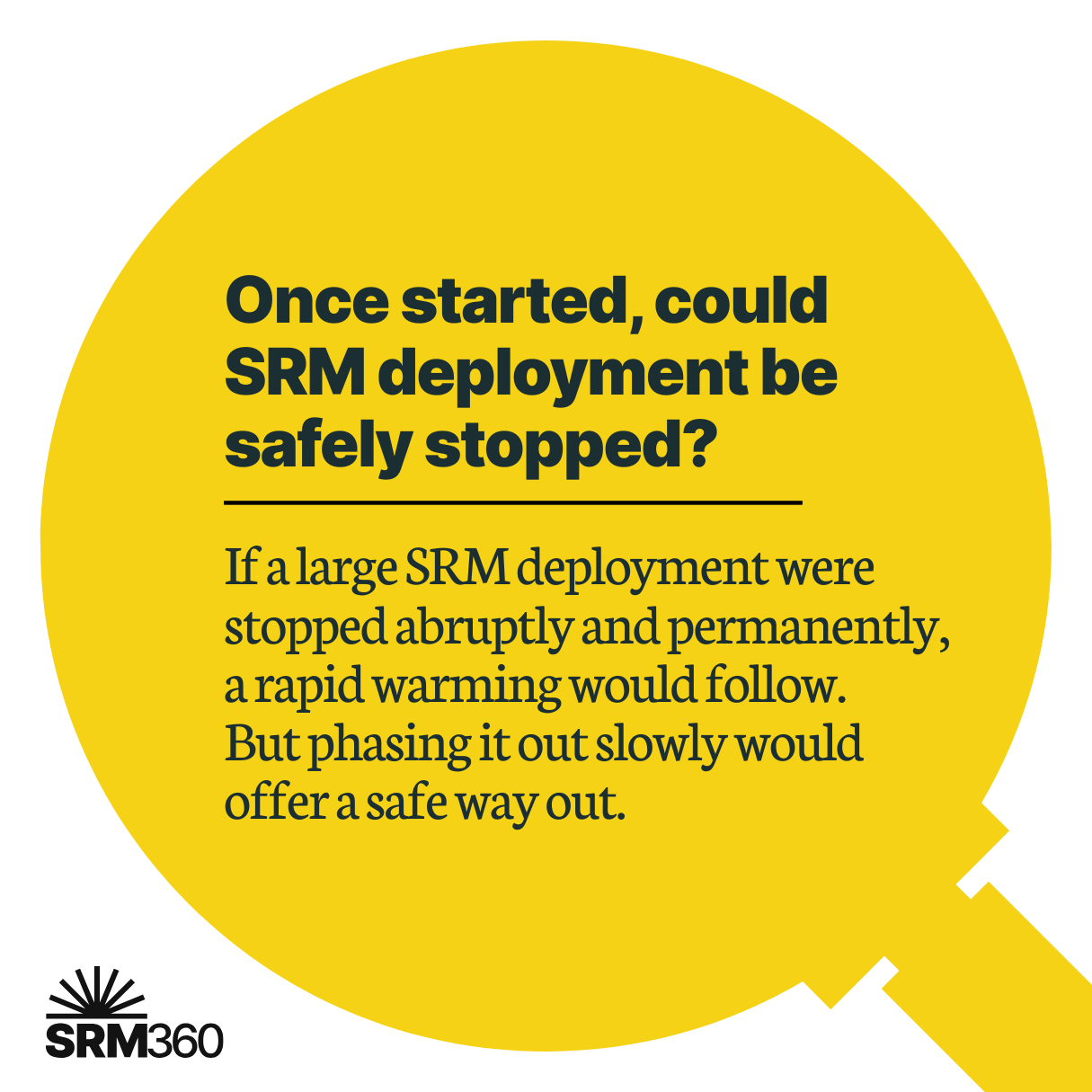
Stopping SRM safely would require patience
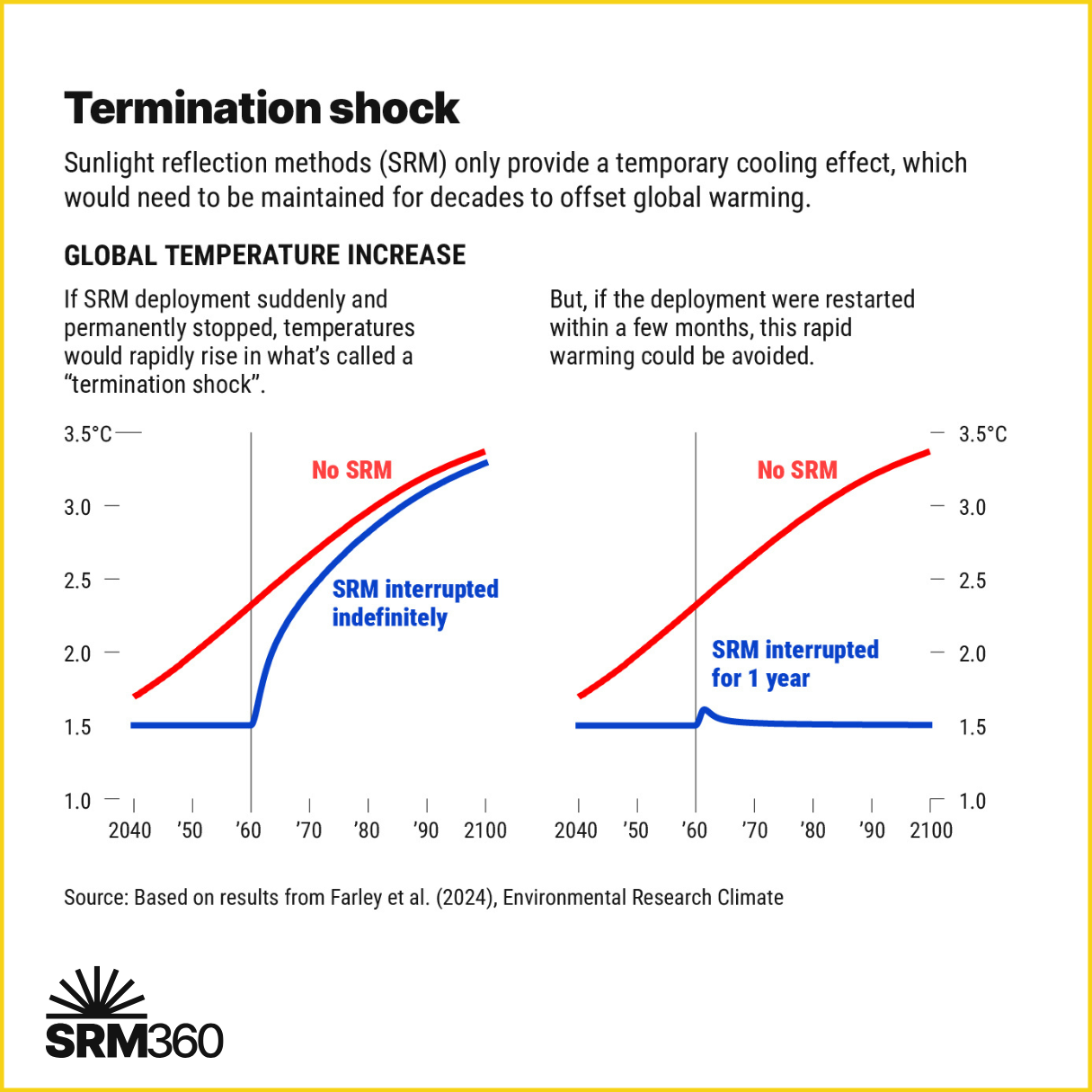
If SRM were ever deployed at a large scale to lower temperatures, stopping it abruptly and permanently would cause temperatures to rise rapidly. 1,2 This is known as termination shock.
The rapid warming of a termination shock would be difficult for both humans1 and natural ecosystems3 to adapt to, and so could pose serious risks. Many events could disrupt a possible SRM deployment – natural disasters damaging infrastructure, or wars between nations causing interruptions.
For a disruption to lead to termination shock, however, it must be severe and sustained. With the most commonly discussed SRM concept, stratospheric aerosol injection, the aerosol particles would remain in the stratosphere for 1–2 years after an interruption occurs.4 This means that even for a complete shutdown, it would take a few months before temperatures began to rise, providing time to repair and restart operations.5
The risk of termination shock would provide strong incentives to make any SRM deployment robust and resilient – and to phase out any deployment slowly over many years, rather than ending it suddenly.
Learn more
End Notes:
- McCusker KE, Armour KC, Bitz CM, Battisti DS. (2014). Rapid and extensive warming following cessation of solar radiation management. Environmental Research Letters. 9(2):024005. http://doi.org/10.1088/1748-9326/9/2/024005
- Jones A, Haywood JM, Alterskjær K, et al. (2013). The impact of abrupt suspension of solar radiation management (termination effect) in experiment G2 of the Geoengineering Model Intercomparison Project (GeoMIP). Journal of Geophysical Research: Atmospheres. 118(17):9743-52. https://doi.org/10.1002/jgrd.50762
- Trisos CH, Amatulli G, Gurevitch J, et al. (2018). Potentially dangerous consequences for biodiversity of solar geoengineering implementation and termination. Nature Ecology & Evolution. 2(3):475-82. https://doi.org/10.1038/s41559-017-0431-0
- Laakso A, Korhonen H, Romakkaniemi S, Kokkola H. (2017). Radiative and climate effects of stratospheric sulfur geoengineering using seasonally varying injection areas. Atmospheric Chemistry and Physics. 17(11):6957-74. https://doi.org/10.5194/acp-17-6957-2017
- Parker A, Irvine PJ. (2018). The risk of termination shock from solar geoengineering. Earth’s Future. 6(3):456-67. https://doi.org/10.1002/2017EF000735
Would solar geoengineering reduce solar power generation?
Copy link to this section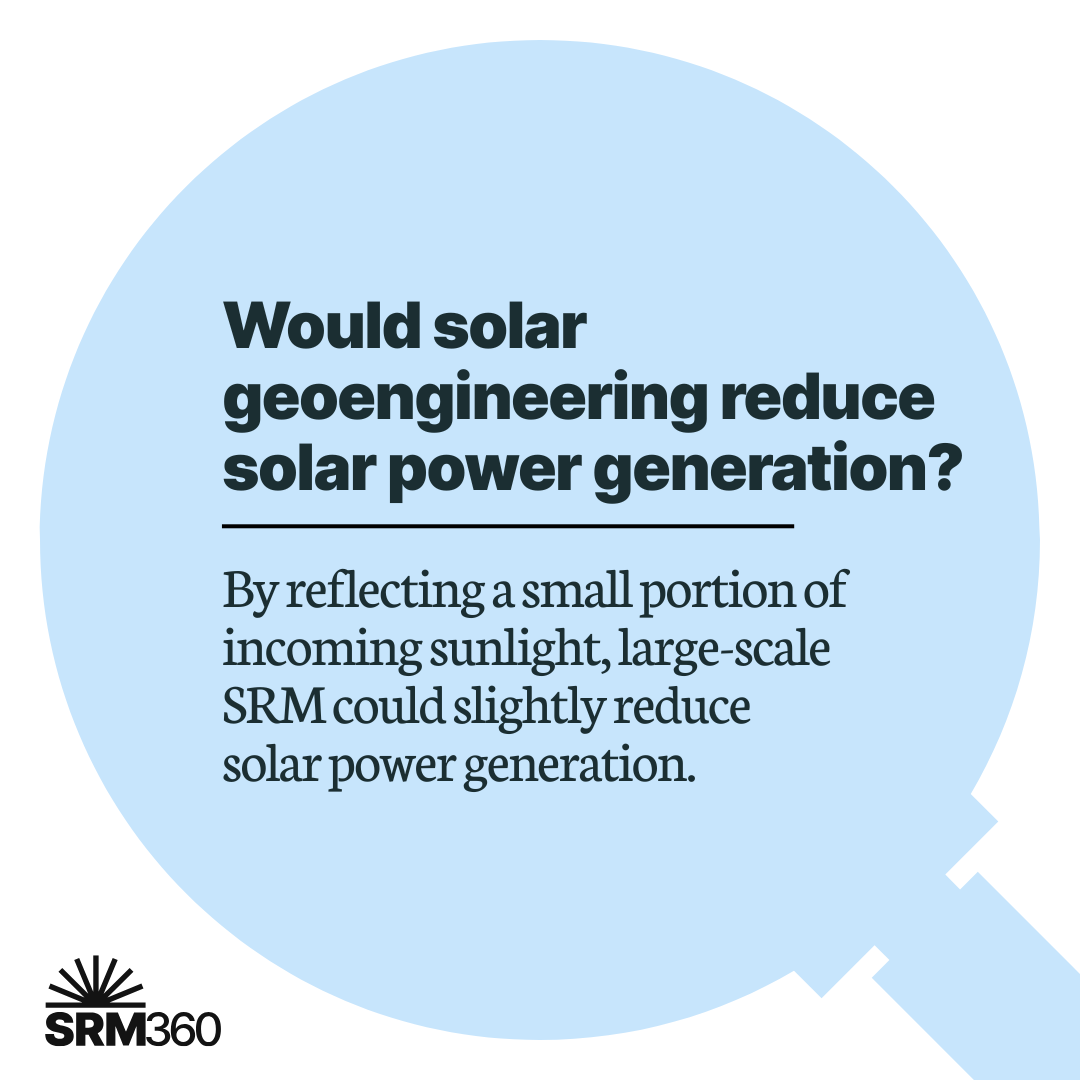
Stratospheric aerosol injection could slightly reduce solar power generation.
Stratospheric aerosol injection (SAI) would cool the planet by reflecting a small portion of incoming sunlight. This reduction in sunlight could raise concerns about its impacts on solar power generation – a key technology for reducing emissions.
The vast majority of solar power comes from solar photovoltaics (PV), which uses semiconductor panels to convert sunlight directly into electricity.1 Solar PV has grown rapidly over the past decade, roughly doubling in capacity every three years, and now generates almost 10% of the world’s electricity.2,3
Researchers estimate that reflecting about 1% of incoming sunlight would cool the planet by about 1°C, offsetting most of human-caused global warming to date.4 One study found that large-scale SAI deployment could reduce solar PV potential by a few percentage points overall, though the results showed substantial variability across regions.5 The magnitude of the impacts is uncertain, partly due to the limited amount of research on this topic.6
If it were deployed, SAI would have some impact on the efficiency of solar power, but it would be unlikely to derail solar PV’s progress towards becoming a leading source of electricity.
Learn more:
Endnotes:
- Osman M, Qureshi I. (2025). Review of photovoltaic and concentrated solar technologies including their performance, reliability, efficiency and storage. Results in Engineering. 25:104424. https://doi.org/10.1016/j.rineng.2025.104424
- IRENA. (2025). Processed by Our World in Data. “Solar photovoltaic capacity” [dataset]. IRENA, “Renewable Energy Statistics” [original data]. Retrieved July 27, 2026 from https://archive.ourworldindata.org/20260710-180106/grapher/solar-pv-cumulative-capacity.html
- Ember. (2026). Energy Institute – Statistical Review of World Energy (2025) – with major processing by Our World in Data. “Share of electricity generated by solar power” [dataset]. Energy Institute, “Statistical Review of World Energy” [original data]. Retrieved July 27, 2026 from https://archive.ourworldindata.org/20260727-131016/grapher/share-electricity-solar.html
- Visioni D, MacMartin DG, Kravitz B, et al. (2021). Identifying the sources of uncertainty in climate model simulations of solar radiation modification with the G6sulfur and G6solar Geoengineering Model Intercomparison Project (GeoMIP) simulations. Atmospheric Chemistry and Physics. 21(13):10039–63. https://doi.org/10.5194/acp-21-10039-2021
- Baur S, Sanderson BM, Séférian R, et al. (2024). Solar radiation modification challenges decarbonization with renewable solar energy. Earth System Dynamics, 15(2), 307–322. https://doi.org/10.5194/esd-15-307-2024
- Kumler A, Kravitz B, Draxl C, et al. (2025). Potential effects of climate change and solar radiation modification on renewable energy resources. Renewable and Sustainable Energy Reviews. Elsevier Ltd. https://doi.org/10.1016/j.rser.2024.114934
Would solar geoengineering disrupt monsoons?
Copy link to this section
SAI could weaken some monsoons, but it’s complicated
Billions of people around the world depend on summer monsoon rains for agriculture and other purposes, and these rains can be altered by climate change, air pollution, and other factors. There has been relatively widespread public concern that stratospheric aerosol injection (SAI), if ever deployed, could dramatically limit those monsoon rains. In fact, while SAI would likely affect the strength and duration of those rains to some extent, the impacts would vary by region and modelling studies remain divided on the details.
Broadly speaking, an SAI deployment to halt global warming would likely somewhat reduce monsoon rainfall compared with current levels, more than offsetting the increase in monsoon rainfall expected due to climate change.1,2 The details of the deployment, however – where the aerosols are deployed, how much cooling is generated, and so on – matter greatly to the impact on monsoons.
If SAI were deployed in the northern and southern hemispheres separately during each hemisphere’s winter months, it could increase summer monsoon rainfall.3 Such a deployment might interrupt winter precipitation, however. A hemispherically symmetrical deployment would in general make wet tropical regions drier and dry regions wetter.4
Monsoon seasons today vary by region, in terms of their strength, duration, and timing. SAI would likely shift those patterns in different ways, though studies using complex computer modelling still disagree on some of the details. In India, one study suggested that SAI could reduce both total monsoon rainfall and extreme rainfall5 – while another found that the reverse could be true, with the country getting wetter overall.6 Across the entirety of Asia, one study finds that simply cutting greenhouse gas emissions would dry out the continent about as much as an SAI deployment would.7
The question of what exactly SAI would mean for monsoons remains open, and studies continue to explore how a potential deployment in the future would alter these critical rainfall patterns.
End Notes:
- Ricke K, Wan JS, Saenger M, Lutsko NJ. (2023). Hydrological consequences of solar geoengineering. Annual review of earth and planetary sciences. 51:447-70. https://doi.org/10.1146/annurev-earth-031920-083456
- Xavier A, Bala G, Roose S, Kh U. (2024). An investigation of the relationship between tropical monsoon precipitation changes and stratospheric sulfate aerosol optical depth. Oxford Open Climate Change. 4(1):kgae016. https://doi.org/10.1093/oxfclm/kgae016
- Kallihosur T, Bala G. (2026). Impact of stratospheric aerosol geoengineering implemented only in the winter hemispheres on the ITCZ and tropical monsoon regions. Environmental Research: Climate. 5(3):035020. https://doi.org/10.1088/2752-5295/ae7200
- Simpson IR, Tilmes S, Richter JH, et al. (2019). The regional hydroclimate response to stratospheric sulfate geoengineering and the role of stratospheric heating. Journal of Geophysical Research: Atmospheres. 124(23):12587-616. https://doi.org/10.1029/2019JD031093
- Asutosh A, Tilmes S, Bednarz EM, Fadnavis S. (2025). South Asian Summer Monsoon under stratospheric aerosol intervention. npj Climate and Atmospheric Science. 8(1):3. https://doi.org/10.1038/s41612-024-00875-z
- Richter JH, Visioni D, MacMartin DG, et al. (2022). Assessing Responses and Impacts of Solar climate intervention on the Earth system with stratospheric aerosol injection (ARISE-SAI): protocol and initial results from the first simulations. Geoscientific Model Development. 15(22):8221-43. https://doi.org/10.5194/gmd-15-8221-2022
- He C, Peng Y, Yu P. (2025). Stratospheric aerosol injection does not cause stronger Asian monsoon drying than greenhouse gas mitigation. Environmental Research Letters. 20(12):124041. https://doi.org/10.1088/1748-9326/ae2282