Sunlight reflection methods (SRM) – also known as solar geoengineering – would not be a solution to climate change but might offer a powerful new tool to reduce climate risks while emissions cuts are ramped up. However, these ideas would also come with additional side effects and risks. How do the risks of SRM compare to the risks of climate change?
SRM is risky, but is it less risky than the alternative?
The goal of sunlight reflection methods (SRM) – also known as solar geoengineering – would be to cool the planet and reduce the risks of climate change.
Stratospheric aerosol injection (SAI) – an idea to add tiny reflective particles in the upper atmosphere – seems to offer a practical means of lowering global temperatures. By reflecting around 1% of incoming sunlight, it could lower global temperatures by about 1°C. Many of the risks would depend on the details of an SAI deployment, such as the latitude at which the particles are injected and the targeted amount of cooling.
Many climate risks are closely tied to temperature, so geoengineering with SAI could help reduce many climate impacts if deployed carefully alongside emissions cuts. However, it could not offset all the effects of climate change and would also introduce new risks or shift how risks are distributed.
How would the risks of deploying SAI compare to the risks of climate change?
Lowering temperatures could reduce climate impacts
By strategically distributing particles in the upper atmosphere, SAI could produce a more-or-less even pattern of cooling that would offset the warming from greenhouse gases across the planet. This could greatly reduce many of the risks of climate change.
Rising temperatures make heat extremes more intense and more frequent, with significant impacts on ecosystems, crops, and human health.
Warmer air can also hold more moisture, making droughts more intense by driving stronger evaporation and making rainfall more extreme by releasing more water in short periods of time. This impacts crops, harms economies, and endangers people.
Higher temperatures also cause snow and ice to melt, replacing bright white surfaces with darker ones that absorb more sunlight, adding to global warming. They also lead to glacier melt and retreat, undermining the year-round water supplies that many communities rely on.
For these and other reasons, lowering temperatures with SAI or other SRM approaches could reduce many of the risks of climate change.
Side effects and shortcomings
While SAI and other SRM approaches could cool the planet, no SRM approach could cancel out all the effects of climate change. Notably, wind and rainfall patterns would be changed, with rainfall increasing in some areas and decreasing in others. This would lead to some regions seeing greater impacts on their water resources than they would have under global warming alone.
Marine cloud brightening – an approach that would brighten clouds over some ocean regions – could produce a global cooling effect, but it may be uneven. This patchiness could lead to greater changes in wind and rainfall patterns than would be seen with SAI.
No SRM approach would address the root cause of climate change – the build-up of carbon dioxide and other greenhouse gases. This means that SRM cannot address ocean acidification, which is caused by the ocean absorbing carbon dioxide, harming marine ecosystems.
SAI would also have several side effects, adding a little to acid rain and air pollution, as well as delaying the slow recovery of the ozone hole.
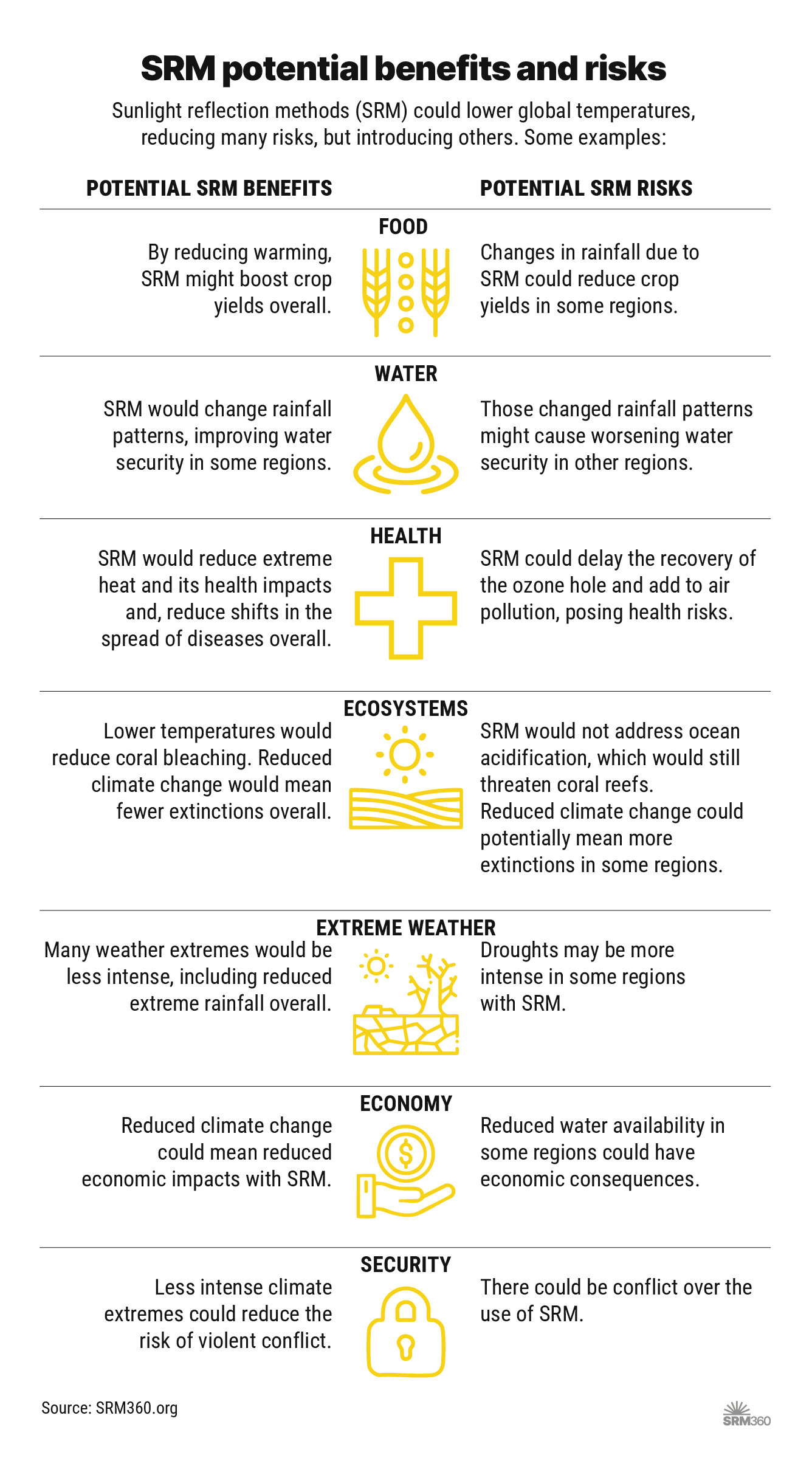
SRM potential benefits and risks
Sunlight reflection methods (SRM) could lower global temperatures, reducing many risks, but introducing others. Some examples:

Potential srm benefits
Potential srm RISKS
Food
Changes in rainfall due to SRM could reduce crop yields in some regions.
By reducing warming, SRM might boost crop yields overall .
WATER
SRM would change rainfall patterns, improving water security in some regions.
Those changed rainfall patterns might cause worsening water security in other regions.
HEALTH
SRM would reduce extreme heat and its health impacts and, reduce shifts in the spread of diseases overall.
SRM could delay the recovery of the ozone hole and add to air pollution, posing health risks.
ECOSYSTEMS
Lower temperatures would reduce coral bleaching. Reduced climate change would mean fewer extinctions overall.
SRM would not address ocean acidification, which would still threaten coral reefs.
Reduced climate change could potentially mean more extinctions in some regions.
EXTREME WEATHER
Many weather extremes would be less intense, including reduced extreme rainfall overall.
Droughts may be more intense in some regions with SRM.
ECONOMY
Reduced climate change could mean reduced economic impacts with SRM.
Reduced water availability in some regions could have economic consequences.
SECURITY
Less intense climate extremes could reduce the risk of violent conflict.
There could be conflict over the use of SRM.
Source: SRM360.org
Potential srm benefits
Potential srm RISKS
Food
By reducing warming, SRM might boost crop yields overall.
Changes in rainfall due to SRM could reduce crop yields in some regions.
WATER
SRM would change rainfall patterns, improving water security in some regions.
Those changed rainfall patterns might cause worsening water security in other regions.
HEALTH
SRM would reduce extreme heat and its health impacts and, reduce shifts in the spread of diseases overall.
SRM could delay the recovery of the ozone hole and add to air pollution, posing health risks.
ECOSYSTEMS
Lower temperatures would reduce coral bleaching. Reduced climate change would mean fewer extinctions overall.
SRM would not address ocean acidification, which would still threaten coral reefs.
Reduced climate change could potentially mean more extinctions in some regions.
EXTREME WEATHER
Many weather extremes would be less intense, including reduced extreme rainfall overall.
Droughts may be more intense in some regions with SRM.
ECONOMY
Reduced climate change could mean reduced economic impacts with SRM.
Reduced water availability in some regions could have economic consequences.
SECURITY
Less intense climate extremes could reduce the risk of violent conflict.
There could be conflict over the use of SRM.
Source: SRM360.org
Learn more
How do scientists know about SRM?
So far, what scientists know about SRM is mainly based on climate models – sophisticated computer simulations of the Earth system.
Using the same models that they use to predict the extent and impacts of global warming, climate scientists are asking how the risks of lowering temperatures with SRM would compare to the risks of climate change.
There are many uncertainties – predicting the response of the complex climate system is challenging – but these models are built on decades of theory, observations, and lab experiments.
It is not possible to “test” how the climate would respond to SRM with small-scale outdoor experiments. However, such experiments can shed light on key processes so that scientists can improve their climate model projections; some small-scale experiments have taken place, and others are planned. Observations of volcanic eruptions and other natural analogues can also help test how well their models capture responses seen in the real world.
Nasty surprises
When something new is introduced into the environment, there can often be nasty surprises – think of CFCs (chlorofluorocarbons) damaging the ozone layer. Should the world expect nasty surprises if SRM is deployed?
Unlike CFCs, the main SRM approaches would not be entirely new. SAI with sulphate particles would mimic the cooling effect of major volcanic eruptions, and marine cloud brightening would increase the amount of sea salt in the lower atmosphere. There are many uncertainties around these ideas, but because nothing wholly new is being introduced into the environment, there is little chance of truly surprising physical interactions occurring.
But how would the climate respond? Some of the biggest uncertainties in climate science are around how key systems will respond to a changing climate. How warm can it get before the tropical corals or the Amazon rainforest can no longer take the heat and die off? When would the Greenland and West Antarctic ice sheets destabilise and how quickly could they collapse? How high do temperatures need to rise before key ocean currents, like the Atlantic Meridional Overturning Circulation, shut down?
SRM would certainly add new uncertainties, but it would also reduce others. By helping to prevent the planet from warming so much, SRM could keep the climate from moving further into uncharted territory, reducing the risk of triggering “tipping points” like the loss of the tropical corals or ice sheets.
Learn more
Towards a risk-risk analysis of SRM
SRM is not a solution to climate change. It would not address its root causes but might help if used alongside emissions cuts and other policies.
SRM poses many risks, but it might also greatly reduce the risks of climate change. Understanding whether SRM could play a useful role alongside emissions cuts will require a careful risk-risk analysis, where the risks of SRM are compared to the risks of climate change.
But the risks of SRM are not fixed and would be different for different people and places; they would depend on how it is deployed and how the world would respond to it. For example, SRM might stoke international tensions or threaten progress on emissions cuts. Even if responsible SRM deployment could reduce risks, it might ultimately prove harmful if it is not used or governed responsibly.
Risk-risk analysis
The deployment of sunlight reflection methods (SRM) would come with risks. More comprehensive forms of risk-risk analysis can provide a broader perspective on the policy options available. A look at three levels of analysing SRM risks:

“SRM is risky.”
Considering only the risks of SRM would provide only a narrow assessment.
SRM
“How do SRM risks compare to climate change?”
A simple risk-risk analysis would compare the risks of SRM against the risks of climate change without SRM, all else equal.
vs.
CLIMATE CHANGE WITH SRM
CLIMATE CHANGE WITHOUT SRM
“What about other options and impacts?”
Assessing SRM as part of a broader portfolio of climate policy options would be more thorough.
SRM
Governance challenges
Carbon dioxide removal
Distributional impacts
Mitigation
Adaptation
Dynamic interactions
Uncertainty
Indirect effects
Public behavior
A comprehensive risk-risk analysis would go further, considering broader implications and complexities.
Source: SRM360, Mark Borsuk,
Tyler Felgenhauer, Jonathan Wiener

“SRM is risky.”
Considering only the risks of SRM would provide only a narrow assessment.
SRM
“How do SRM risks compare to climate change?”
A simple risk-risk analysis would compare the risks of SRM against the risks of climate change without SRM, all else equal.
CLIMATE CHANGE WITH SRM
CLIMATE CHANGE WITHOUT SRM
vs.
“What about other options and impacts?”
SRM
Governance challenges
Carbon dioxide removal
Distributional impacts
Mitigation
Assessing SRM as part of a broader portfolio of climate policy options would be more thorough.
Adaptation
Uncertainty
Indirect effects
Public behavior
A comprehensive risk-risk analysis would go further, considering broader implications and complexities.
Dynamic interactions
Source: SRM360, Mark Borsuk, Tyler Felgenhauer, Jonathan Wiener