News Reaction
African Ministers Reject SRM – an “Unacceptable Climate Solution”
At the 20th African Ministerial Conference on the Environment (AMCEN), African ministers reaffirmed their opposition to solar geoengineering, also known as sunlight reflection methods (SRM), and called for a non-use agreement. Experts share their reactions to these developments.
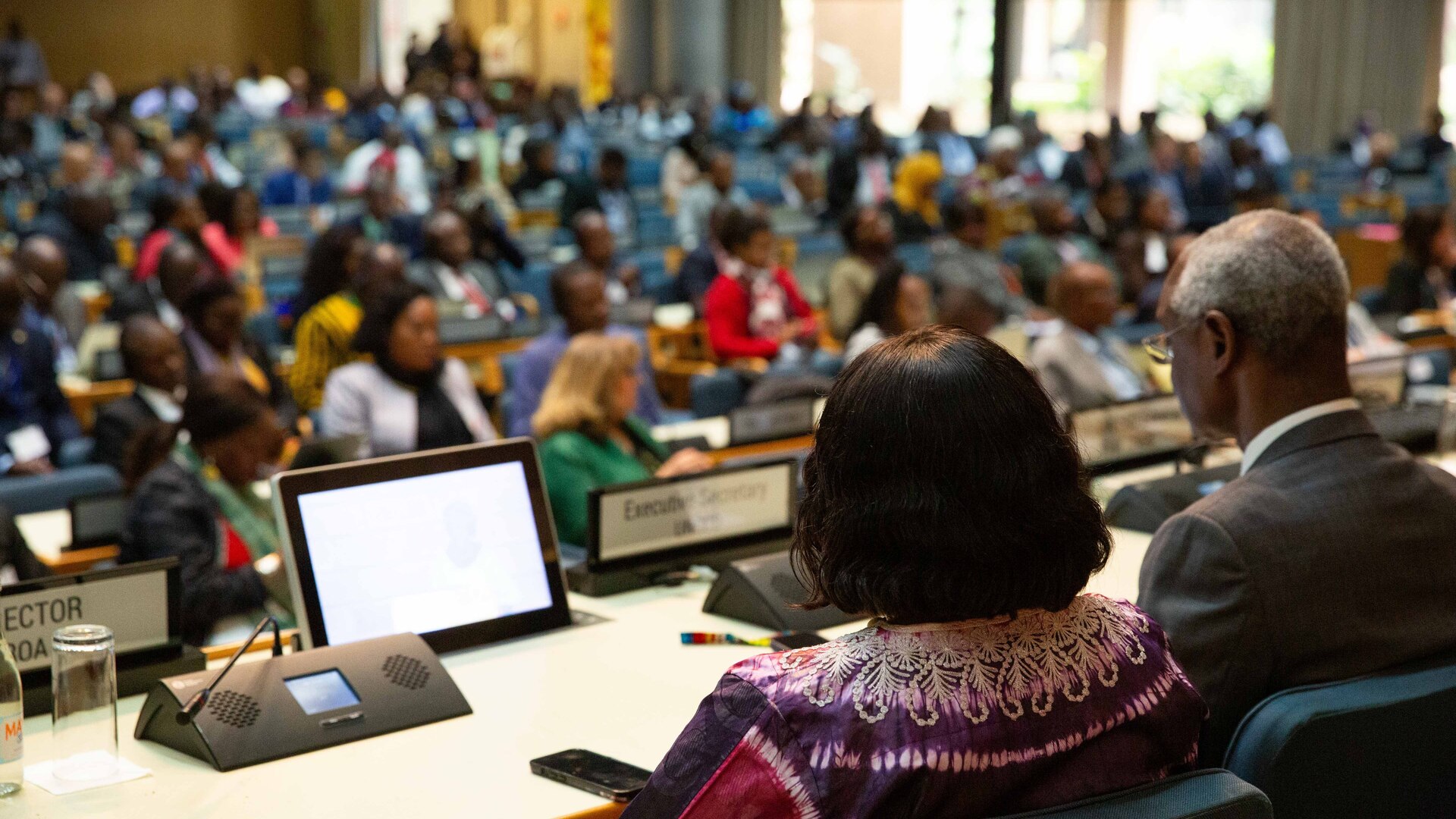
A high-level session during the 20th AMCEN meeting (Photo: IISD/ENB | Natalia Mroz)

AMCEN meetings play a critical role in advancing Africa’s environmental agenda by consolidating the African Group’s formal positions in international climate and environmental forums, such as the UNFCCC COP, UNEA, and the CBD.1
While SRM did not make it into the high-level political statement of the 20th AMCEN meeting (Nairobi, Kenya, 14–18 July), it did appear in a longer declaration where ministers resolved to “reaffirm our unequivocal rejection of stratospheric aerosol injection and other forms of solar geoengineering as unacceptable climate solutions, given their significant environmental, ethical and geopolitical risks”.2
SRM was also addressed in a decision that called for “the establishment of a solar geoengineering non-use agreement” to be pursued in international forums.3,4
Several civil society groups were present at AMCEN and appeared to play a role in shaping discussions on solar geoengineering at the event.
Several representatives from the ETC Group, the Hands Off Mother Earth (HOME) Alliance, and the Center for International Environmental Law – all of which have taken strong public positions against SRM – were in attendance, alongside a representative from DEGREES, an NGO that supports research on SRM in the Global South.
During the event, some of these civil society groups distributed materials advocating against SRM. For example, HOME handed out a 24-page policy brief5 and a two-page summary, both titled “Don’t Geoengineer Africa”. The two-page summary included a set of demands to reject SRM, pursue a global non-use agreement, and prohibit many geoengineering-related activities.
While the AMCEN decisions strongly rejected SRM and supported the pursuit of a global non-use agreement, they stopped short of endorsing outright bans or prohibiting research, funding, or patenting.
We asked experts for their reactions to these developments and what these decisions might mean for the future of SRM governance.

Edward A. Parson
Distinguished San and Rae Emmett Professor of Environmental Law; Faculty director
Emmett Institute on Climate Change and the Environment, UCLA School of Law
SRM’s potential risks, contributions, and governance challenges are of grave importance. They require serious high-level attention, particularly in climate-vulnerable regions like Africa, both from national governments and from regional coordinating bodies like AMCEN. It is possible that some form of coordinated international declarations that governments will not pursue SRM “use” – i.e., potential interventions big enough to have significant climate impact – would help calm concerns about reckless or unilateral use and build toward the needed serious governance deliberations.
Unfortunately, the statements on SRM from the recent AMCEN 20 suggest the needed serious, high-level governmental attention has not yet begun. The statements do not signal that SRM-related concerns received priority attention, being deeply buried in a large volume of conference outputs. (They appear as one of 63 resolutions in the ministerial declaration, and one of 12 points in one of the 11 decisions adopted by the Conference.) The statements are perfunctory and conclusory, appearing to take no account of the growing body of research on SRM’s effects in Africa. And they repeat, largely verbatim, claims advanced for more than 15 years by a few NGOs who advocate pre-emptive prohibition of SRM, who first worked in a few countries in Europe and North America but now increasingly target political fora in the Global South. In one sign that the energy for the statements comes from these groups rather than from participating governments, two of the groups6 made celebratory announcements of the statements nearly two weeks before they were finalized.
Statements calling for a “non-use agreement” (NUA) carry especially acute risks for climate-vulnerable regions, which are not obvious. While a true non-use agreement might help advance good global SRM governance, in this context the term “non-use agreement” has been captured by a specific 2022 proposal, which in addition to suspending SRM “use” would also bar public funding for SRM research, associated international deliberations, and other actions needed to advance SRM knowledge and capability. This over-broad, prohibitory form of NUA would pre-empt the ability of policy-makers to make informed decisions about SRM’s potential benefits and harms and its potential use or non-use.
In a positive shift in the SRM debate, however, there are now many African scientists and researchers working on SRM and its implications for their continent. Some of these African experts weighed in two months ago when one of the prohibitionist groups denounced an international SRM forum held in Cape Town and featuring African SRM research. Given the reluctance of Global North governments to start serious discussions of SRM, there is an opportunity for governments of the Global South, in Africa and elsewhere, to exercise world leadership in shaping SRM’s governance. But this will require serious critical examinations of the implications of these technologies for the African region, which cannot be accomplished relying on talking points developed a decade ago in Berlin, Utrecht, and Washington. When African governments decide to begin this serious, critical examination of SRM and its implications for their region, they will be able to call on a strong and growing group of African experts to inform their deliberations. This important strengthening of independent African climate science and policy capacity is to be celebrated.
Edward A. Parson holds degrees in Physics, Management Science, and Public Policy. He is a law professor and faculty director at UCLA and has served on advisory committees for the U.S. National Academies of Sciences and consulted for the White House, U.S. Congress, and Canadian Government among others.

Aarti Gupta
Professor of Global Environmental Governance
Wageningen University
At its most recent meeting in July 2025, the African Ministerial Conference on the Environment (AMCEN) reaffirmed, resoundingly and clearly, its unequivocal rejection of solar radiation modification technologies as having any role to play in addressing climate change. Environmental ministers from across the African continent have called for a global non-use agreement on solar geoengineering, noting the profound environmental, ethical, and geopolitical risks on a planetary scale that development and use of such technologies pose.
As a co-initiator and signatory of the academic initiative calling for an International Non-Use Agreement on Solar Geoengineering, I greatly welcome this AMCEN decision and the continued vital African leadership that it represents.
This is not the first time that African countries have voiced such opposition to solar geoengineering. Previous decisions and positions include the AMCEN’s 2023 Decision 19/5 calling for a global governance mechanism for non-use of solar radiation modification, and the proactive leadership by the African Group during multilateral deliberations on solar geoengineering at the 6th session of the United Nations Environment Assembly in February 2024. This time, AMCEN has not only reaffirmed its full rejection of any attempts to promote solar geoengineering technologies, but has also requested that African countries advance this solar geoengineering non-use position in all other relevant international negotiations and processes.
This call from African ministers sends a clear message to the rest of the world: some of the most vulnerable countries to climate change are leading the opposition to solar geoengineering. Those promoting and investing in research that may result in technology development will need to acknowledge this political reality of strong African rejection.
And African countries are not alone in their resolute call for non-use of solar geoengineering. During UNEA-6, the African Group’s strong stance against solar geoengineering found support from several other countries in the Global South, including Colombia, Fiji, Mexico, Pakistan, and Vanuatu. In other UN settings, Vanuatu and other Pacific Island countries have also urged States to “refrain from developing and using these technologies and prohibit their development and use” and to “proactively ban false and dangerous ‘solutions’ such as geoengineering”.
With this decision from AMCEN, close to sixty countries in the Global South, including some of those most vulnerable to climate change, have now spoken out against solar geoengineering, calling for the negotiation of a non-use agreement on solar geoengineering or a similar mechanism. The views of large swaths of civil society are clear as well, with extensive and long-standing opposition to solar radiation modification technologies, and with over 2000 civil society organisations, with global membership, having endorsed the academic initiative calling for an International Non-Use Agreement on Solar Geoengineering. The support of African civil society for these recent AMCEN decisions has also been widespread.
The case is clear – solar geoengineering is a non-starter. And this case is now being made, unequivocally and convincingly, by political leadership emanating from the Global South.
Aarti Gupta is Professor of Global Environmental Governance at Wageningen University, The Netherlands, and the 2025 Zennström Visiting Professor of Climate Change Leadership at Uppsala University, Sweden. Her research focuses on accountability and equity in global climate policy and governance.

Hosea Patrick
Postdoctoral Fellow
McMaster University
The 20th AMCEN position on SRM reflects historical patterns similar to the non-alignment movement of 1961, where Global South states avoided alignment with major power blocs during the Cold War. The call for a global non-use agreement seeks to navigate power dynamics without prohibiting SRM research and funding. Given that many Africans rely on climate conditions for their livelihoods, uncertainties surrounding SRM, along with public unfamiliarity and ethical concerns, hinder support for its potential deployment. Additionally, past and current global power structures do not favor Africa, raising fears that the continent may become a “laboratory” for untested SRM strategies.
The preliminary findings of my research on African perceptions of solar geoengineering indicate general unfamiliarity with SRM, mixed feelings about its potential outcomes, and suspicions of Western motives. There’s also a religious perspective viewing SRM as “playing God.”
AMCEN’s stance is understandable, and Africa must not be used as a testing ground for SRM. Nevertheless, ongoing research is essential to ensure Africa is not left behind in SRM governance and understanding.
Dr. Hosea Patrick is an environmental politics and governance scholar with a secondary focus on political theory. He is a Postdoctoral Fellow at the Africa and Black Diaspora Studies (ABLDs), McMaster University, Canada. He is also a Research Associate at the University of KwaZulu-Natal, South Africa.

Josh Horton
Senior Consultant
University of Chicago
Looking at the AMCEN statements from a political perspective, I interpret them as evidence that African governments have maintained their uniform opposition to SRM, in anticipation of SRM possibly appearing on the agenda of the seventh session of the UN Environment Assembly (UNEA-7) this December.
AMCEN made a similar statement at its last meeting in 2023, before UNEA member states considered a Swiss proposal to establish a scientific expert group on SRM just prior to UNEA-6 in 2024. During those discussions, the African Group held firm in their rejection of any consultative or information mechanism tied to the science-based World Meteorological Organization or informed by submissions from member states more receptive to SRM – this was a key (though not the only) reason why the Swiss pulled the proposal from further consideration.
Today, AMCEN appears to be preparing for the possibility that something similar might arise at UNEA-7, and working to ensure that African governments act as one to advocate for “non-use” of SRM if that were to happen.
Josh is a Senior Consultant at the University of Chicago. He provides support for international policy initiatives related to solar geoengineering and conducts research on its political and governance aspects.
The views expressed by Perspective writers and News Reaction contributors are their own and are not necessarily endorsed by SRM360. We aim to present ideas from diverse viewpoints in these pieces to further support informed discussion of SRM (solar geoengineering).

Endnotes
- United Nations Framework Convention on Climate Change Conference of the Parties, United Nations Environment Assembly, Convention on Biological Diversity
- AMCEN-20, Tripoli Declaration, Clause 35
- AMCEN-20, Decision 9, Clause 6
- SRM was also mentioned in the annex to Decision 9, in message d, where the ministers “Take note of the report presented by the Executive Director of the United Nations Environment Programme outlining key priorities to the seventh session to the Environment Assembly, for advancing sustainable solutions for a resilient planet, and which invited member States to consider advancing the resolution proposal within the scope that include, among other, protection of the Earth’s shield through stratospheric protection. While we acknowledge the relevance of these emerging areas, we would like to reaffirm our full rejection of any attempt to promote stratospheric aerosol injection or other forms of solar geoengineering technology as a climate change mitigation solution. We reiterate our position, that such technologies pose significant and uncertain environmental, ethical, and geopolitical risks, and must not be considered as viable options within the multilateral environmental agenda.”
- A previously distributed version of this briefing is available here.
- ETC Group and Hands Off Mother Earth Alliance