News Reaction
Climate Scientists Expect SRM Deployment Attempt This Century
New Scientist recently surveyed climate researchers on sunlight reflection methods (SRM). Two thirds of respondents expect an attempt to deploy large-scale SRM by 2100, though a similar share thought deployment should not be considered even if 2°C of global warming were certain. We asked experts for their reaction to the findings.
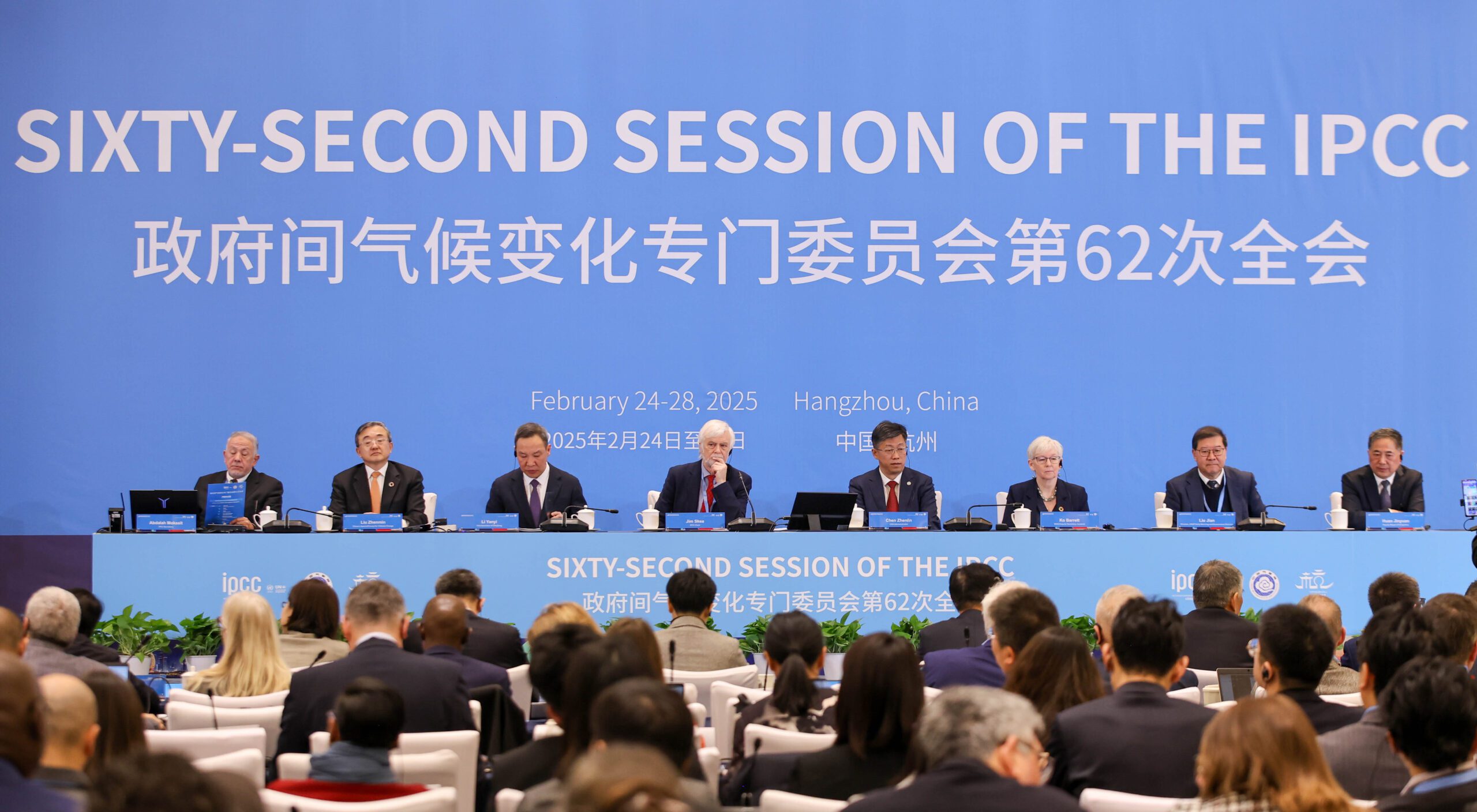
A session of the Intergovernmental Panel on Climate Change (Photo: IISD/ENB | Anastasia Rodopoulou)

Recently, New Scientist surveyed 120 researchers who had contributed to the most recent Intergovernmental Panel on Climate Change (IPCC) Assessment Report.
Almost 70% of respondents said SRM deployment has become more likely given recent shortcomings in emissions cuts, and a similar proportion expect a large-scale deployment attempt this century. A slightly smaller share thought that deployment should not be considered even if the world were certain to breach 2°C of global warming.
However, support for SRM research among respondents appears to be growing, with one in three saying that they have become more supportive considering the poor progress on emissions cuts. Almost half the respondents support small-scale outdoor SRM experiments.
SRM remains a controversial field – one in ten said they had avoided contributing to SRM research to protect their professional reputation.
Experts weigh in on SRM
Some results from recent survey of researchers by the New Scientist magazine:

Do you anticipate countries or private groups will attempt to deploy large scale solar radiation modification (SRM) this century?
Yes
66%
No
9%
Don’t know
25%
Does the world need a new international treaty or convention to govern potential deployment of SRM?
No
8%
Yes
81%
Don’t know
11%
Do you agree or disagree with this statement?
“We should consider deploying SRM if the world’s emissions trajectory means we are certain to breach the 2°C global average warming target under the Paris Agreement.”
Neutral
15%
Agree
19%
Disagree
29%
Strongly agree
2%
Strongly disagree
35%
Which of these represent the most serious risks* of solar geoengineering in your view?
Unknown consequences
80%
Environmental consequences
74
Social / political consequences
72
Reduces support to mitigate emissions
68
Agricultural consequences
49
Weaponisation
43
Consequences for human health
28
*Multiple responses allowed.
Source: New Scientist magazine invited nearly 800 researchers to participate in an anonymous online survey about SRM research. All of those polled have contributed to the most recent Intergovernmental Panel on Climate Change (IPCC) Assessment Report. A total of 120 researchers responded.

Do you anticipate countries or private groups will attempt to deploy large scale solar radiation modification (SRM) this century?
Does the world need a new international treaty or convention to govern potential deployment of SRM?
Yes
66%
No
8%
Yes
81%
No
9%
Don’t know
11%
Don’t know
25%
Do you agree or disagree with this statement?
“We should consider deploying SRM if the world’s emissions trajectory means we are certain to breach the 2°C global average warming target under the Paris Agreement.”
Neutral
15%
Agree
19%
Disagree
29%
Strongly agree
2%
Strongly disagree
35%
Which of these represent the most serious risks* of solar geoengineering in your view?
Unknown consequences
Environmental consequences
Social / political consequences
Reduces support to mitigate emissions
Agricultural consequences
Weaponisation
Consequences for human health
80%
74
72
68
49
43
28
*Multiple responses allowed.
Source: New Scientist magazine invited nearly 800 researchers to participate in an anonymous online survey about SRM research. All of those polled have contributed to the most recent Intergovernmental Panel on Climate Change (IPCC) Assessment Report. A total of 120 researchers responded.

Do you anticipate countries or private groups will attempt to deploy large scale solar radiation modification (SRM) this century?
No
9%
Don’t know
25%
Yes
66%
Source: New Scientist magazine invited nearly 800 researchers to participate in an anonymous online survey about SRM research. All of those polled have contributed to the most recent Intergovernmental Panel on Climate Change (IPCC) Assessment Report. A total of 120 researchers responded.

Does the world need a new international treaty or convention to govern potential deployment of SRM?
No
8%
Don’t know
11%
Yes
81%
Source: New Scientist magazine invited nearly 800 researchers to participate in an anonymous online survey about SRM research. All of those polled have contributed to the most recent Intergovernmental Panel on Climate Change (IPCC) Assessment Report. A total of 120 researchers responded.

Do you agree or disagree with this statement?
“We should consider deploying SRM if the world’s emissions trajectory means we are certain to breach the 2°C global average warming target under the Paris Agreement.”
Neutral
15%
Agree
19%
Disagree
29%
Strongly agree
2%
Strongly disagree
35%
Source: New Scientist magazine invited nearly 800 researchers to participate in an anonymous online survey about SRM research. All of those polled have contributed to the most recent Intergovernmental Panel on Climate Change (IPCC) Assessment Report. A total of 120 researchers responded.

Do you anticipate countries or private groups will attempt to deploy large scale solar radiation modification (SRM) this century?
Unknown consequences
Environmental consequences
Social / political consequences
Reduces support to mitigate emissions
Agricultural consequences
Weaponisation
Consequences for human health
80%
74
72
68
49
43
28
*Multiple responses allowed.
Source: New Scientist magazine invited nearly 800 researchers to participate in an anonymous online survey about SRM research. All of those polled have contributed to the most recent Intergovernmental Panel on Climate Change (IPCC) Assessment Report. A total of 120 researchers responded.
We asked experts for their reaction.

Lisa Dilling
Associate Chief Scientist
Environmental Defense Fund
This survey reveals that climate change is an issue that is incredibly consequential and will likely remain so for the next century. While we may feel that needed progress on emissions reductions remains an uphill battle, we also know that we mustn’t lose hope. Cutting emissions is the only way to truly address the root of the climate change problem. Looking ahead, it’s quite possible to see dramatic progress in innovation in the energy system as we have seen in solar energy and battery storage in the past 15 years.
This study also shows that we cannot ignore SRM as a possible technology to temporarily reduce global temperatures. We must therefore accelerate research into the technology to be prepared for a future when deployment might be considered. We still know very little about how SRM might affect agriculture on the ground, or ecosystems, or water supply, for example. Research into SRM must be transparent, well-governed, and relevant to questions that the public and decision makers might have. Research can help to inform future decisions. Research should not be seen as a step to deployment, but rather as a way for society to gain wider insight into the risks and benefits. Ignorance is not an option.
Lisa Dilling is Associate Chief Scientist at the Environmental Defense Fund and leads their SRM program. She is an interdisciplinary scientist, studying the science-policy interface and how to implement effective climate change responses for over 25 years. She has published research on carbon management, climate adaptation, usable science, and geoengineering.

Daniele Visioni
Assistant Professor of Earth and Atmospheric Science
Cornell University
These results are very interesting, as they indicate that solar geoengineering is becoming more and more an unavoidable topic for climate science. Many are and will always be uncomfortable talking about this: its relevance is yet another dire warning of the dangers we face due to climate change, both considering the very slim chances we have to stay below 2°C as the Paris Agreement intended, and considering the emerging impacts we are observing already at current levels of warming. If reticence is understandable, burying our collective head in the sand is not.
I hope this will lead more climate scientists to engage seriously with the topic, expanding our collective understanding of the potential risks of solar geoengineering – but also of its potential to help ameliorate some climate change impacts. Ultimately, the service we, as a scientific community, owe society is to provide an unbiased assessment of what the best available research tells us: we still have much to do in expanding this kind of research, and who is doing it, both geographically and in terms of disciplines, moving past taboos or concerns about social ostracism.
Daniele Visioni is a climate scientist with expertise in the behaviour of stratospheric aerosols and how they interact with atmospheric chemistry and the climate. He is currently an Assistant Professor at Cornell University in the Department of Earth and Atmospheric Science and a Cornell Atkinson Faculty Fellow.

Jacob Aron
News Editor
New Scientist
The solution to climate change is both incredibly simple and fiendishly complicated: cut greenhouse gas emissions to net zero. While this goal is easy to state and scientifically sound, getting there will require technological, economic and societal change on a global scale. It is no wonder then that solar geoengineering is increasingly talked about as an alternative option that would allow us to cool the climate. But unlike cutting emissions, attempting to dim the sun would be a huge gamble – and not one taken lightly.
Climate change has been a massive, unplanned global experiment, conducted largely by richer nations but affecting everyone. Solar geoengineering would be an extreme version of this, with the potential for a single nation or even a sole billionaire to alter the atmosphere with unknown consequences. At the same time, it is not an option we can completely dismiss out of hand, when all ideas to tackle climate change need to remain on the table.
It is this tension that inspired New Scientist to conduct our survey of climate researchers and measure the mood of people at the front line of research. The fact that respondents were overwhelmingly in favour of an international treaty to regulate solar geoengineering should make policymakers sit up and pay attention. If we are going to take such drastic action, it needs to be done by the whole world, and not at the whim of the few.
Jacob Aron leads the news team at New Scientist, the world’s most popular weekly science and technology publication.
Read New Scientist’s article on their survey here.
The views expressed by Perspective writers and News Reaction contributors are their own and are not necessarily endorsed by SRM360. We aim to present ideas from diverse viewpoints in these pieces to further support informed discussion of SRM (solar geoengineering).