Perspective
Different Takes: Could SRM Be Weaponised?
Three experts offer their views on the potential of sunlight reflection methods (SRM), or solar geoengineering, to be used with hostile intent, highlighting how definitions and terminology are critical to understanding this complicated topic.
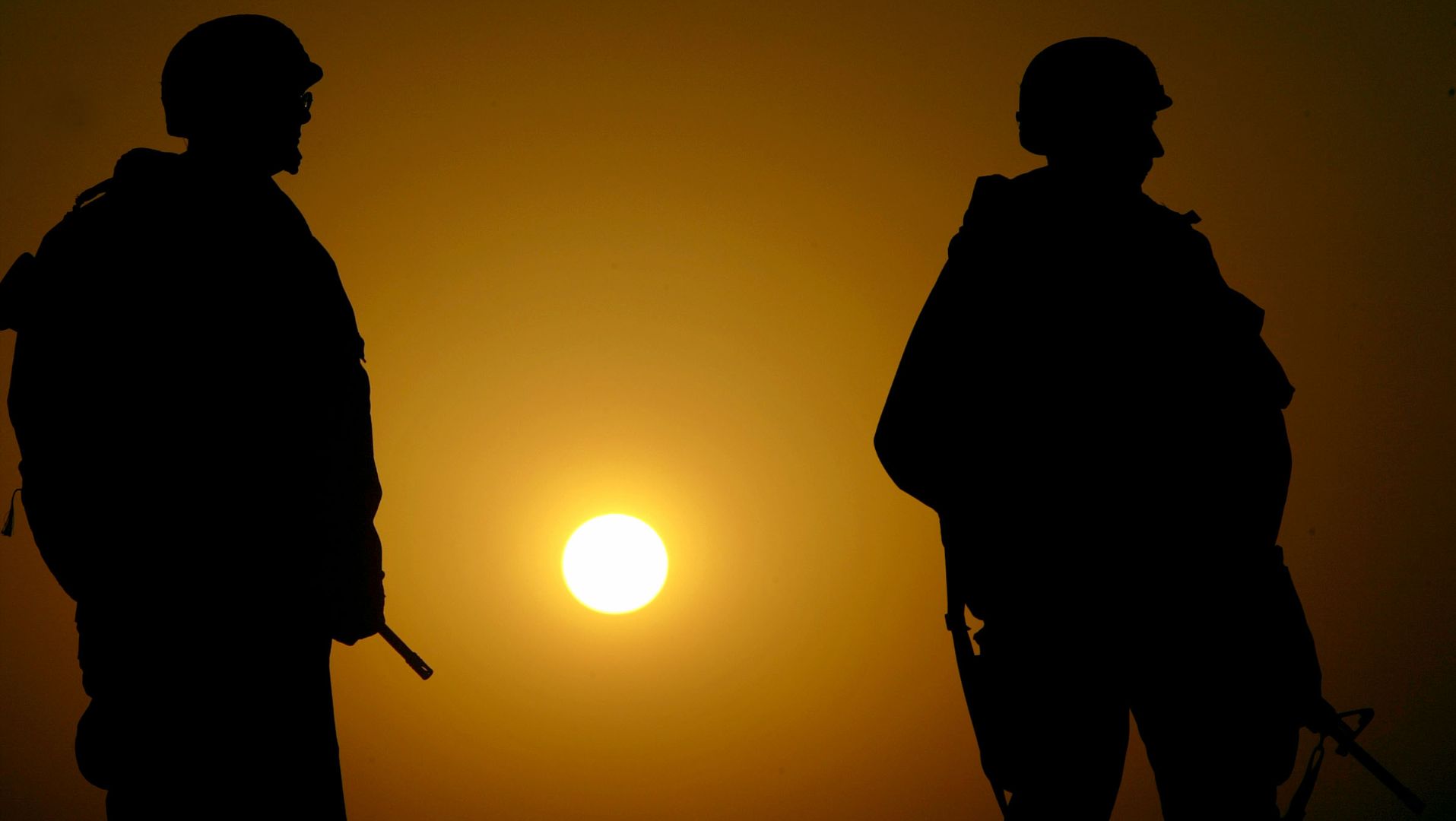
Photo: REUTERS

Technology that could change regional or global climate would inherently have complicated geopolitical implications. Ongoing research and discussions about SRM have increasingly tried to reckon with those geopolitical and security dynamics, and one question in particular arises frequently: could SRM be deployed as a weapon?
Answering that question inevitably leads to several others: What is meant by the word “weapon”? Should a careless or destabilising approach to deployment be considered “weaponisation”? What about perceptions or accusations of hostile intent?
We asked three experts to offer their thoughts on this complex and weighty topic.

Elizabeth Chalecki
Associate Professor of International Relations
University of Nebraska, Omaha
The question of whether SRM can be weaponized comes down to what we mean by “a weapon” and what we think it does, who it is “aimed at,” and what sort of advantage is sought by its use.
Traditionally, we think of weapons as offering kinetic force: a knife, a gun, a bomb. These are weapons in their crudest sense, only meant to do one immediate, unmistakable thing. So-called dual use technologies can have both weaponized and non-weaponized uses, such as the Haber-Bosch process – which can help make both fertilizers and explosives – or atomic fission – which can be harnessed in power plants or in atomic bombs. Both of these types of weapons are used by one party against an adversary (person or territory) with overtly hostile intent.
SRM would not be weaponized like this.
The potential weaponization of SRM could fall into a different category, however, because it can be used for long-term destabilization. It could potentially alter the climate of a country or region over several years, perhaps putting that region at an environmental disadvantage. Because stratospheric aerosol injection dissipates along its injection latitude, it could not be aimed at a rival area precisely, but might be used to affect large swaths of territory. Marine cloud brightening might have ancillary effects on ocean ecosystems, affecting food security.
In our consideration of SRM and security, it is important that we are not overly arrogant in our predictions of what could or could not happen in the future. Our modeling of these types of SRM is not exact enough at this point in time to be able to rule in or out precise ecosystem disruptions from its use, but should any negative effects be observed or predicted, security planners and strategic thinkers will consider how those effects can be turned against rivals.
This is how SRM would be weaponized.
Elizabeth L. Chalecki is an Associate Professor of International Relations at the University of Nebraska Omaha. Her expertise lies in the areas of climate change and security, international environmental policy, and the intersection of science, technology and international relations.

Josh Horton
Senior Consultant
University of Chicago
Focusing on stratospheric aerosol injection (SAI), if the question is taken literally – “can SAI be used to produce specific destructive or disruptive effects at specific times and places?” – then the answer is no, SAI cannot be weaponized because it is too imprecise; I have elaborated this argument elsewhere.
However, if the question is taken figuratively – “can SAI be used to attempt to gain strategic advantage over one’s adversaries?” – then the answer is yes, SAI could be “weaponized” to advance geopolitical or other aims. Lots of things have been, and are being, weaponized in this sense, in lots of different contexts – oil and gas, critical minerals, legal systems, social grievances, political polarization, conspiracy theories, fear, shame, etc., etc. And one can imagine many scenarios in which actors might use SAI to try to outmaneuver their opponents – for example, a state that is implementing the technology might “weaponize” SAI by threatening to halt deployment and produce a termination shock unless others give in to possibly unrelated demands.
Yet weaponization of this sort is clearly different from using SAI to, say, direct a tropical cyclone against a hostile power, which would not be possible. And using the language of weaponization figuratively when it is literally impossible runs multiple risks. Most obviously, it creates confusion by suggesting that SAI might be dual-use when it is not. Such confusion can promote an adversarial mindset that hinders cooperation or collaboration. Adopting the language of weaponization can also encourage the “securitization” of SAI and its associated political pathologies.
SAI can thus be weaponized in a figurative sense, but not in a literal sense. And given the risks entailed when communicators fail to specify the sense in which they use the term, I think it is best to avoid the language of weaponization when discussing SAI.
Josh is a Senior Consultant at the University of Chicago. He provides support for international policy initiatives related to solar geoengineering and conducts research on its political and governance aspects.

Cynthia Scharf
Senior Fellow
Centre for Future Generations
SRM seems unlikely to be weaponized in the traditional or literal sense, but its potential deployment would raise governance challenges with serious security implications:
First is the requirement for a multi-decadal (or longer) deployment. A ‘safe’ phased-in and phased-down SAI deployment might last a century or more. Could an international coalition of the willing, let alone a unilateral actor, abide by agreed ‘rules’ for 100 years? This would’ve been a challenge even during the heyday of globalization, let alone today’s fractured world.
The world will need a durable and flexible governance framework that could adapt to changing environmental, socio- and geopolitical conditions. A century is a long time for the world to maintain a stable, scientifically sound deployment.
Further, science and geopolitics operate on different time scales. There is a significant time lag between the start date of a deployment, the time needed to detect aerosols in the stratosphere, and the much longer time period required for attributing climate changes, which could take a decade or longer given internal climate variability. Meanwhile, it only takes a few hours for social-media fueled misinformation to take hold that might trigger conflict.
Right or wrong, there’s now someone to blame. Immediately. A first user could be blamed for any ensuing extreme weather, regardless of whether there is an actual causal link. No one will be waiting for the scientists’ reports years later.
If SAI is justified to the public as quick relief from extreme heat, and yet there is little immediately discernible change the first decade after deployment (due to internal climate variability), public support for deployment could wane, potentially leading to calls to halt deployment. The risk of termination shock increases.
Would other countries agree to continue the deployment if the first mover drops out, and do so uninterrupted for decades, to prevent termination shock? What might the security implications be if no other actors agreed to deploy?
When we talk about security risks of SAI, we need to realize the risks of global destabilization are deeply entwined with the unique governance challenges it raises.
Cynthia Scharf is a senior fellow at the Centre for Future Generations, a European think tank, leading their work on climate intervention technologies. She was senior strategy director for the Carnegie Climate Governance Initiative, and served in the Office of the UN Secretary-General as the head of strategic climate communications and chief speechwriter on climate change.
The views expressed by Perspective writers and News Reaction contributors are their own and are not necessarily endorsed by SRM360. We aim to present ideas from diverse viewpoints in these pieces to further support informed discussion of SRM (solar geoengineering).