Perspective
Different Takes: Could SRM Help Preserve Nature?
Three experts offer their thoughts on how sunlight reflection methods (SRM), or solar geoengineering, might interact with the natural world, and whether technological climate intervention could be a form of conservation or a violation of it.

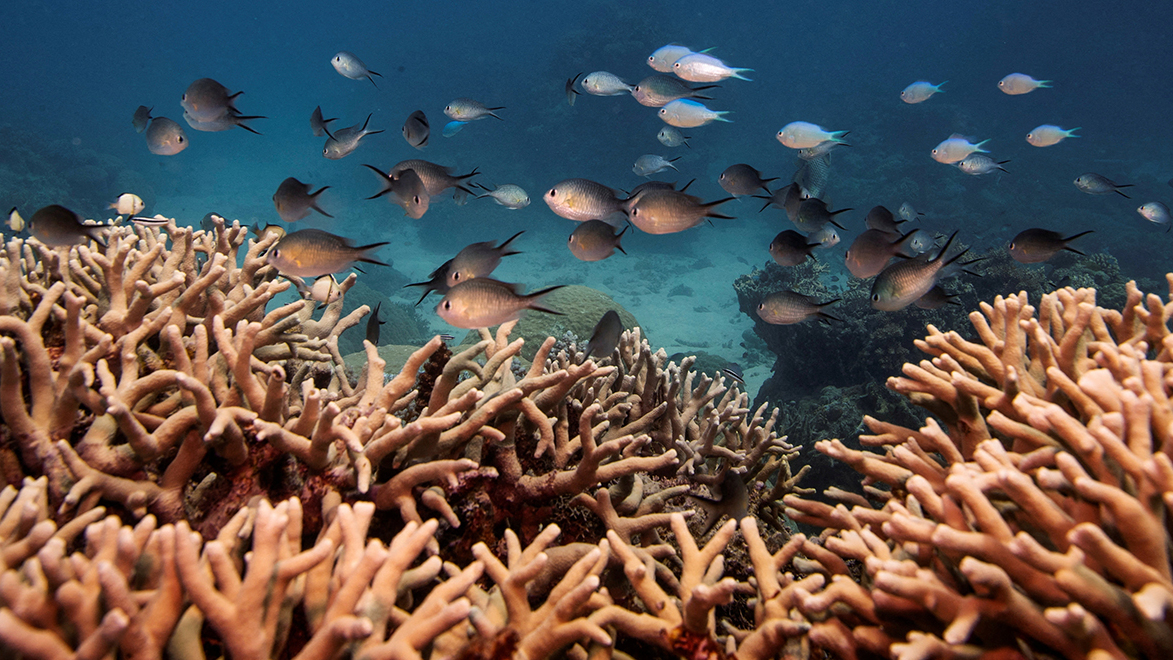
Photo: REUTERS

Humans have altered the natural world in a wide array of ways. Climate change is among the most far-reaching, affecting every ecosystem on the planet and shifting the very concept of “nature” as the world warms.
SRM could lower global temperatures and potentially reduce some of those impacts on nature. But it would introduce its own set of risks, and also would raise thorny ethical questions. What does “nature” mean in the current context of the changing climate, and how would SRM fit in that picture? If SRM could offer some degree of protection to the natural world, does that have inherent value, or would a technological intervention be incompatible with nature and conservation? And from a scientific perspective, what is known about SRM’s connection to nature and various ecosystems, and what questions remain?
We asked three experts from varying fields their thoughts on SRM’s potential to help preserve the natural world.

Leonie Bossert
University Assistant
University of Vienna
Nature is a notoriously contested term. But regardless of how one understands or defines nature, it is a habitat for animals.
For those who argue that no ‘wild’ nature exists anymore, neither would wild animals exist anymore. Like nature, the destinies of free-living animals are massively influenced by humans through alterations and destruction of habitats, including feeding and drinking sources, and migration routes. Anthropogenic climate change plays its part. However, whether wild or not, whether primary nature or a semi-natural environment, nature in the broadest sense constitutes the habitat of various animal species. It is, of course, also the habitat of plants, microbes, and fungi; however, only sentient animals possess interests in the strong sense, meaning they themselves have interests, and what happens to them matters to them. Therefore, it matters to them how their environmental conditions are shaped.
SRM has significant potential to shape animals’ environmental conditions.
If we frame the question as whether SRM can protect animal habitats, the answer is both yes and no. Evidently, much depends on the species in question. While the deployment of a particular SRM technology may protect individuals of certain species – for example, those that are not tolerant of heat – it may at the same time harm individuals of other species, such as those that would have benefited from expanding their range in response to rising temperatures. SRM may, however, also have both positive and negative effects on individuals of the same species when those individuals occur across different climatic zones, such as red foxes, common rats, or great tits.
Given the current state of – scientific as well as philosophical – research, no answer can be provided as to whether the deployment of SRM would, on balance, protect or harm more animals.
Focusing on the survival prospects of animals, however, makes the question of whether SRM can preserve nature less dependent on any particular conception of nature or on the degree of technological intervention one considers compatible with nature conservation. Instead, this focus seeks to broaden the human-centered perspective (even justifications for conservation can at times remain strongly human-centered). It asks what SRM would mean for other living beings, who also have a claim to tolerable climatic conditions.
Dr. Leonie N. Bossert is a University Assistant at the University of Vienna, Department of Philosophy. Her expertise lies in ethical evaluations of the socio-ecological impacts of disruptive technologies, and her research focuses on the intersection of environmental and technology ethics.
Christopher Preston
Writer
Whether SRM can help preserve nature depends a bit on how persnickety one wants to be about the term ‘nature.’ Many conservationists note that ‘nature’ gained its shape independently of humans. What Aldo Leopold found so remarkable about the crane marsh was its connection to distant evolutionary history. The crane’s call, ventured Leopold, was “a trumpet in the orchestra of evolution.” The marsh wore “a paleontological patent of nobility, won in the march of eons.”
The sentiment Leopold captures, one that inhabits environmental thought across several cultures, is that history matters on a landscape. Hydrological, geological, and ecological processes, working independently of humans for tens of millions of years, result in something remarkable. Origin stories count, for both indigenous and settler cultures. That’s why Leopold deemed it important to “think like a mountain.”
Such ideological purity starts to look suspicious in the Anthropocene. Not only does it draw an exaggerated line between human works and nature’s, it also appears increasingly futile. Everything bears the stamp of human endeavor. Climate change makes sure of that. It might be time to think of ‘nature’ differently, or at least to dissociate it from the Leopoldian scaffolding. Nature might still be valuable, even with a human imprint.
SRM – a human work – could prove capable of maintaining conditions in which crane marshes stay moist. Wolverines might keep the snow they need for denning and high-elevation forests might be kept from burning.
But the requirements for life have many layers. The stability of ecosystems is not just about temperature. It’s about rates of precipitation, seasonal change, regular disturbance, and evolving predator–prey relationships, to name a few. These must all stay within bounds.
SRM might help. It could probably take care of one variable. And that’s a start. But it’s not the whole story. And prudence suggests recognizing it would offer no guarantee.
Christopher J. Preston is an English-born writer and philosophy professor based in Missoula, MT. He has written on topics related to wildlife, environment, climate, and technology for venues that include The Atlantic, Orion, Smithsonian, Discover, the BBC, and the Wall Street Journal. He is the author of two award-winning books, Tenacious Beasts: Wildlife Recoveries that Change How We Think About Animals and The Synthetic Age, both with MIT Press.

Paulo Artaxo
Professor of Physics
University of Sao Paulo
If any method of SRM could work and be field deployable, there could be some potential benefits and also serious problems for nature. Science does not know yet the collateral effects that SRM could have on ecosystems. Even the potential benefits are not yet known.
The primary argument for SRM is that it potentially could rapidly arrest global temperature increases. For ecosystems currently approaching their thermal limits, such as tropical forests and sea ice, this could be a lifeline. SRM could prevent us from reaching critical tipping points: SRM could theoretically prevent us from crossing thresholds such as the total loss of Arctic summer sea ice or the “dieback” of the Amazon rainforest due to extreme heat and drought. Eventually, SRM could offer some glacial and permafrost protection: By potentially reducing surface temperatures, SRM could slow the melting of glaciers and the thawing of permafrost, which contains massive amounts of sequestered carbon and supports unique tundra ecosystems. In the oceans, maybe SRM could reduce thermal stress. Sea surface temperature spikes drive mass bleaching of coral reefs. Slowing this warming could give marine life more time to adapt or migrate.
While cooling the planet using SRM might help, the way it could be achieved would have side effects that could be just as damaging to nature as the warming itself. Among them:
- SRM will not address the ocean acidification issue. This means the oceans would continue to absorb carbon dioxide, leading to increased ocean acidification. Potentially, it makes it difficult for shellfish and corals to build their skeletons, collapsing marine food webs.
- Shifts in photosynthesis: By making the sky hazier, there would be a reduction in direct sunlight and an increase in diffuse light. This will change plant ecosystems, favoring certain species and making life difficult for others, thereby altering biodiversity.
- Altered rainfall patterns: Because temperature and precipitation are linked, there will be changes in the hydrological cycle in many regions of the world. In a region like the Amazon, which relies on a moisture recycling loop, a “cooled” planet with disrupted rainfall could lead to forest loss.
This all means that while SRM might help, it might actually cause more damage to nature than the issue it tries to fix. There is no remedy to halt global warming other than to eliminate fossil fuel exploration and use as quickly as possible. Science on SRM impacts still needs to be developed before any SRM deployment could even be considered.
Paulo Artaxo is a full professor in the Department of Applied Physics at the USP Physics Institute. He works with physics applied to environmental problems, mainly on issues of global climate change, the environment in the Amazon, atmospheric aerosol physics, urban air pollution, and other topics.
The views expressed by Perspective writers and News Reaction contributors are their own and are not necessarily endorsed by SRM360. We aim to present ideas from diverse viewpoints in these pieces to further support informed discussion of SRM (solar geoengineering).