Perspective
Towards a Roadmap for Sunlight Reflection Research
Alistair Duffey explains why the sunlight reflection methods (SRM) research community needs to be able to prioritise the questions and uncertainties in the field, and how a new public database from Reflective will help.

Photo illustration by SRM360; Image: Getty

Research into stratospheric aerosol injection (SAI) – one of the leading proposals for sunlight reflection as a climate intervention – is progressing. New funding has expanded the field of researchers, new computer modeling is giving us fresh insights, and the global diversity of the conversation continues to widen. At the same time, the scientific field studying SAI remains small, shockingly so when compared to the global importance of this research. SAI may have the potential to substantially reduce harms from climate change this century, but there are still large uncertainties over many key questions.
Given the limited time available before real-world decisions on SAI might be made, and limited funding and resources, research must prioritize addressing the uncertainties which are critical to those decisions. But there is no clear consensus on exactly which of the huge range of open questions – from engineering to stratospheric dynamics to ocean biogeochemistry – matter in this way, and what it would take to resolve them.
At Reflective, a non-profit research organization aiming to radically accelerate the pace of sunlight reflection research, we are working on such a research roadmap. As a first step towards this, we have built an SAI Uncertainty Database – a continually updated, public, scientifically-grounded assessment of the key technical uncertainties in SAI. We hope that the database can help researchers select projects, funders prioritize research questions, and policy-makers understand the current state of the science.
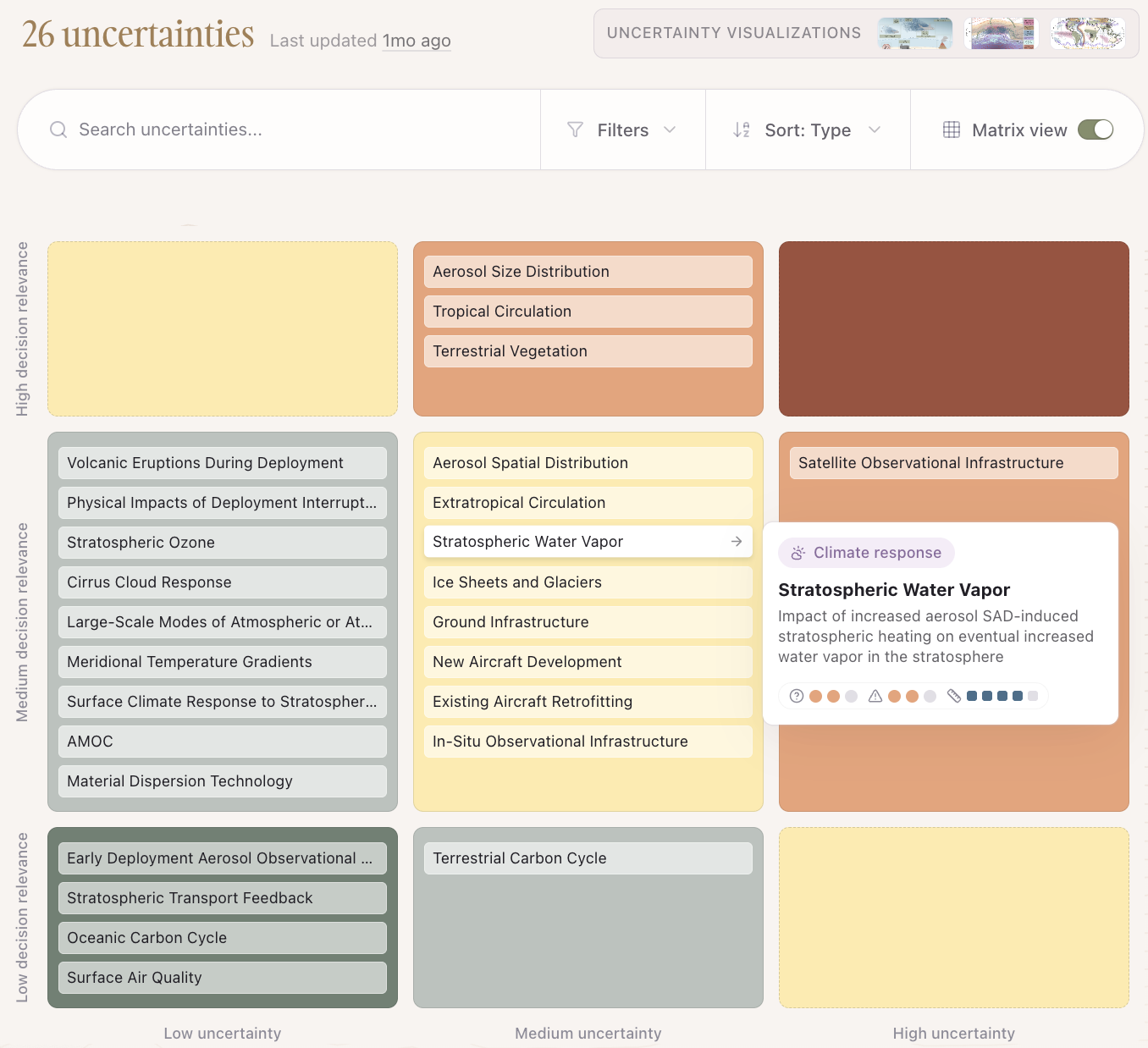
Reflective’s SAI Uncertainty Database, viewed as a matrix.
The database defines priority uncertainties in the engineering and physical climate science of SAI, and sorts them according to two dimensions: their ‘decision-relevance’ (whether well-informed future decision-making needs to know the answer) and their degree of uncertainty (how wrong we might be). Research questions that rank highly on both of these dimensions – high uncertainty, high decision-relevance – become clear priorities for research. Drawing on our expertise, literature review, and early conversations with external experts, we defined a list of key uncertainties, across four categories: Aerosol Evolution, Climate Response, Earth System Response, and Engineering.
We exclude societal, governance and geo-political uncertainties, not because they are unimportant – in fact we believe they are critical – but simply to make the project workable in this early stage. We also exclude scenario uncertainty by defining a single representative scenario on which to anchor our assessments. We expect to expand the scope by relaxing both of these constraints in time.
Our chosen scenario is one possible version of an SAI deployment. In it, deployment begins in 2035 with high-latitude low-altitude injection,1 which is assumed to use existing aircraft retrofitted with sulfur storage and distribution equipment, and then switches to higher altitude (>21km) deployment using novel aircraft by the time cooling is larger than several tenths of a degree Celsius. These assumptions matter when thinking about the decision-relevance of, for example, how long it might take to launch a new satellite carrying remote sensing instruments.
We then populate the database with a description of each uncertainty, scores for the degree of uncertainty and decision-relevance, and a categorization of how the uncertainty could be resolved – with computer modeling alone, via outdoor experiments at various scales, or in some cases, only after long-term and large-scale deployment. We are not the first to think about many of these questions, and our database has benefited from previous community efforts, such as by the Geoengineering Modeling Research Consortium.2
Taking the uncertainty in the size of sulfate aerosols in the stratosphere as an example, our assessment is that there is ‘medium’ uncertainty in this (while the latest modeling shows quite consistent aerosol sizes,3 models agreeing with one another does not necessarily mean that models agree with reality), and that this has a high degree of decision-relevance, because it strongly affects overall cooling efficiency, and also impacts other side effects like stratospheric heating. While our scoring of uncertainties is subjective, it lays the groundwork for community input, as well as more structured elicitation of expert views, which we plan to conduct through 2026. The full details of our approach can be seen on our methodology page.
While we at Reflective will maintain the database, we see it as a community resource, and this first version has already benefited from the expertise of many SRM researchers. It is now open for public comment, and we welcome input which will help us refine and expand the resource; our plans for a second version include relating uncertainties to climate impacts felt on the ground, and to the specific research programs required to reduce and ultimately resolve them. We are presenting the database at upcoming academic conferences – including a poster at the American Meteorological Society Annual Meeting this week in Houston – and would happily visit other universities and organizations to talk about the database and hear your thoughts (email us at roadmap@reflective.org).
Climate change is a present-day problem. At around 1.4°C of global warming, the widespread and irreversible loss of warm-water coral reefs is already underway.4 While decisions on SAI deployment cannot and should not be taken today, nor lightly, they may well be taken in the coming decades. On scientific timescales, the time available to inform decision-making is short. Research must therefore proceed with responsible urgency. We hope that this database can help clarify what research matters most.
About Reflective
Reflective is a non-profit research organization aiming to radically accelerate the pace of sunlight reflection research. Their mission is to equip the world with the data and tools needed to make informed decisions about SRM, fast enough to matter. For more information, please visit www.reflective.org.
The views expressed by Perspective writers and News Reaction contributors are their own and are not necessarily endorsed by SRM360. We aim to present ideas from diverse viewpoints in these pieces to further support informed discussion of SRM (solar geoengineering).


Endnotes
- Duffey A, Lee W, Wheeler L, et al. (2025). The global climate response to High-Latitude Low-Altitude Stratospheric Aerosol Injection (HiLLA-SAI). EGUsphere. [Preprint]. https://doi.org/10.5194/egusphere-2025-5356
- Eastham SD, Butler AH, Doherty SJ, et al. (2025). Key gaps in models’ physical representation of climate intervention and its impacts. Journal of Advances in Modeling Earth Systems. 17(6):e2024MS004872. https://doi.org/10.1029/2024MS004872
- Lee WR, Visioni D, Wagman BM, et al. (2025). G6-1.5 K-SAI and G6sulfur: changes in impacts and uncertainty depending on stratospheric aerosol injection strategy in the Geoengineering Model Intercomparison Project. EGUsphere. [Preprint] https://doi.org/10.5194/egusphere-2025-5742
- Lenton TM, Milkoreit M, Willcock S, et al., (eds). (2025). The Global Tipping Points Report 2025. University of Exeter. https://global-tipping-points.org/