Navigating Plan C
AN INTRODUCTION TO THE IDEAS EXPLORED IN PLAN C FOR CIVILIZATION
What could go wrong?
Any proposal to deliberately alter the Earth’s climate carries serious risks, and the researchers studying solar geoengineering are often the first to say so.
Side effects and uneven outcomes
Solar geoengineering would not reduce climate risks evenly. The most studied approach – stratospheric aerosol injection – could cool the Earth substantially, but some regions would likely see greater changes to rainfall than they would from climate change alone. The particles used could delay recovery of the ozone layer and contribute to air pollution.
There are also political risks. Attributing specific weather events to SRM would be extremely difficult, especially early on. A country experiencing a record drought after deployment began might blame SRM – regardless of whether the drought was a side effect, would have happened anyway, or was actually made less severe by the intervention. Without trusted mechanisms for resolving such disputes, the potential for conflict could be high.
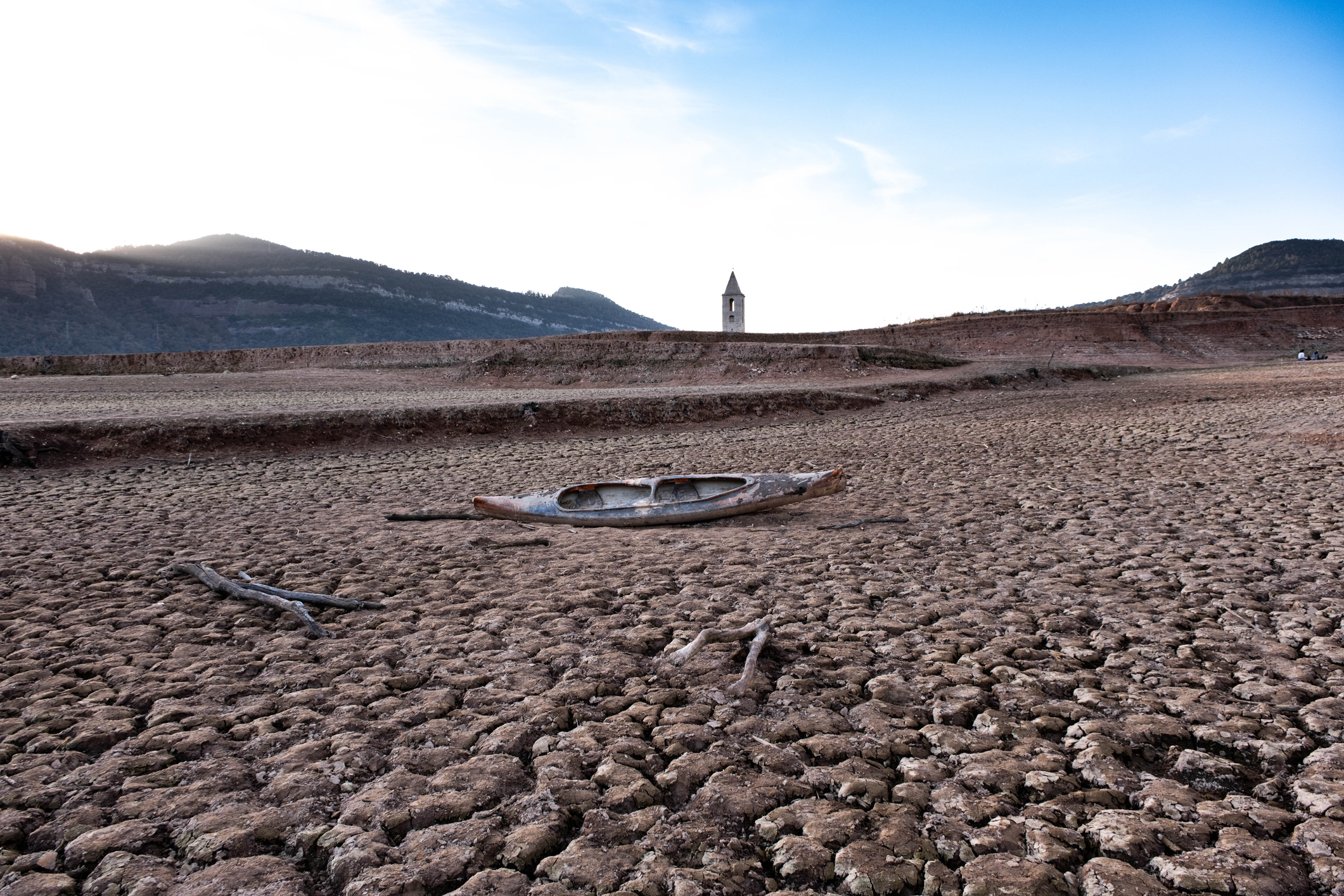
Sau reservoir during drought. Credit: mai saki.
Termination Shock
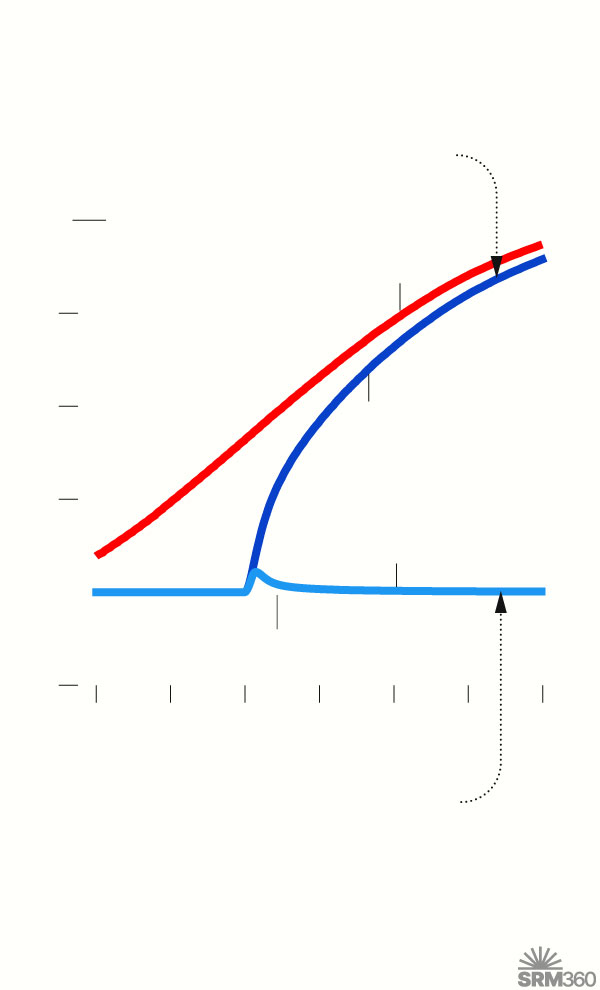
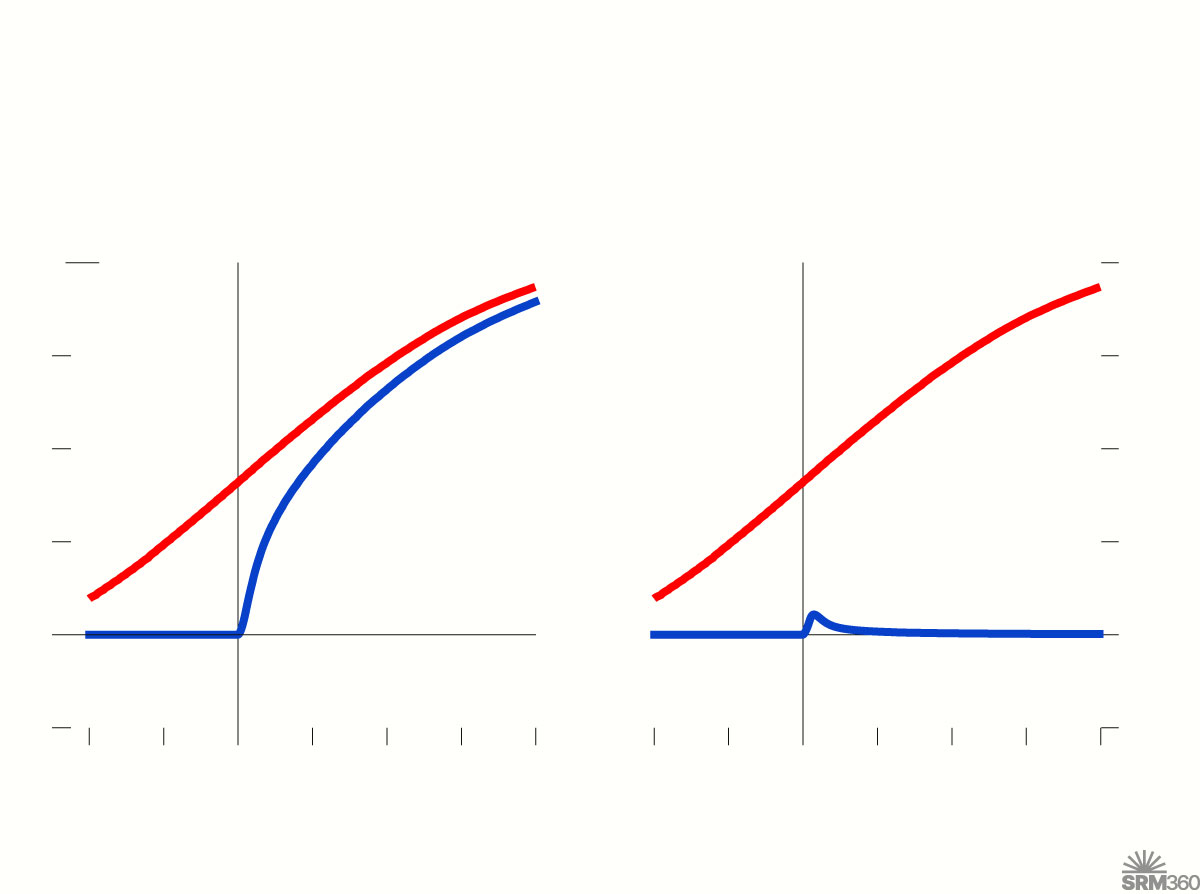
Because SRM would mask warming rather than remove the greenhouse gases causing it, stopping deployment suddenly could cause temperatures to rebound rapidly – potentially faster than ecosystems and societies could adapt. This is known as “termination shock”. Research shows, however, that if deployment were interrupted and restarted within a few months, this rapid warming could be largely avoided. Sustained SRM would need to be treated as critical infrastructure – maintained with the reliability expected of electricity grids – and paired with accelerated emissions reductions to limit long-term dependence.
Termination shock
Sunlight reflection methods (SRM) only provide a temporary cooling effect, which would need to be maintained for decades to offset global warming.
GLOBAL TEMPERATURE INCREASE
If SRM deployment suddenly and permanently stopped, temperatures would rapidly rise in what’s called a “termination shock”.
3.5°C
No SRM
3.0
2.5
SRM interrupted indefinitely
2.0
SRM interrupted for 1 year
1.5
SRM continues
1.0
2040
’50
’60
’70
’80
’90
2100
But, if the deployment were restarted within a few months, this rapid warming could be avoided.
Source: Based on results from Farley et al. (2024), Environmental Research Climate
GLOBAL TEMPERATURE INCREASE
But, if the deployment were restarted within a few months, this rapid warming could be avoided.
If SRM deployment suddenly and permanently stopped, temperatures would rapidly rise in what’s called a “termination shock”.
3.5°C
3.5°C
No SRM
No SRM
3.0
3.0
2.5
2.5
SRM interrupted indefinitely
SRM interrupted for 1 year
2.0
2.0
1.5
1.5
1.0
1.0
2040
’50
’60
’70
’80
’90
2100
2040
’50
’60
’70
’80
’90
2100
Source: Based on results from Farley et al. (2024), Environmental Research Climate

Weighing risks against risks
The conversation about SRM risks takes place against the backdrop of climate change already causing severe harm. Researchers increasingly frame the question not as “Is SRM risky?” but as “How do SRM risks compare to the risks of a warming world without it?”
Every available option carries risk – including the option of doing nothing additional. And those risks would not be experienced equally across regions or populations. Climate change without SRM means continued escalation of heat extremes, rising seas, and ecosystem collapse. SRM could reduce many of those harms, but would introduce new risks. Informed decisions would require weighing both sets of risks – physical, political, and ethical – rather than evaluating SRM in isolation.
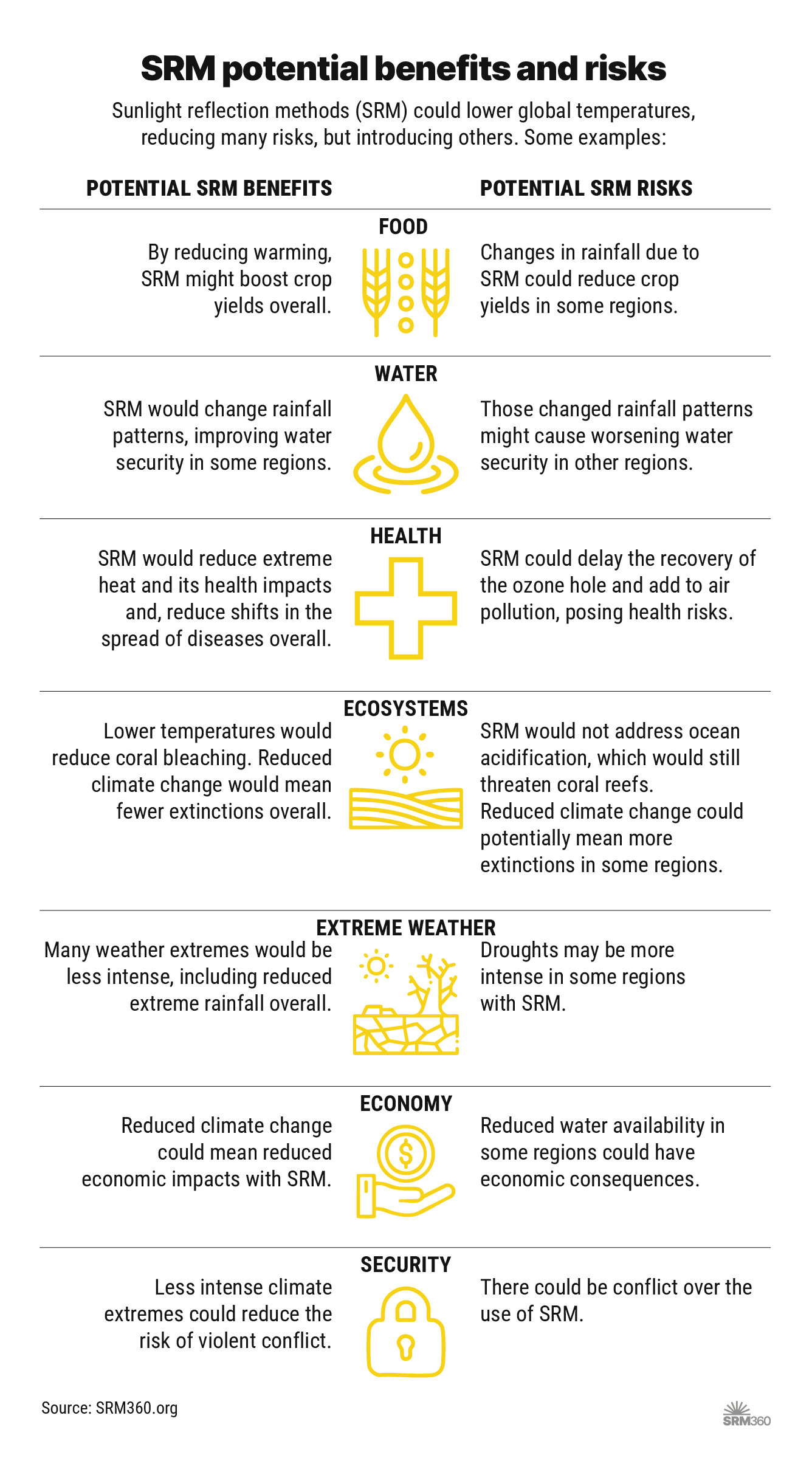
SRM potential benefits and risks
Sunlight reflection methods (SRM) could lower global temperatures, reducing many risks, but introducing others. Some examples:

Potential srm benefits
Potential srm RISKS
Food
Changes in rainfall due to SRM could reduce crop yields in some regions.
By reducing warming, SRM might boost crop yields overall .
WATER
SRM would change rainfall patterns, improving water security in some regions.
Those changed rainfall patterns might cause worsening water security in other regions.
HEALTH
SRM would reduce extreme heat and its health impacts and, reduce shifts in the spread of diseases overall.
SRM could delay the recovery of the ozone hole and add to air pollution, posing health risks.
ECOSYSTEMS
Lower temperatures would reduce coral bleaching. Reduced climate change would mean fewer extinctions overall.
SRM would not address ocean acidification, which would still threaten coral reefs.
Reduced climate change could potentially mean more extinctions in some regions.
EXTREME WEATHER
Many weather extremes would be less intense, including reduced extreme rainfall overall.
Droughts may be more intense in some regions with SRM.
ECONOMY
Reduced climate change could mean reduced economic impacts with SRM.
Reduced water availability in some regions could have economic consequences.
SECURITY
Less intense climate extremes could reduce the risk of violent conflict.
There could be conflict over the use of SRM.
Source: SRM360.org

Potential srm benefits
Potential srm RISKS
Food
By reducing warming, SRM might boost crop yields overall.
Changes in rainfall due to SRM could reduce crop yields in some regions.
WATER
SRM would change rainfall patterns, improving water security in some regions.
Those changed rainfall patterns might cause worsening water security in other regions.
HEALTH
SRM would reduce extreme heat and its health impacts and, reduce shifts in the spread of diseases overall.
SRM could delay the recovery of the ozone hole and add to air pollution, posing health risks.
ECOSYSTEMS
Lower temperatures would reduce coral bleaching. Reduced climate change would mean fewer extinctions overall.
SRM would not address ocean acidification, which would still threaten coral reefs.
Reduced climate change could potentially mean more extinctions in some regions.
EXTREME WEATHER
Many weather extremes would be less intense, including reduced extreme rainfall overall.
Droughts may be more intense in some regions with SRM.
ECONOMY
Reduced climate change could mean reduced economic impacts with SRM.
Reduced water availability in some regions could have economic consequences.
SECURITY
Less intense climate extremes could reduce the risk of violent conflict.
There could be conflict over the use of SRM.
Source: SRM360.org
Stay up to date with the latest from SRM360 and the Plan C team
Dig deeper on this topic
- Guide: How Could SRM Go Wrong?
- Infographic: Termination Shock
- Article: Risk-Risk Analysis