Navigating Plan C
AN INTRODUCTION TO THE IDEAS EXPLORED IN PLAN C FOR CIVILIZATION
Who gets to decide?
There is no dedicated international framework for governing solar geoengineering – and no mechanism for collective decision-making about the deliberate modification of a shared atmosphere.
The governance gap
No international body currently has the authority to approve, regulate, or prevent solar geoengineering. Existing treaties don’t cover it – the closest is the 1977 ENMOD convention, which only prohibits hostile environmental modification. A 2010 decision by the Convention on Biological Diversity urged caution, but is non-binding and has not been actioned. More recently, a Swiss proposal to create a UN scientific expert group on SRM was pulled in 2024 after opposition from the African Group and others. The result is a patchwork of informal norms – with no clear rules for a set of technologies that would affect everyone, and no established framework for ensuring transparency, public participation, or equitable decision-making.

Photo: Westend61
Could a single country act alone?
Solar geoengineering could, in theory, be deployed by one country without international consent. The financial costs – estimated in the tens of billions of dollars per year – are within reach of many governments. However, only about ten countries possess the aerospace and logistical capacity for large-scale deployment, and any that tried would likely face significant pushback: economic sanctions, diplomatic isolation, or worse.
These constraints make unilateral deployment less likely than is sometimes claimed. A country wanting to pursue SRM would probably seek a coalition or agreement. But the absence of any framework for doing so is the core problem. There is currently no institution or process through which countries could negotiate, agree on, or object to a deployment – which is why governance is considered at least as urgent as the science itself.

A plane taking off, silhouetted against an orange sunset. Credit: John.
A divided landscape
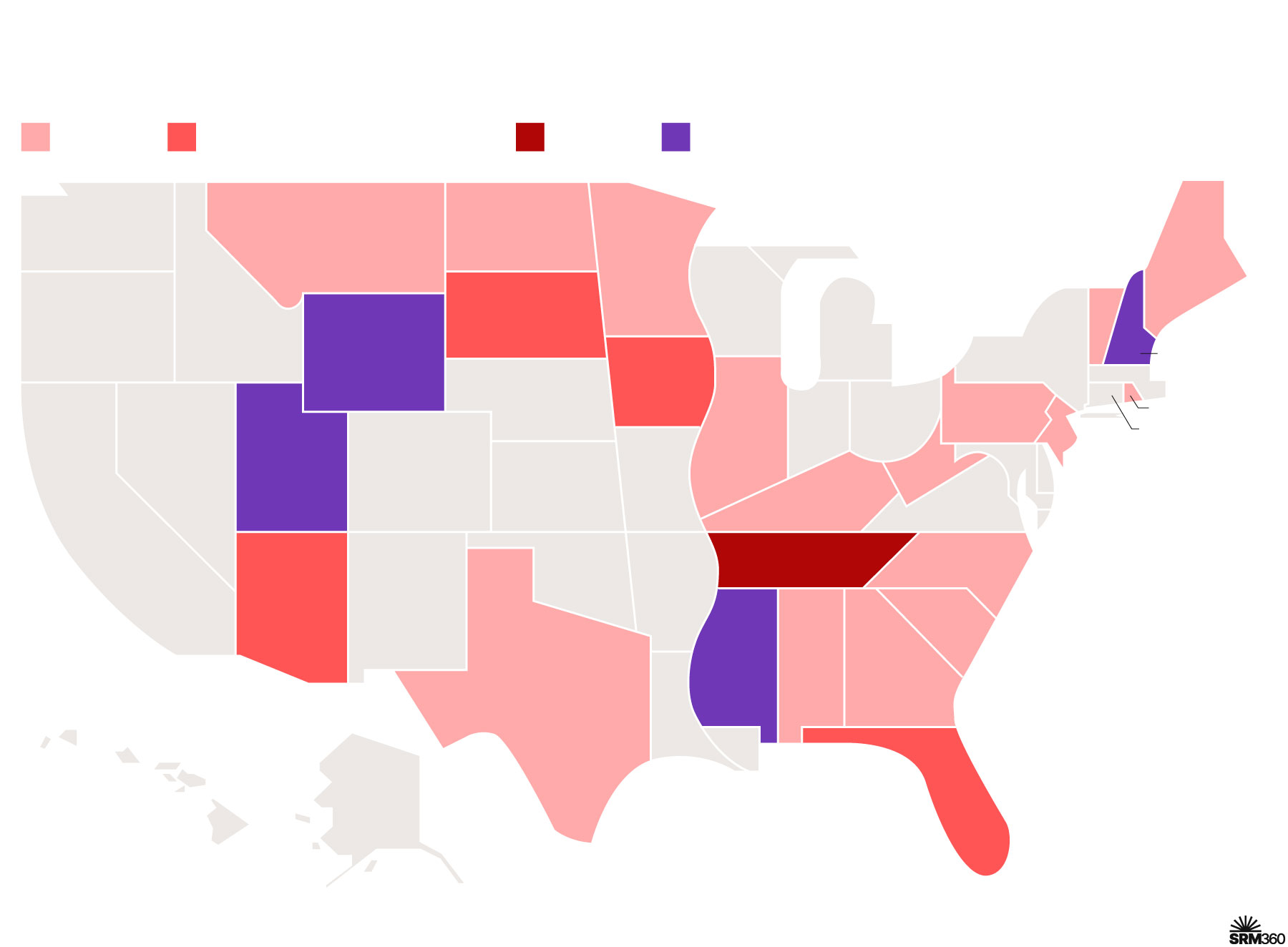
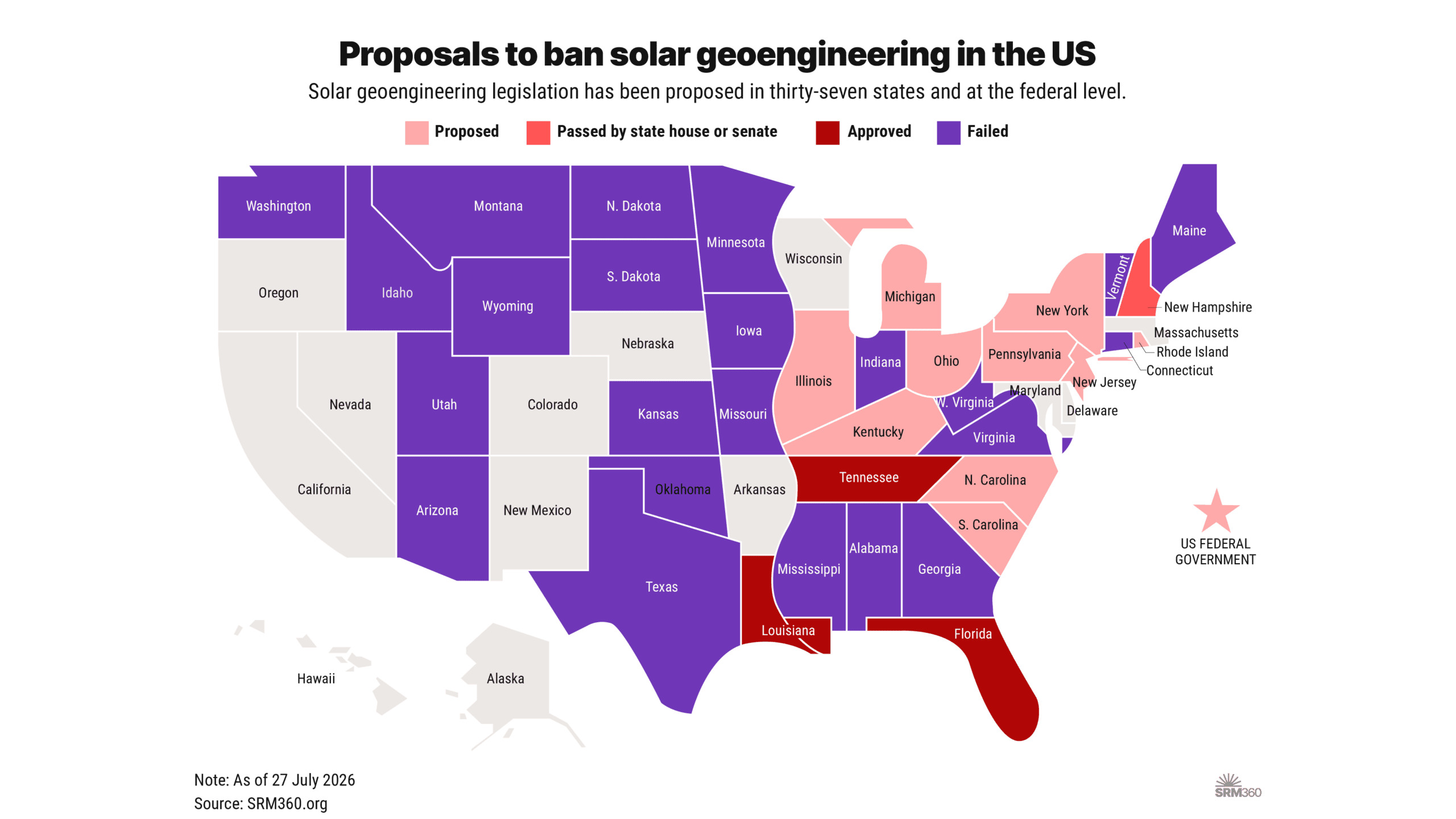
In the United States, legislation to ban or restrict SRM activities has been proposed in 37 states and at the federal level, with three states already approving such measures. Internationally, African environment ministers have called for a formal non-use agreement. These movements reflect concerns not only about the technology, but about power, trust, and historical inequity.
At the same time, governments – notably the UK – are increasing their investment in SRM research, and the topic is appearing on intergovernmental agendas more frequently. The result is a governance landscape defined by tension rather than consensus.
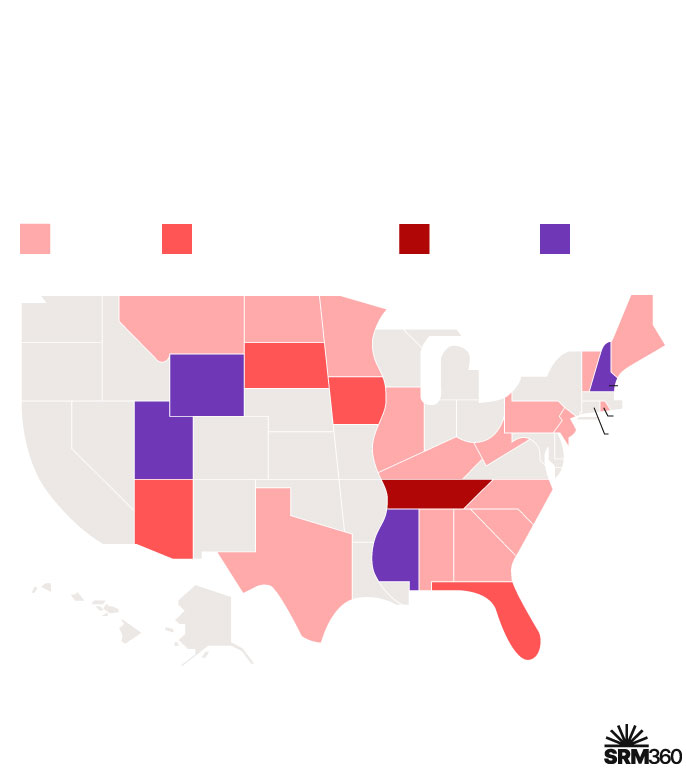
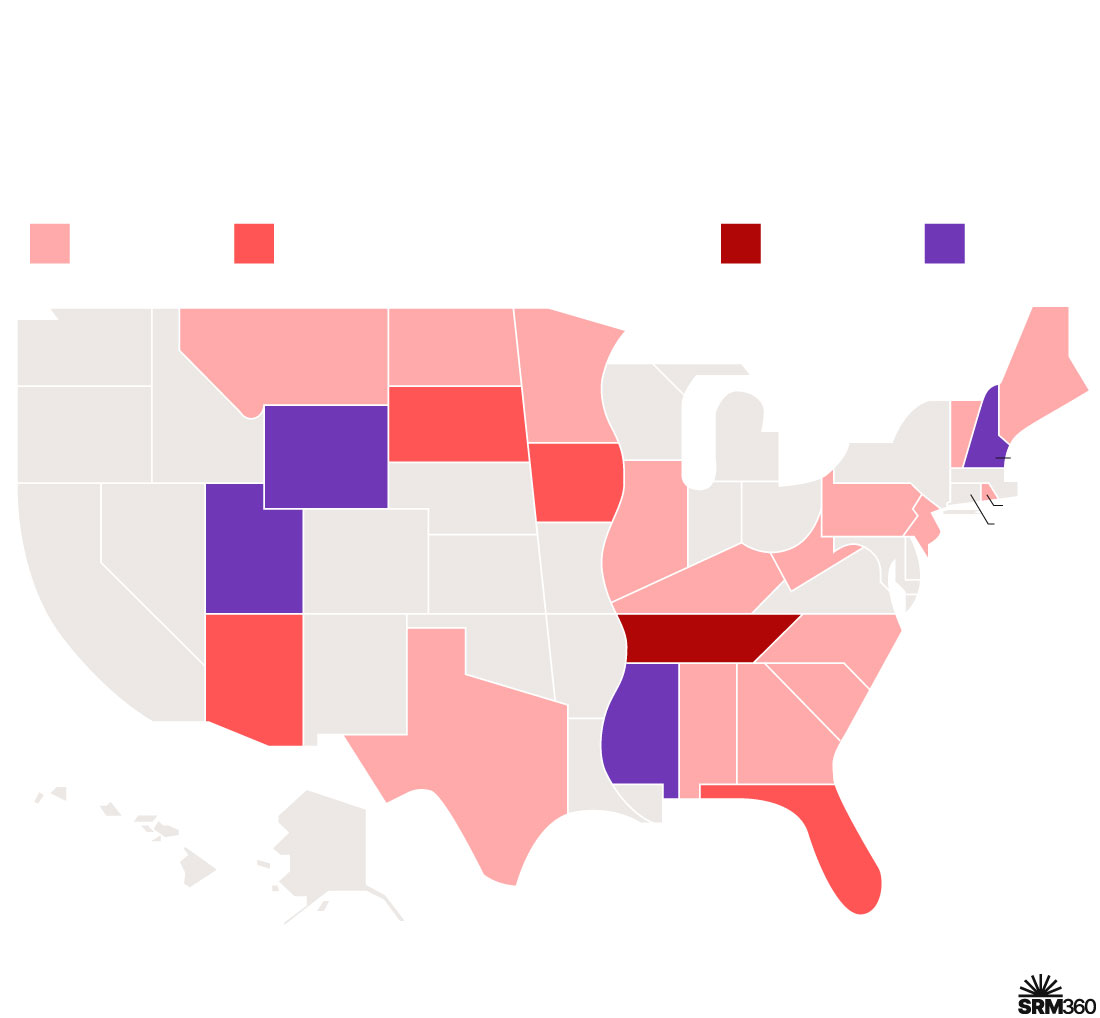
Proposals to ban solar geoengineering in the US
Thirty-seven US states and the federal government have proposed banning solar geoengineering since 2023.
Proposed
Passed by state house or senate
Died in committee/
Failed to pass vote
Approved
Wash.
Mont.
N. D.
Mich.
Maine
Minn.
Wis.
Vt.
S. D.
Ore.
Idaho
N.H.
Wyo.
N.Y.
Mass.
Iowa
Neb.
R.I.
Pa.
Ohio
Ind.
N.J.
Conn.
Ill.
Md.
W. V.
Nev.
Utah
Colo.
Del.
Kan.
Mo.
Ky.
Va.
Tenn.
N. C.
Ark.
Calif.
Okla.
Ariz.
N.M.
S. C.
Ala.
Miss.
Ga.
US FEDERAL GOVERNMENT
Texas
La.
Fla.
Hawaii
Alaska
Note As of 27 July 2026
Source: SRM360.org
Proposed
Passed by state house or senate
Approved
Died in committee/
Failed to pass vote
Wash.
Mont.
N. D.
Maine
Minn.
Wis.
Vt.
S. D.
Ore.
Idaho
Mich.
Wyo.
N.H.
N.Y.
Iowa
Mass.
Neb.
R.I.
Pa.
Ohio
Ind.
Conn.
N.J.
Ill.
Md.
W. V.
Nev.
Utah
Colo.
Del.
Kan.
Mo.
Ky.
Va.
Tenn.
N. C.
Calif.
Okla.
Ark.
Ariz.
N.M.
S. C.
Ala.
Miss.
Ga.
US FEDERAL GOVERNMENT
Texas
La.
Fla.
Hawaii
Alaska
Note As of 27 July 2026
Source: SRM360.org
Died in committee/Failed to pass vote
Proposed
Passed by state house or senate
Approved
Washington
Montana
N. Dakota
Maine
Vermont
Minnesota
Wisconsin
S. Dakota
Oregon
Idaho
Michigan
Wyoming
New Hampshire
New York
Iowa
Massachusetts
Nebraska
Rhode Island
Pennsylvania
Ohio
Indiana
Connecticut
Illinois
New Jersey
Maryland
W. Virginia
Nevada
Utah
Colorado
Delaware
Kansas
Missouri
Kentucky
Virginia
Tennessee
N. Carolina
California
Oklahoma
Arkansas
US FEDERAL GOVERNMENT
Arizona
New Mexico
S. Carolina
Alabama
Mississippi
Georgia
Texas
Louisiana
Florida
Hawaii
Alaska
Note As of 27 July 2026
Source: SRM360.org
Stay up to date with the latest from SRM360 and the Plan C team
Dig deeper on this topic
- Guide: How Should SRM Be Governed?
- Article: Unilateral Deployment: Could a Single Country Change the Climate?
- Interactive Tool: US State Bans Tracker