News Reaction
New Details Emerge on Cancelled Outdoor SRM Experiment in Alameda
An investigation by Politico shines a new light on the cancelled marine cloud brightening (MCB) experiment in Alameda, California last year. Experts weigh in on the developments and reflect on the implications for future field experiments.
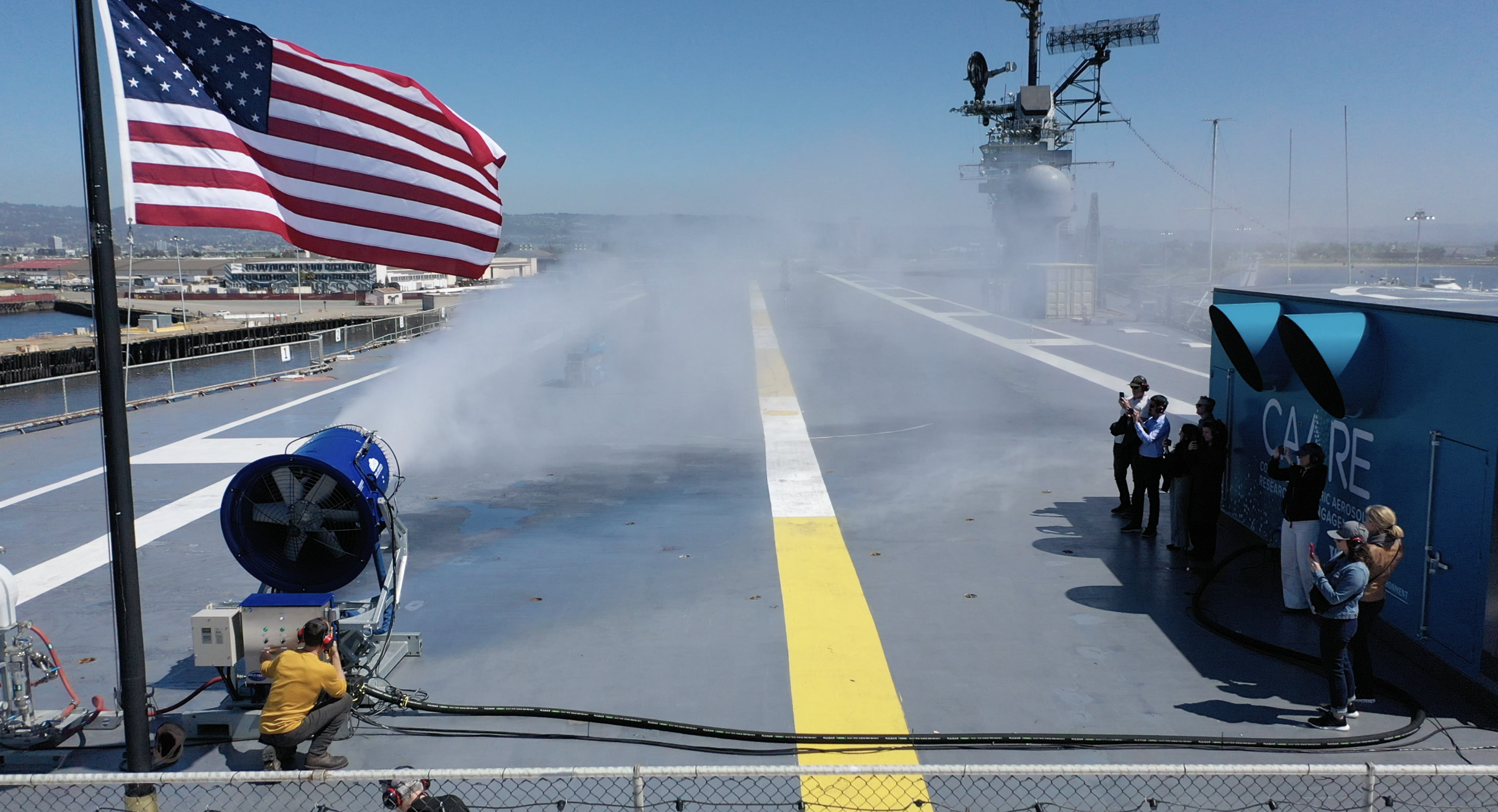
The University of Washington Marine Cloud Brightening Research Program’s Cloud-Aerosol Research Instrument (CARI) generates a mist of sea-salt aerosol droplets on the deck of the USS Hornet Sea, Air & Space Museum in spring 2024 (photo: David Masuda).
Politico’s 27 July report draws on internal documents from the University of Washington team behind the cancelled 2024 MCB experiment. They reveal a vision for much larger future experiments as part of a proposal to a philanthropic funder and a decision to keep the Alameda experiment out of public messaging about the MCB program in the run-up to the study.
The small-scale outdoor experiment, conducted aboard the decommissioned aircraft carrier USS Hornet, aimed to evaluate the aerosol particles generated by a sea-salt spraying device. However, as Politico previously reported, the project was only brought to the attention of city officials through coverage in the national media.
The discovery prompted a series of city council meetings where supporters and opponents weighed in on the experiment. Ultimately, the Alameda city officials voted unanimously to cancel the experiment.
We asked experts, including some of those involved, for their reactions to these developments and what lessons can be learned for future field experiments.

Shaun Fitzgerald
Director
Centre for Climate Repair
Openness and transparency in research into exploring climate cooling options are incredibly important.
I was rather surprised to learn about the Alameda experiment in the news when the experiment was launched. We now know that even Mayor Marilyn Ezzy Ashcraft first learned about it by reading a New York Times article.
Now that we learn there were discussions in a small group about plans bigger than the Alameda experiment, this just reinforces the lesson that openness and transparency are key tenets for research in this area. This is because it isn’t just about what you are doing, but how you are going about your work in exploring climate cooling options.
I think there are helpful lessons to be learned from different groups working in the broad area of research into climate cooling options. Although the Alameda and SCoPEx experiments were unsuccessful, work has been undertaken on Marine Cloud Brightening over the Great Barrier Reef and Ice Thickening in northern Canada. In both of these cases, the local populations and indigenous groups are not just consulted ahead of experiments but are actively involved. The inclusive nature of a research programme is key.
As Director of the Centre for Climate Repair at the University of Cambridge, Dr Fitzgerald coordinates research efforts into solutions that could help repair the climate, including refreezing sea ice, injecting aerosols into the stratosphere, and brightening marine clouds.

Sarah Doherty
Senior Research Scientist
Cooperative Institute for Climate, Ocean and Ecosystems Studies, University of Washington
As researchers at a public university, whose mission is rooted in the public good, our first priority has always been to be transparent and engage with people outside of academia. That’s why, as part of our field studies, we partnered with the USS Hornet Museum to ensure that people in the local community could see our research in action, ask questions, and raise concerns directly with our team.
That said, we clearly made mistakes in our efforts in Alameda. Given the controversy surrounding marine cloud brightening research, we took too cautious an approach and waited too long to share information about our research with the broader public. We have done our best to learn from these mistakes, and in any future effort would certainly engage more proactively with local communities.
At the same time, we categorically deny that we were – or are – working toward an experiment like the one described, which conflates two unrelated items: theoretical descriptions we based on previously published works describing a range of possible scientific field studies, and meetings and discussions with funders and science agencies that had nothing to do with those hypothetical field studies. Those meetings were about building support for an effort to fill gaps in critically needed observations of our atmosphere as it exists right now – entirely independent of marine cloud brightening field experiments.
Further, the descriptions of hypothetical field experiments of this sort predate even the existence of the UW Marine Cloud Brightening Research Program, as can be seen here, here, and here.
We believe that transparency and oversight are crucial to any effort to study marine cloud brightening, and we have pursued our research with a primary goal of empowering the public to make informed decisions about its future use and regulation. We have specifically contributed to these descriptions of hypothetical studies because we think it’s important that people understand what such experiments would look like and their scientific value, and so that our fellow scientists and members of the public can evaluate them openly.
We stand by those values, and they continue to form the foundation of our research program.
Sarah J. Doherty is a senior research scientist and associate professor at the University of Washington, where she is program director of the Marine Cloud Brightening Research Program.

Kelly Wanser
Executive Director
SilverLining
SilverLining works to fill gaps in the information society needs to determine whether interventions in weather and climate are safe and effective and what might be needed to monitor, regulate and make decisions about them.
We do this through programs that expand atmospheric observations, improve Earth system models and carefully and transparently evaluate the safety and efficacy of sunlight reflection approaches. We do not advocate for the use of these interventions.
One key aim of situating the Coastal Atmospheric Research and Engagement (CAARE) Program on the USS Hornet Museum was the opportunity to conduct research in a fully open and transparent way, increasing public education, access and equitable engagement around marine cloud brightening research. We support the University of Washington Marine Cloud Brightening Research Program team in its work and echo its comments.
Kelly Wanser is the Executive Director of SilverLining, a non-profit organisation dedicated to ensuring a safe and secure Earth system. In that capacity, she leads the organisation’s efforts to advance scientific research, effective policy, and international cooperation on possibilities for rapidly responding to Earth system changes.
The views expressed by Perspective writers and News Reaction contributors are their own and are not necessarily endorsed by SRM360. We aim to present ideas from diverse viewpoints in these pieces to further support informed discussion of SRM (solar geoengineering).