Perspective
What Do People in Bangladesh Think About SRM?
Dr Md. Sadique Rahman shares findings from his recent study exploring public perceptions of sunlight reflection methods (SRM) in Bangladesh and discusses broader dynamics between the Global North and the Global South.
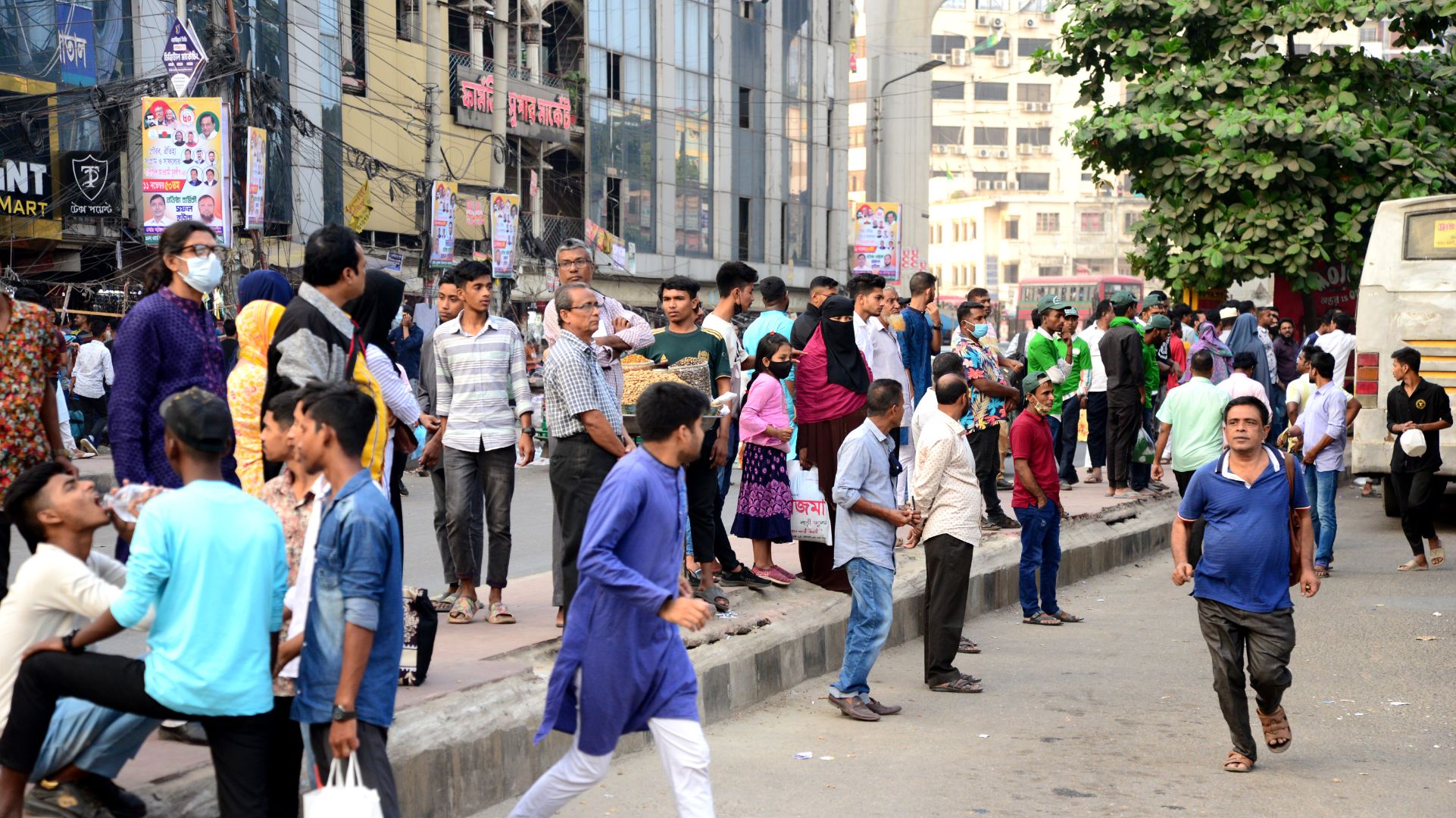
Dhaka, Bangladesh (Photo: Mamunur Rashid via Reuters Connect)

Although efforts to curb greenhouse gas emissions have intensified, global temperatures continue to rise, with countries in the Global South being disproportionately affected. Researchers, particularly those from the Global North, have suggested solar radiation modification (SRM) as a complementary approach to existing climate change mitigation strategies.1
SRM refers to proposed technologies that would reflect a portion of sunlight back into space to temporarily cool the planet. However, SRM could introduce new risks, especially for climate-vulnerable countries of the Global South.
This is particularly the case for countries that depend on rain-fed agriculture, since SRM could alter monsoon patterns, affecting agricultural production and food security. Therefore, it is crucial to incorporate the participation and perspectives of climate-vulnerable Global South countries, including those in South Asia, into SRM research and governance.
Our recent study, published in Environmental Research Communications in 2026,2 offered a critical, localized lens on the public perceptions and geopolitical issues of SRM by examining Bangladesh, a country that serves as “ground zero” for climate vulnerability.
Stakeholders’ perceptions of SRM
Our study included in-depth interviews and focus group discussions. The interviews were conducted with experts in climate research and policy, while the focus groups involved a wider array of stakeholders, including farmers, civil service officials, and students.
This approach provided insights into both grassroots and institutional perspectives. At the start of each discussion, we provided a concise presentation outlining SRM technologies, their potential benefits, and risks.
Our findings reveal that stakeholders in Bangladesh hold diverse views regarding SRM.
The most striking finding is the enthusiasm for SRM among grassroots stakeholders, such as farmers. In an agriculturally dependent country such as Bangladesh, where farmers face severe challenges in cultivating crops due to drought or excessive heat, many viewed SRM through the lens of survival, seeing it as a potential solution to their agricultural production problems.
In contrast, the climate experts we interviewed in Bangladesh viewed SRM with caution, fearing that this complex engineering solution might distract Global North countries from cutting emissions or create geopolitical tension. In such a case, Global South countries like Bangladesh would face negative consequences.
Experts demanded more proof of the effectiveness of SRM and were unwilling to acknowledge it as a good option for combating climate change. They highlighted the need for Bangladesh and other Global South countries to build scientific capacity to participate meaningfully in global SRM discussions, rather than relying solely on knowledge generated in the Global North.
In light of these findings, transparent, science-based communication is warranted to address these issues and gain a clearer understanding of Global South perspectives.
Governance challenge: Who holds the remote?
In Bangladesh, the prospect of slowing global warming is welcomed by several stakeholders; however, this has not necessarily translated into support for SRM, as its pros and cons remain poorly understood, and governance remains a key challenge.
Bangladeshi experts highlighted that global climate governance lacks clarity, raising questions linked to accountability and how to accurately quantify (and financially compensate for) climate damages. Stakeholders in Bangladesh emphasized that the national government must lead SRM governance, with support from academia and civil society.
Despite Bangladesh being a leader in the Climate Vulnerable Forum, Bangladeshi experts fear being sidelined in global climate decisions due to a lack of financial and negotiation power.
These findings highlight important governance challenges. For SRM to be ethical, it must move away from a top-down Global North-imposed approach toward a multilateral, transparent framework in which vulnerable nations have veto power or significant input. Given the transboundary nature of SRM risks, countries such as Bangladesh should also advocate for regional cooperation and push for a legally binding international framework on SRM.
The road ahead
SRM is not an abstract scientific curiosity; it reflects a world that is running out of time. We may be entering an era in which the most vulnerable communities are so desperate that they are willing to embrace high-risk, unproven technologies.
In this situation, inclusive knowledge production is warranted. As such, research on SRM needs to be decentralized. In the absence of empirical evidence demonstrating SRM’s effectiveness, policymakers in Global South countries such as Bangladesh are reluctant to integrate it into national climate policy. They argue that SRM decisions based on evidence from the Global North might overlook local context and sociopolitical realities.
This context calls for evidence-based small-scale experiments on SRM in Global South countries. To achieve this, Bangladesh and other countries of the Global South require more research funding and capacity-development initiatives to meaningfully engage in SRM research, governance, and decision-making processes. Moreover, researchers in the Global South must take the lead in lab-based modeling and in addressing the governance issues associated with SRM.
The views expressed by Perspective writers and News Reaction contributors are their own and are not necessarily endorsed by SRM360. We aim to present ideas from diverse viewpoints in these pieces to further support informed discussion of SRM (solar geoengineering).


Endnotes
- MacMartin DG, Ricke KL, Keith DW. (2018). Solar geoengineering as part of an overall strategy for meeting the 1.5 C Paris target. Philosophical transactions. Series A, Mathematical, physical, and engineering sciences. 376(2119):20160454. https://doi.org/10.1098/rsta.2016.0454
- Rahman MS, Sarker F, Kabir MH, et al. (2026) Stakeholder and expert opinion of solar radiation modification in South Asia: insights into perceptions, geopolitical, and governance concerns in Bangladesh. Environmental Research Communications. 8(3):035035. https://doi.org/10.1088/2515-7620/ae5473