Perspective
Why Research Space-Based Sunlight Reflection?
Among the various sunlight reflection methods (SRM) that could potentially cool the planet, placing reflective material in space may be the most ambitious. Many consider it implausible, but Morgan Goodwin of the Planetary Sunshade Foundation explains why he believes it should not be dismissed.
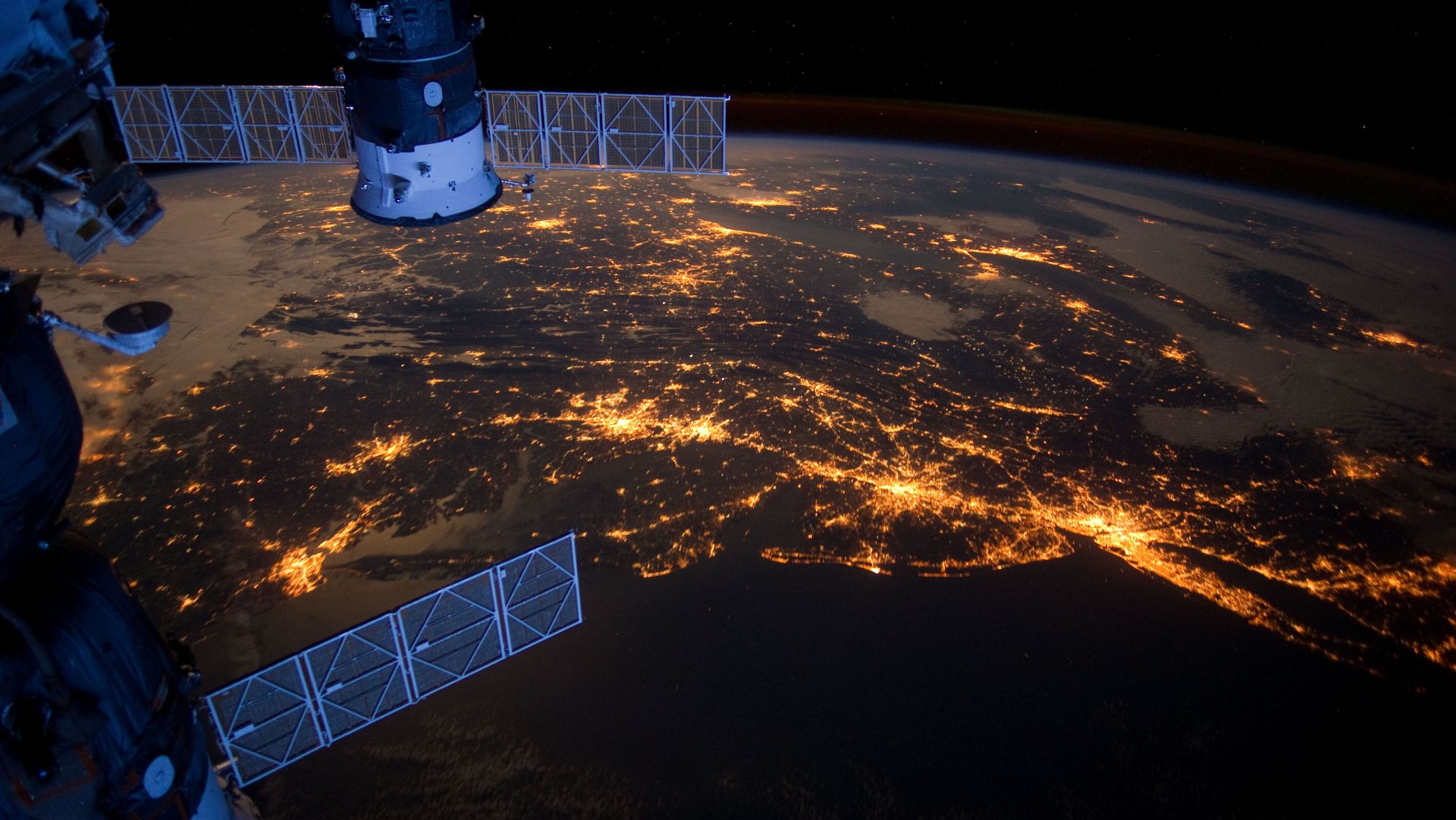
Photo: NASA via Reuters

I’ve spent the past 18 years working on climate policy in various venues. Why am I investing my time and energy into researching sunlight reflection, and specifically reflection from space?
Readers of SRM360 are familiar with the reasons to research sunlight reflection. For the past three years, it’s been clear to me that even with best-case emission reduction scenarios, the world faces dangerous warming and the risk of catastrophic tipping points. Sunlight reflection at a planetary scale would cool global average temperatures, and so I think it broadly warrants research and consideration.
But sunlight reflection from space, the planetary sunshade concept, gets very little attention. While there are many variations, this general version of the concept has emerged in the academic literature over the past 35 years. To cool global average temperatures by 1°C, you would need to reflect about 1% of incoming sunlight.
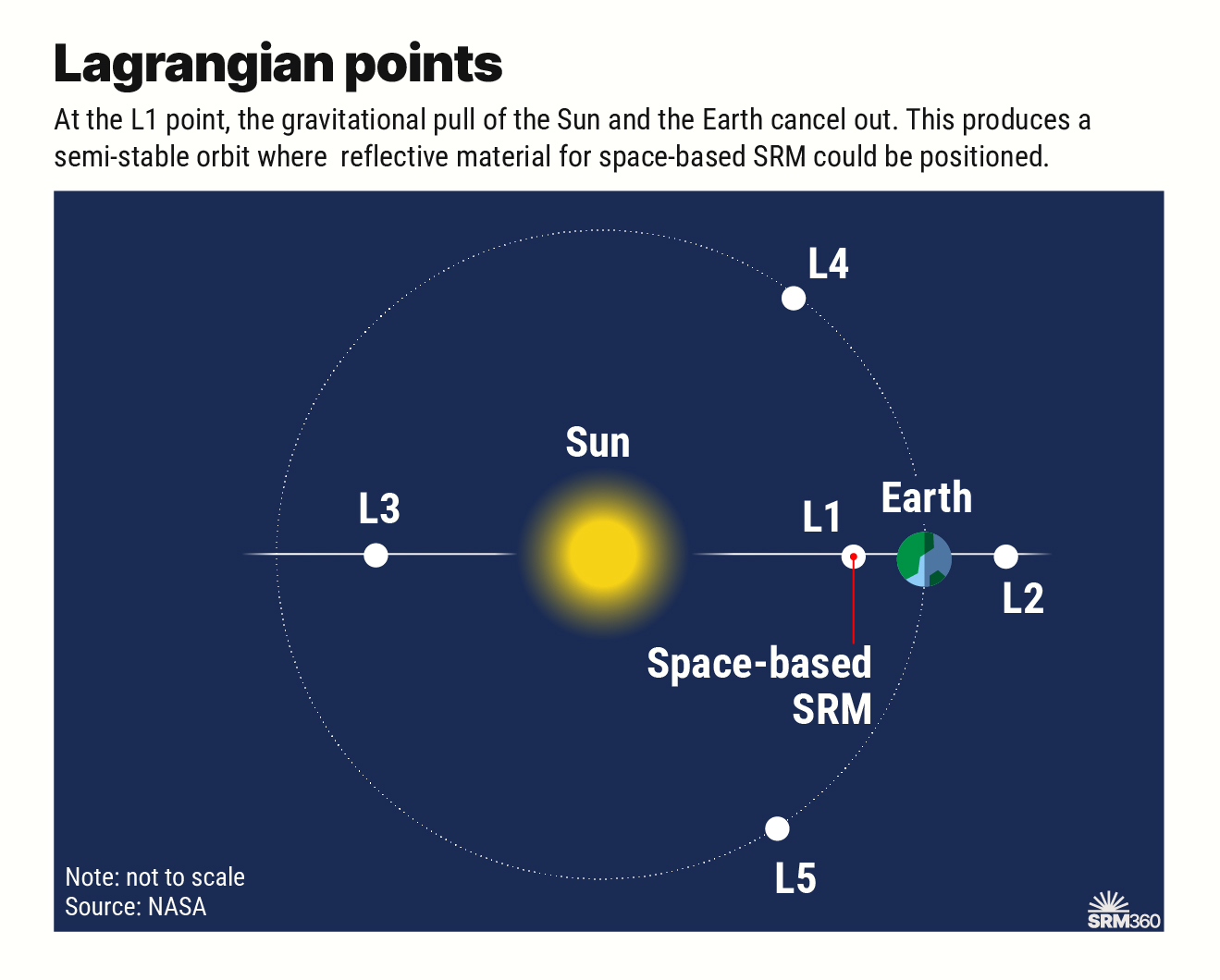
For structures in space to continuously reflect sunlight away from the earth, they must be located near the Sun-Earth Lagrange point, about 2 million km from earth, or about five times further than the moon. At this location, reflecting 1% of sunlight would require a total area of roughly 3 million km2 – almost the size of India. This could be achieved with a constellation of thousands of spacecraft, built mostly from huge reflective sheets of aluminum, all together weighing between 50 and 100 million metric tons.
These craft could maintain position using solar radiation pressure as thrust – essentially, using the momentum of photons from the Sun to have the sheets act as maneuverable sails. The shading on earth would be evenly distributed, and the sunshade would be invisible from earth, unless one used a fairly high-powered telescope.
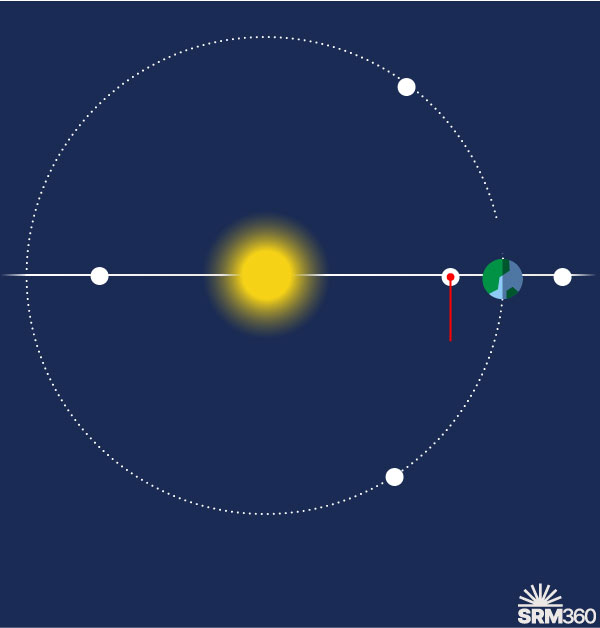
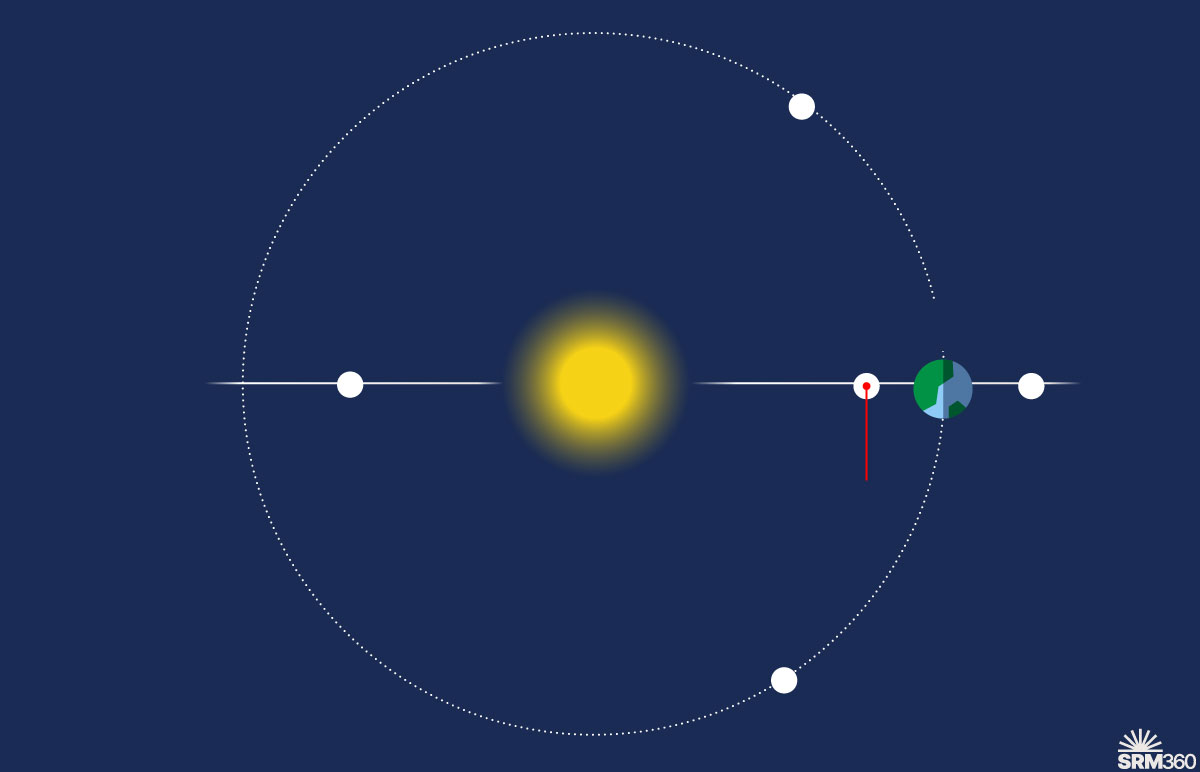
Lagrangian points
At the L1 point, the gravitational pull of the Sun and the Earth cancel out. This produces a semi-stable orbit where reflective material for space-based SRM could be positioned.
L4
Sun
Earth
L3
L1
L2
Space-based SRM
L5
Note: not to scale
Source: NASA
L4
Sun
Earth
L3
L1
L2
Space-based SRM
Note: not to scale
Source: NASA
L5
The physics are not in doubt, nor is the fact that this is a massive and costly project. However, the sunshade concept is often dismissed as too expensive to build, with most attention focused on near-term interventions. But should we dismiss this idea so quickly? I don’t think so. Here are the three main reasons why:
-
A planetary sunshade would be a long-term and persistent solution which would complement other near-term interventions.
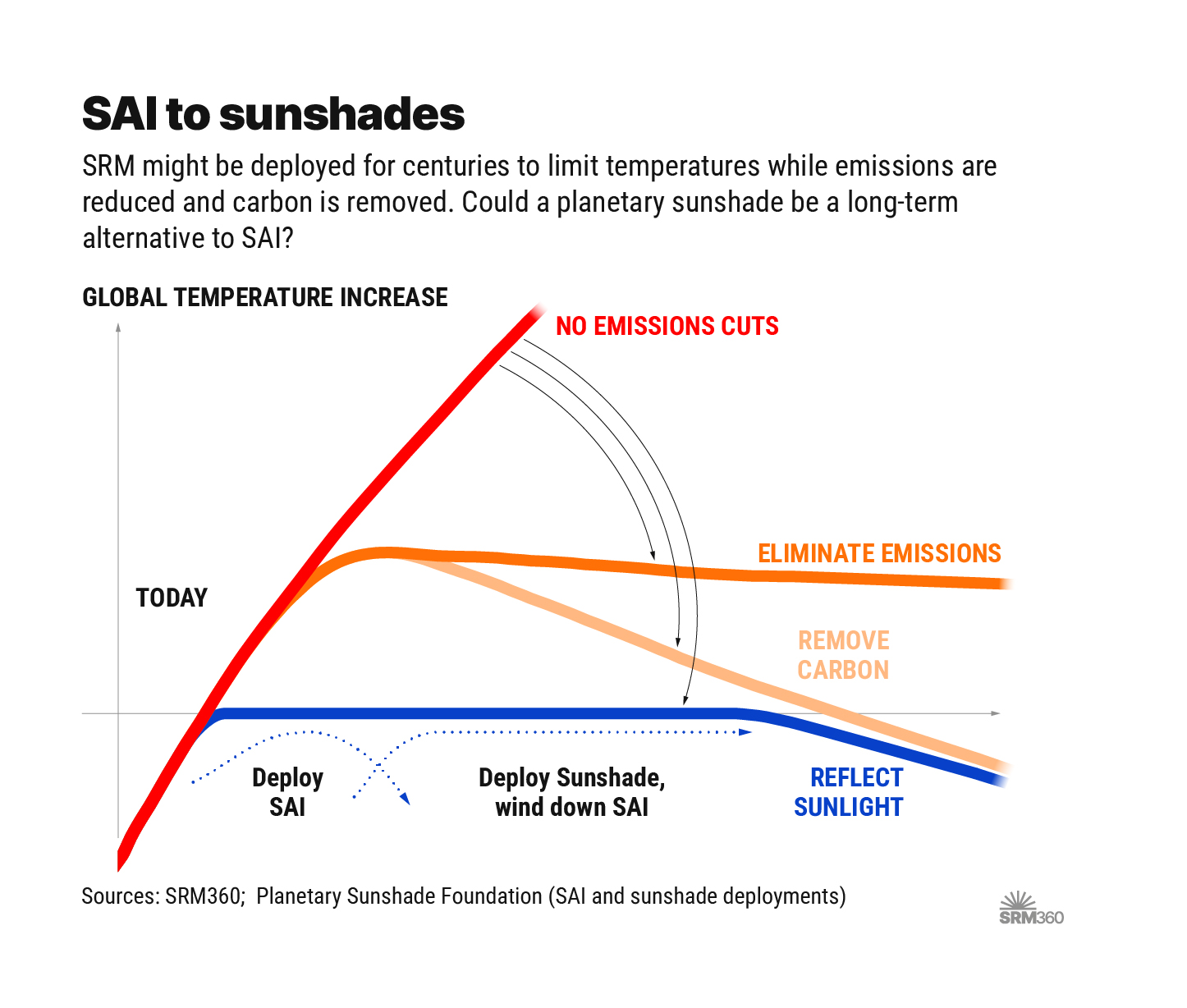
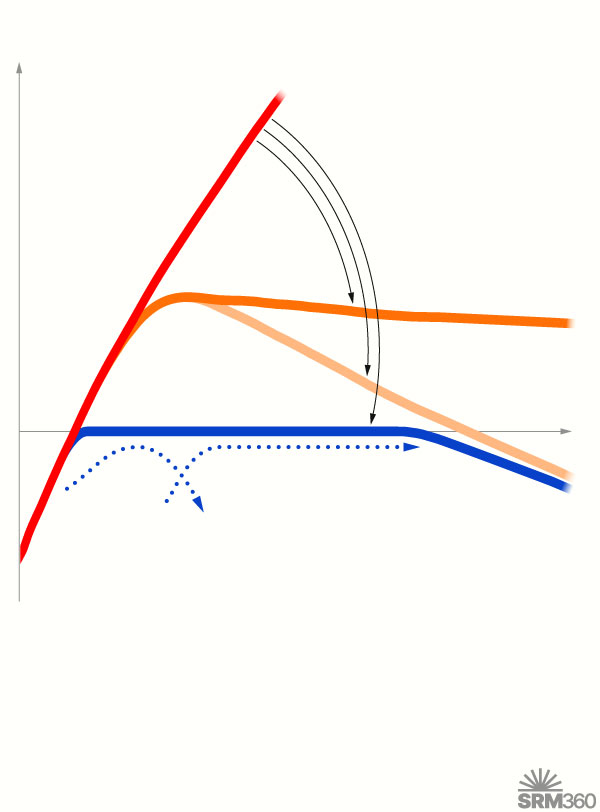
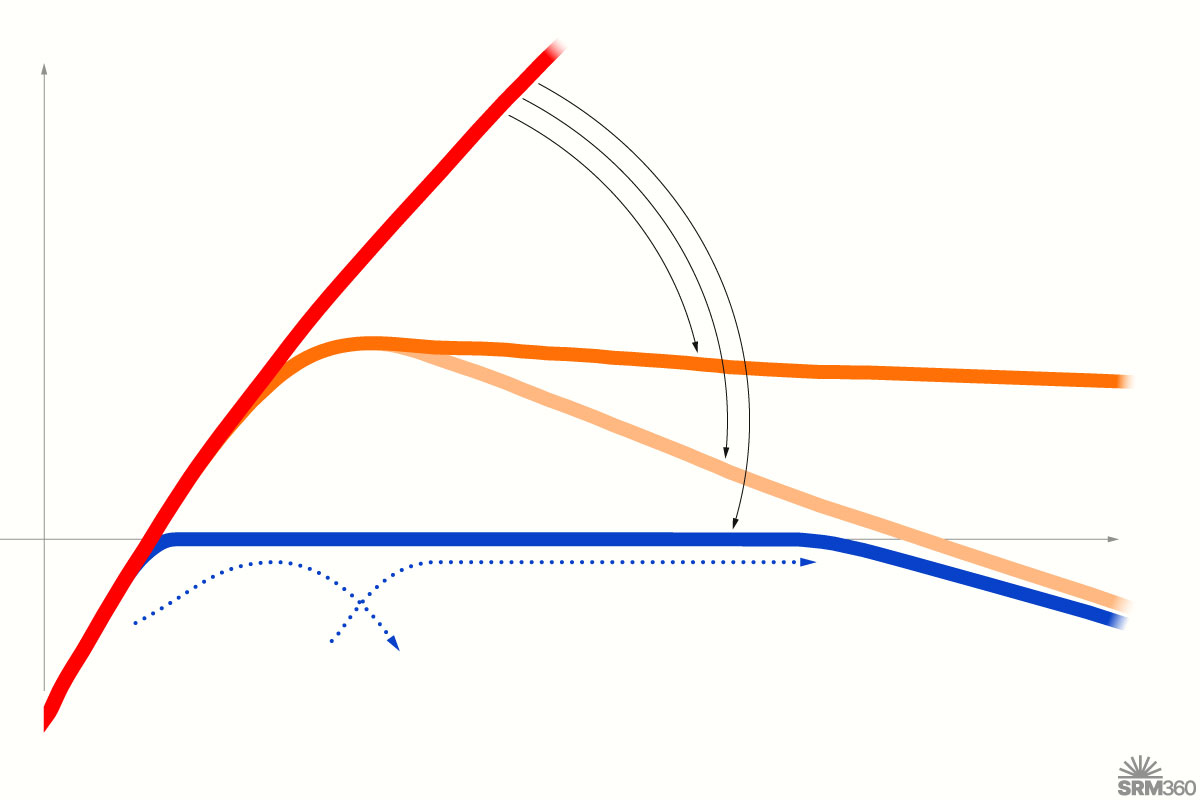
A planetary-scale climate intervention, often assumed as stratospheric aerosol injection (SAI), is at least a century-long endeavor, needed while emissions are slowly removed. Once begun, the world would face a dangerous termination shock if cooling stopped.
I think of the relationship between SAI and sunshades as a complimentary set of curves that fill in each other’s gaps and provide the option of redundancy over the next century. Having two planetary cooling mechanisms would be better than one.
SAI to sunshades
SRM might be deployed for centuries to limit temperatures while emissions are reduced and carbon is removed. Could a planetary sunshade be a long-term alternative to SAI?
GLOBAL TEMPERATURE INCREASE
NO EMISSIONS CUTS
ELIMINATE EMISSIONS
Today
REMOVE CARBON
Deploy SAI
Deploy Sunshade,
wind down SAI
REFLECT SUNLIGHT
Sources: SRM360; Planetary Sunshade Foundation (SAI and sunshade deployments)
GLOBAL TEMPERATURE INCREASE
NO emissions cuts
eliminate EMISSIONS
Today
REMOVE CARBON
Deploy SAI
Deploy Sunshade,
wind down SAI
REFLECT SUNLIGHT
Sources: SRM360; Planetary Sunshade Foundation (SAI and sunshade deployments)
-
A sunshade could achieve optimal global shading.
The geometry of a sunshade’s shadow, being larger than the Earth, creates evenly spaced shade across the globe. Furthermore, the sunshade could be positioned to provide more shading in the northern hemisphere in the northern summer, and more in the southern hemisphere in the southern summer, which could mimic or even improve upon proposed SAI deployments.
-
Space investment can be channeled into climate action.
The world invested over $600 billion in space in 2024 between commercial and government actors. As launches become cheaper and the infrastructure more developed, these numbers are expected to increase. Virtually all space investment contributes to capacity that makes a sunshade more feasible. The recent movement toward data centers in space, for example, only becomes profitable when basic materials can be sourced from lunar resources. The strategies that will make space endeavors more profitable will move humanity closer to sunshade capability.
Furthermore, a global decision to do sunlight reflection would both focus current space investment and also create new economic beneficiaries as space logistics, construction, and mining gain a massive customer. I see a sunshade as a strategy to align the emerging trillion-dollar space sector with the goal of a stable climate.
I am not so naive to think that a sunshade would be easy – it would be one of the most challenging projects humanity has ever undertaken, much like addressing climate change in general. In addition to sharing many of the challenges of SAI, a sunshade also faces:
- Cost: No matter how it would be built, it would be expensive – potentially in the range of 1–5 trillion dollars, though this is difficult to estimate because of unknowns in how the space sector’s capabilities will develop. While the builders would reap secondary economic benefits, footing the bill would need to be a centerpiece of a national policy for an actor like the US or China.
- Politics: The geopolitics of space are getting more complicated as China and the US race for supremacy in the space economy. A sunshade could be a peaceful collaboration, but it could also exacerbate tensions. A sunshade controlled by China would likely be seen as a threat to the US, and vice-versa. Is a joint agreement for SRM the only hope for a peaceful deployment?
- Law: The Outer Space Treaty is very strong by the standards of international law, but is currently being tested. A sunshade would test it further.
What will the next few years look like? Sunshade researchers should continue contributing to the larger SRM discussion, informing governance frameworks and policy scenarios. At the Planetary Sunshade Foundation, we will continue to convene researchers in this field, creating shared and transparent knowledge for the benefit of decision makers. We’ll represent the sunshade in discussions about how SRM might be governed. We will also continue to organize actors in the space sector who want to engage in climate action.
Let’s be clear: the world has not decided to do global sunlight reflection, nor is it obvious how such a decision could even be made. Given the uncertain state of the world’s political system, I think it’s safe to say that the future of planetary sunlight reflection will be far stranger than any of us can imagine.
But I remain hopeful that there is a path forward. As the Outer Space Treaty so eloquently states, “The exploration and use of outer space, including the moon and other celestial bodies, shall be carried out for the benefit and in the interests of all countries.” I can think of no greater benefit that space could bring to the world than preventing catastrophic climate tipping points.
The views expressed by Perspective writers and News Reaction contributors are their own and are not necessarily endorsed by SRM360. We aim to present ideas from diverse viewpoints in these pieces to further support informed discussion of SRM (solar geoengineering).