Perspective
Iceland and the AMOC: When Existence Is at Stake
Nordic countries are increasingly concerned about the potential collapse of a major system of ocean currents as the climate warms. Páll Gunnarsson of the Reykjavík Institute explores what Iceland’s recent statements on the issue mean for potential sunlight reflection methods (SRM) research leadership.
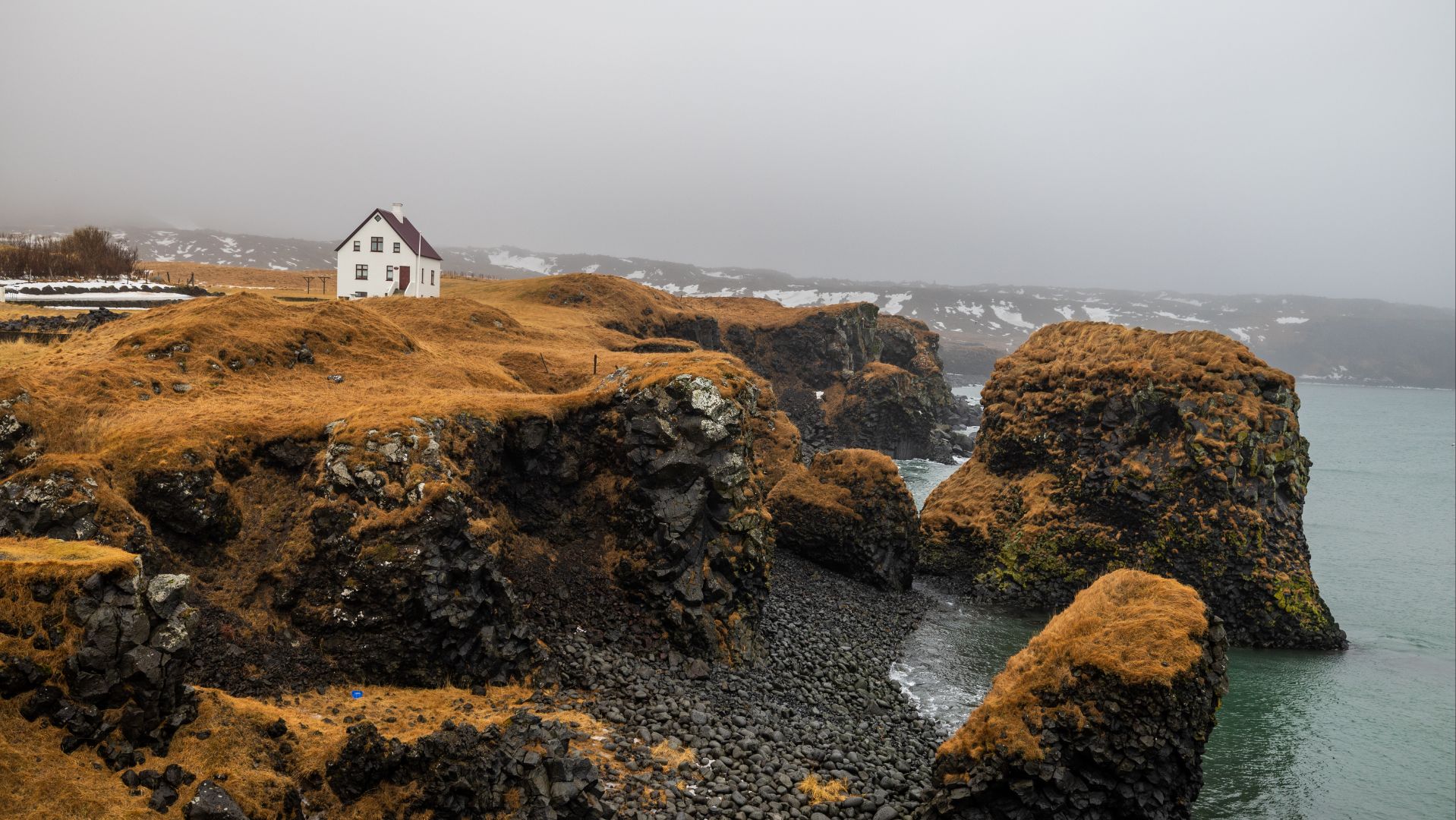
Arnarstapi, Iceland (Photo: Manuel Romano via Reuters Connect)

Iceland’s government has done something few governments have: it has formally elevated the risk of Atlantic Meridional Overturning Circulation (AMOC) collapse to a national security threat – and publicly communicated it as an existential one. The AMOC is a large system of ocean currents that brings warm water north towards Europe and helps shape the global climate. Its slowdown or collapse thanks to climate change would have widespread consequences.
As an Icelander working on AMOC risk governance, I want to speak directly to fellow Icelanders engaged in this issue, and to pose a question that I believe the broader SRM community also needs to grapple with.
Do we accept our government’s assessment? I do. The estimated tipping threshold for AMOC collapse starts as low as 1.4°C of global warming, and recent modelling suggests a 25–70% chance of collapse across emissions scenarios. Even a partial slowdown would reshape Nordic climate, energy systems, food security, and geopolitical stability.
But if we accept this assessment, it raises an uncomfortable question: does a nation facing an existential climate threat carry a different kind of responsibility in the international debate on response actions? And if it does, what does coherence between that position and our actual behaviour demand of us? If we say this is existential but engage with the caution and hedging of a country for which it is not, we do not just fail to act – we undermine the credibility of our own position.
Leveraging action from words
The experience of small island developing states (SIDS) offers both inspiration and a sobering lesson here. Facing existential threat from rising sea levels, SIDS leveraged their standing to achieve something remarkable at Paris in 2015: the adoption of the 1.5°C target, arguably beyond expectations at the time.
Yet a decade later, the world is nowhere near that trajectory, and SIDS still face the same threat – whether because of insufficient political will, or because the international community is already operating near the ceiling of viable mitigation effort. Either way, the result is the same: moral standing achieved an extraordinary commitment, but it did not deliver protection. Standing must be paired with demands where follow-through is within reach.
Can AMOC collapse be avoided?
Iceland is now in an analogous position, but with the benefit of that hindsight. The emerging AMOC response landscape is coalescing around three pillars: understanding socio-economic impacts, building early warning systems, and reducing the likelihood of collapse. It is the third where the question of agency is sharpest.
On reducing the likelihood of collapse, increased global mitigation ambition is essential – and that necessarily begins at home. Advocating internationally for what we are unwilling to pursue nationally cannot be taken seriously. Even under the most optimistic scenarios for any complementary intervention, accelerated decarbonisation remains the non-negotiable foundation for bringing risk below unacceptable levels. But a nation of 400,000 has very limited real agency over global emission trajectories – as the SIDS experience painfully illustrates.
This is where SRM research enters the picture – not as an alternative to mitigation, but as a question that demands an urgent answer. Recent modelling suggests that SRM could partially stabilise the AMOC, potentially enough to matter during the critical decades ahead.
But the evidence base is thin, and there is a troubling mismatch between timelines: some modelling indicates that only near-term deployment would have a meaningful stabilising effect, while best estimates for deployment readiness of SRM are one to two decades out. If SRM could work for this purpose, the window to act on that knowledge may already be closing. If it cannot, we need to know that quickly – so that all efforts and political capital can be concentrated where they will have the most effect.
Some will raise the concern of moral hazard – that pursuing SRM research gives the world an excuse to ease off on mitigation. The moral hazard argument is typically framed in abstract terms, as a concern about incentive structures. But viewed from the perspective of those most threatened, it amounts to something else: a doctrine of enforced vulnerability – keeping the most exposed populations at existential risk as a motivational tool.
Unfortunately, the results demonstrably show that enforced vulnerability has not driven sufficient action, as we have effectively agreed as an international community that low-lying Pacific Island nations will cease to geographically exist. And on the specific question of whether SRM research undermines mitigation ambition, the emerging empirical evidence is clear: multiple large-scale studies have found no detectable moral hazard effect from SRM awareness, with some suggesting that confronting the need for climate intervention may increase rather than diminish the perceived urgency of mitigation.
Leading the way
Iceland could realistically convene a coalition of like-minded nations and philanthropic funders to mount a concentrated effort to determine whether SRM could help stabilise the AMOC. The research agenda is specific enough to be actionable and the coalition small enough to be buildable. But this is not something Iceland can or should pursue in isolation. The pursuit of knowledge must be accompanied by the development of governance and regulatory frameworks that make responsible research possible – and that requires the understanding and engagement of the international community.
Iceland must continue to advocate, forcefully, for increased mitigation ambition – globally and at home. But is it wise – is it responsible – to stop there? Having declared AMOC collapse an existential threat, is it even credible for Iceland to then place all of our trust in a pathway we cannot control?
We owe it to our people to act in concert with the government’s assessment – to pursue every credible avenue with the urgency that an existential threat demands. At a time when international climate leadership is in short supply, Iceland’s government has stepped out onto the ice with a rare willingness to lead. Now the rest of us must step out with them.
And so the question we pose to the broader SRM community is this: if nations facing existential climate threats have standing to pursue answers, does the international community have an obligation to help build the conditions under which those answers can be responsibly found?
The views expressed by Perspective writers and News Reaction contributors are their own and are not necessarily endorsed by SRM360. We aim to present ideas from diverse viewpoints in these pieces to further support informed discussion of SRM (solar geoengineering).