Article
Would Stratospheric Aerosol Injection Disrupt the Monsoons?
Monsoons bring heavy rains to some tropical regions in summer as a result of seasonally shifting winds. Globally, billions of people rely on monsoon rains for agriculture, though these rains can also bring devastating floods. With climate change and air pollution already affecting monsoons, what impacts could stratospheric aerosol injection (SAI) have on them?
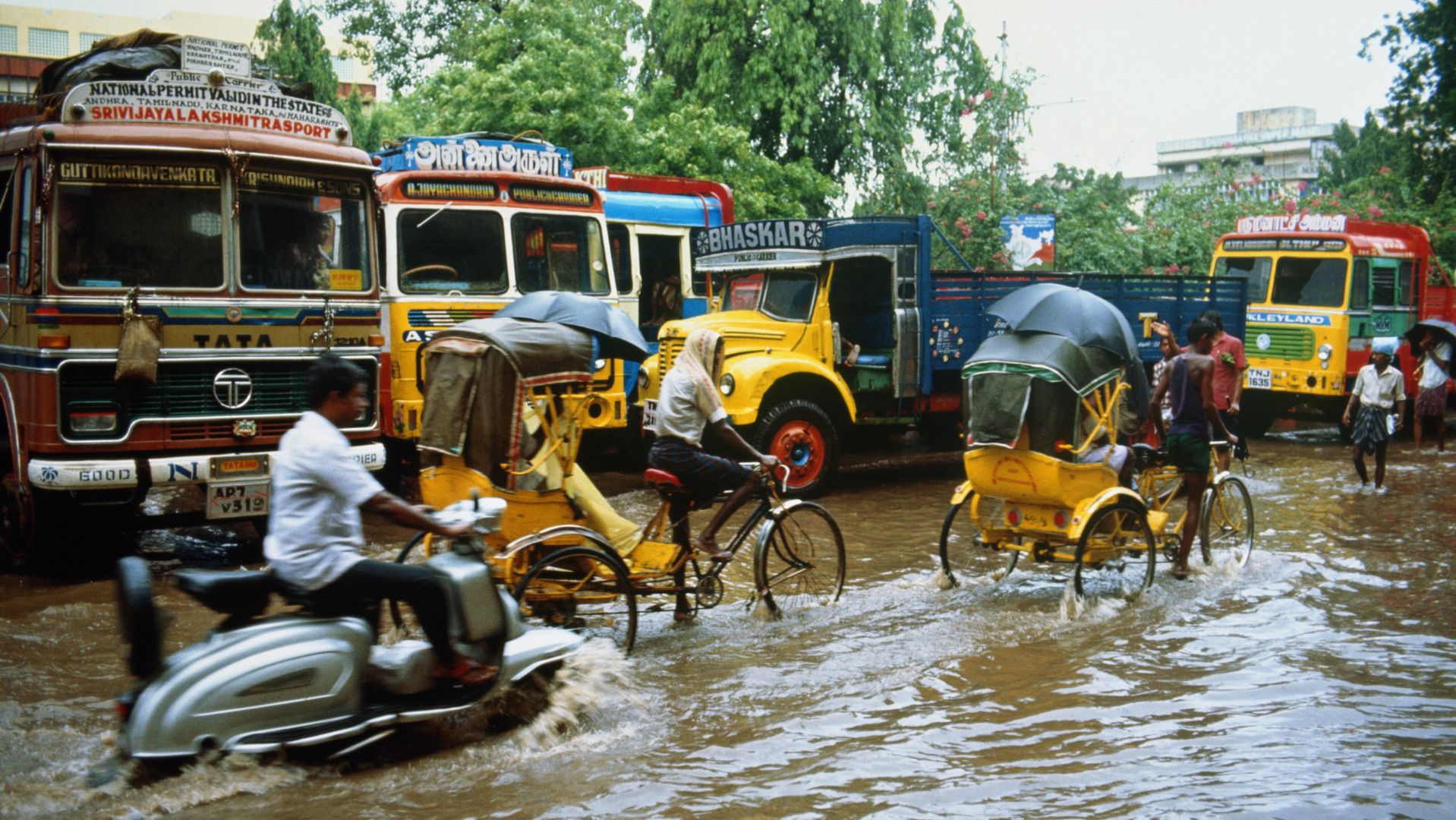
Traffic during monsoon floods in Chennai, India (Photo: Martin Puddy)

Key takeaways
- More than two-thirds of the world’s population lives in regions with monsoons.
- Warming due to climate change would generally strengthen monsoon rains, but the opposing effect of air pollution and other factors mean regional projections are very uncertain.
- SAI would generally weaken monsoon rains, but the net change would vary across regions and would depend on the combined effects of climate change, air pollution, and how SAI is deployed.
Between about 30° north and south of the equator, seasonal changes in wind direction have a significant influence on rainfall patterns in many tropical and subtropical regions. These regional circulation patterns, known as monsoons, drive distinct wet and dry seasons, unlike the hot and cold seasons farther from the equator.
More than two-thirds of people around the world live in regions affected by summer monsoon rainfall,1 which can provide upwards of 75 percent of annual rainfall in some regions.2
Critically, monsoons are already changing. Climate change and air pollution are affecting the intensity of their rainfall,3 potentially impacting agriculture as well as flood risks for billions of people.4 Could cooling from SAI reduce these changes, or might it introduce new uncertainties and potential disruptions?
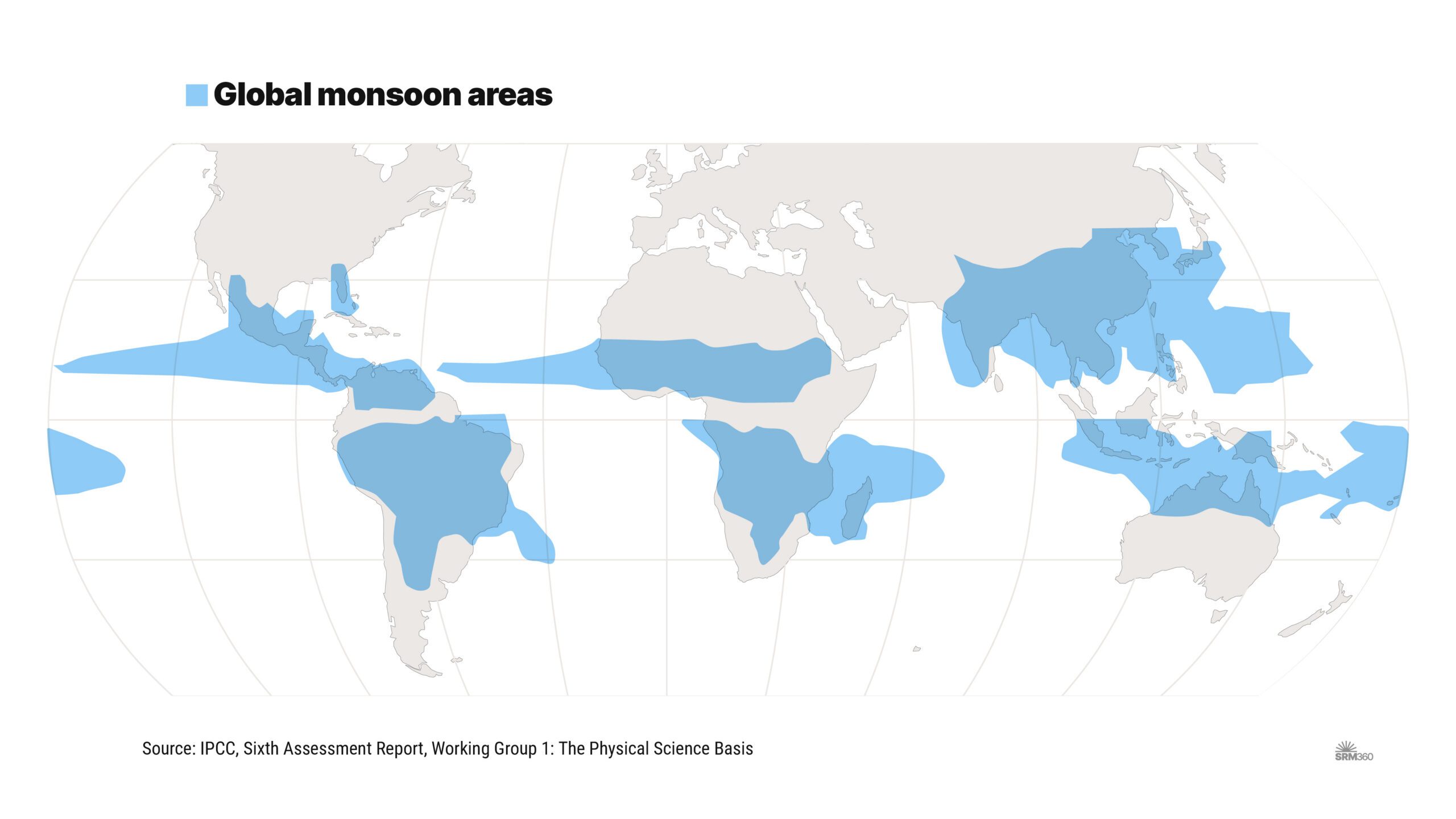
Regions with monsoons
This map shows which regions receive monsoon rainfall based on the IPCC’s “global monsoon” definition, which identifies areas receiving at least 2.5 mm more rainfall per day in summer than winter.
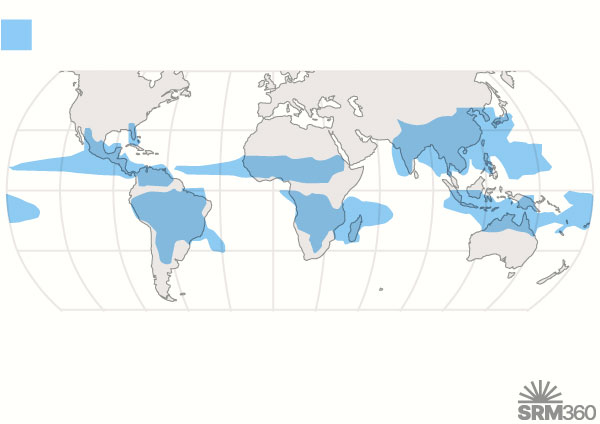
Global monsoon areas
Source: IPCC, Sixth Assessment Report, Working Group 1: The Physical Science Basis
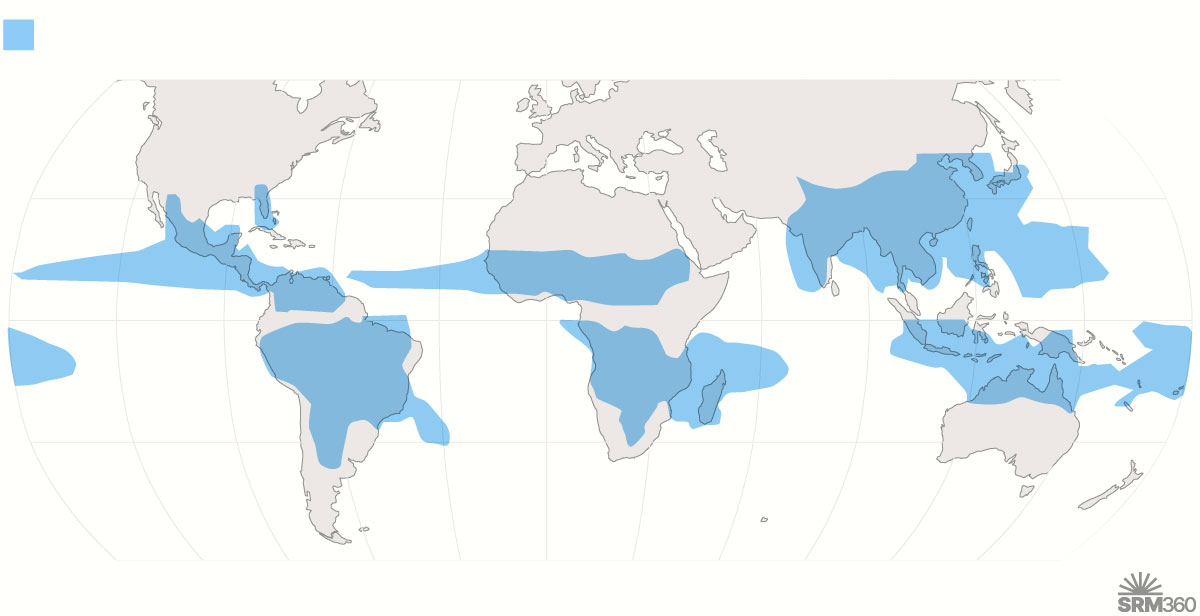
Global monsoon areas
Source: IPCC, Sixth Assessment Report, Working Group 1: The Physical Science Basis
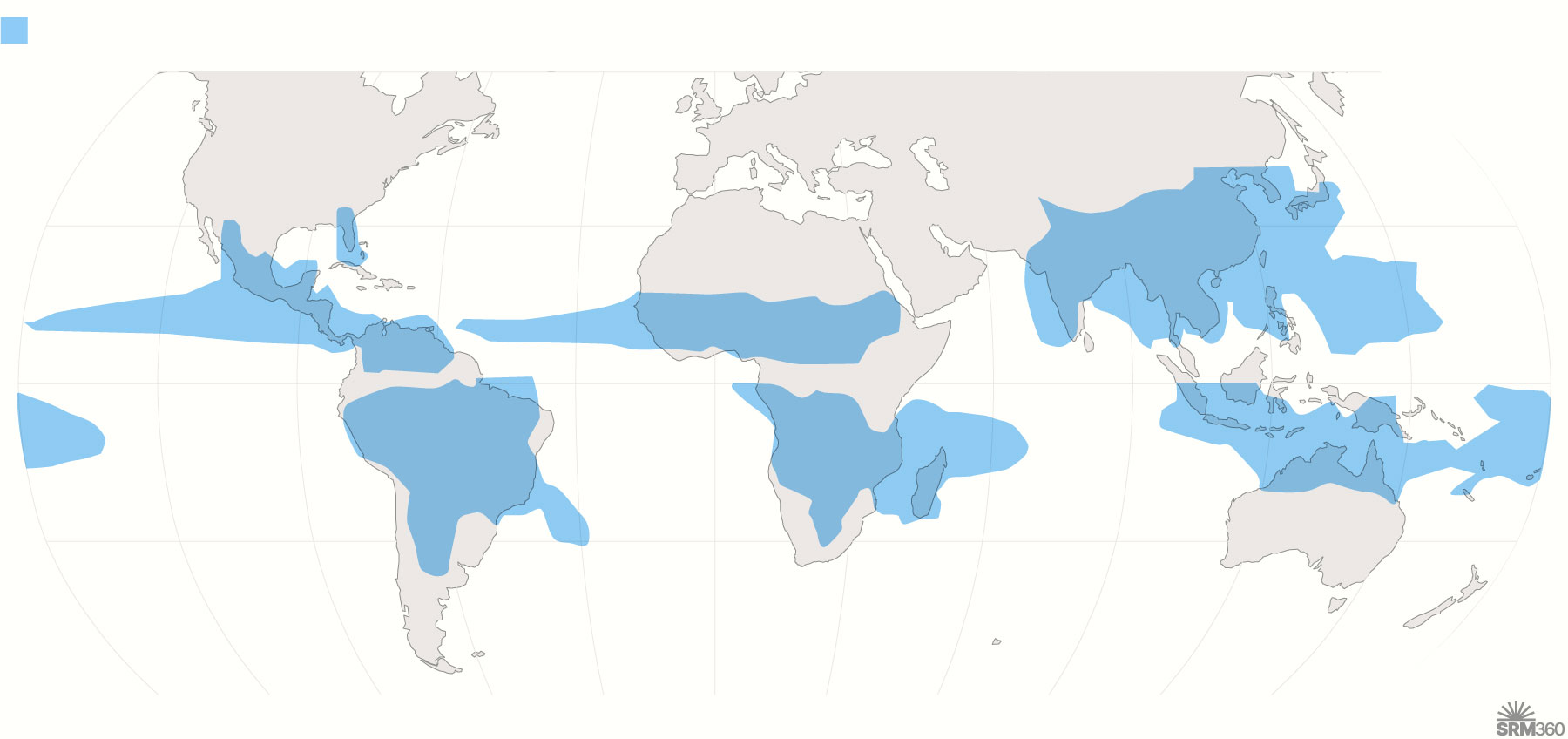
Global monsoon areas
Source: IPCC, Sixth Assessment Report, Working Group 1: The Physical Science Basis
What causes monsoons?
Monsoons are driven by seasonal changes in sunlight and tropical atmospheric circulation, with patterns shaped by the distribution of the continents.
The equator receives the most concentrated sunlight on Earth, causing intense heating that draws in trade winds from both the Northern and Southern Hemispheres to converge near this region. Where the trade winds meet, the warm, moist air rises, forming frequent large thunderstorms along a band known as the Intertropical Convergence Zone (ITCZ).
Seasonal shifts in the ITCZ are tightly linked to the formation of monsoons. As the Northern Hemisphere warms from March to September, the ITCZ moves northwards, bringing monsoon rain to India, China, and other places in the Northern Hemisphere. As the seasons switch, the ITCZ rain band shifts southwards. The contrast in temperatures between land and sea, as well as land features such as mountains, also contribute to the distribution and dynamics of monsoons.2
Monsoons generally occur on a predictable seasonal cycle. However, due to natural variability, monsoon rains are sometimes weaker than normal, leading to drought. This is not a new phenomenon – in fact, monsoon-related droughts have been documented in ancient literature.5
Human impacts on an enduring pattern
Climate change is generally expected to increase monsoon rainfall, primarily because a warmer atmosphere can hold more water vapour.1 This projection aligns with observed trends that show that monsoon rains across the world have become more intense as temperatures continue to rise.6
Rising temperatures could also alter the duration of tropical rainy seasons. Research suggests that monsoon seasons in most regions will become longer as temperatures increase, but those in the Americas may shorten.1
Other human activity also can affect monsoons. Tiny particles from air pollution and natural sources, known as aerosols, have complex impacts on the climate, including on monsoon rainfall.3 Because they have a cooling effect overall and are primarily emitted in the highly populated Northern Hemisphere, aerosol pollution has cooled the Northern Hemisphere and shifted the ITCZ southwards.7 Aerosol pollution has also had a larger cooling effect on land in summer, reducing the seasonal contrast in temperature between land and ocean, limiting monsoon development and rainfall.7,8
Would SAI decrease monsoon rains?
Many studies indicate that SAI deployed to offset future global warming could lead to a reduction in monsoon rainfall compared to current levels; in other words, it could more than offset the increase in monsoon rainfall that global warming is expected to bring.4,9 However, the impacts of SAI on monsoon rains would vary by region and depend on how it is implemented and how greenhouse gas emissions change in the future.10
To avoid causing shifts in the ITCZ and to minimise accompanying disruptions to monsoons, an SAI deployment would need to be roughly symmetrical across the hemispheres, meaning a similar amount of aerosols would need to be injected north and south of the equator.4 An SAI programme that targeted each hemisphere only during its winter season could increase the summer monsoon rainfall, though it could have some unintended effects like the disruption of winter rainfall.11
Even with a symmetrical deployment, SAI would generally make wet regions of the tropics drier and dry regions wetter by altering circulation patterns through its warming effect on the lower stratosphere.12
In the world’s most populous country, India, studies have differed on what an SAI deployment would mean for the monsoons. Some modelling finds that SAI deployed to offset future warming could decrease both average and extreme monsoon rainfall relative to expected levels under climate change alone this century, with significant implications for floods, droughts, and agriculture.13 Other results show a different response, with India getting wetter overall with SAI deployment.14
In mainland Southeast Asia, SAI could reduce overall and extreme rainfall across much of the region, though some areas may receive more rainfall.15 Another study finds that SAI deployed near the equator may cause no more drying across Asia than would occur from reductions in greenhouse gas emissions.16
In short, the effects of SAI on monsoons would be complicated and depend strongly on future greenhouse gas emissions, air pollution, and how SAI is deployed. SAI would not simply reverse the effects of global warming, and many uncertainties remain.
Open questions
- What impact would future reductions in air pollution have on monsoon rainfall?
- Which scenarios of climate change, air pollution, and SAI deployment should be studied to produce detailed assessments of the potential impacts on monsoons?
- How could marine cloud brightening or other SRM approaches impact monsoon rainfall?

Endnotes
- Moon S, Ha KJ. (2020). Future changes in monsoon duration and precipitation using CMIP6. npj Climate and Atmospheric Science. 3(1):45. https://doi.org/10.1038/s41612-020-00151-w
- Geen R, Bordoni S, Battisti DS, Hui K. (2020). Monsoons, ITCZs, and the concept of the global monsoon. Reviews of Geophysics. 58(4):e2020RG000700. https://doi.org/10.1029/2020RG000700
- IPCC. (2021). Technical Summary. In: Climate Change 2021 – The Physical Science Basis: Working Group I Contribution to the Sixth Assessment Report of the Intergovernmental Panel on Climate Change. Cambridge: Cambridge University Press. p. 35–144. https://doi.org/10.1017/9781009157896.002
- Ricke K, Wan JS, Saenger M, Lutsko NJ. (2023). Hydrological consequences of solar geoengineering. Annual review of earth and planetary sciences. 51:447-70. https://doi.org/10.1146/annurev-earth-031920-083456
- Kathayat G, Sinha A, Breitenbach SF, et al. (2022). Protracted Indian monsoon droughts of the past millennium and their societal impacts. Proceedings of the National Academy of Sciences. 119(39):e2207487119. https://doi.org/10.1073/pnas.2207487119
- Zeng J, Zhang Q. (2020). The trends in land surface heat fluxes over global monsoon domains and their responses to monsoon and precipitation. Scientific reports. 10(1):5762. https://doi.org/10.1038/s41598-020-62467-0
- Li Z, Lau WM, Ramanathan V, et al. (2016). Aerosol and monsoon climate interactions over Asia. Reviews of geophysics. 54(4):866-929. https://doi.org/10.1002/2015RG000500
- Dave P, Bhushan M, Venkataraman C. (2017). Aerosols cause intraseasonal short-term suppression of Indian monsoon rainfall. Scientific Reports. 7(1):17347. https://doi.org/10.1038/s41598-017-17599-1
- Xavier A, Bala G, Roose S, Kh U. (2024). An investigation of the relationship between tropical monsoon precipitation changes and stratospheric sulfate aerosol optical depth. Oxford Open Climate Change. 4(1):kgae016. https://doi.org/10.1093/oxfclm/kgae016
- Krishnamohan KS, Bala G. (2022). Sensitivity of tropical monsoon precipitation to the latitude of stratospheric aerosol injections. Climate Dynamics. 59(1):151-68. https://doi.org/10.1007/s00382-021-06121-z
- Kallihosur T, Bala G. (2026). Impact of stratospheric aerosol geoengineering implemented only in the winter hemispheres on the ITCZ and tropical monsoon regions. Environmental Research: Climate. 5(3):035020. https://doi.org/10.1088/2752-5295/ae7200
- Simpson IR, Tilmes S, Richter JH, et al. (2019). The regional hydroclimate response to stratospheric sulfate geoengineering and the role of stratospheric heating. Journal of Geophysical Research: Atmospheres. 124(23):12587-616. https://doi.org/10.1029/2019JD031093
- Asutosh A, Tilmes S, Bednarz EM, Fadnavis S. (2025). South Asian Summer Monsoon under stratospheric aerosol intervention. npj Climate and Atmospheric Science. 8(1):3. https://doi.org/10.1038/s41612-024-00875-z
- Richter JH, Visioni D, MacMartin DG, et al. (2022). Assessing Responses and Impacts of Solar climate intervention on the Earth system with stratospheric aerosol injection (ARISE-SAI): protocol and initial results from the first simulations. Geoscientific Model Development. 15(22):8221-43. https://doi.org/10.5194/gmd-15-8221-2022
- Narenpitak P, Kongkulsiri S, Tomkratoke S, Sirisup S. (2024). Regional impacts of solar radiation modification on surface temperature and precipitation in Mainland Southeast Asia and the adjacent oceans. Scientific Reports. 14(1):22713. https://doi.org/10.1038/s41598-024-73149-6
- He C, Peng Y, Yu P. (2025). Stratospheric aerosol injection does not cause stronger Asian monsoon drying than greenhouse gas mitigation. Environmental Research Letters. 20(12):124041. https://doi.org/10.1088/1748-9326/ae2282
We thank Govindasamy Bala for reviewing an earlier draft of this article.