Article
Mixed-Phase Cloud Thinning
Mixed-phase cloud thinning is an idea to artificially modify polar clouds in order to lower temperatures in the rapidly warming polar regions. The clouds are complicated, with more work needed to understand them, and this idea remains firmly at the conceptual stage. What is the potential for this novel solar geoengineering concept?

Photo: Science Photo Library


Key takeaways
- Mixed-phase clouds contain a combination of ice crystals and supercooled liquid water, and play an important climatic role in polar regions.
- Seeding mixed-phase clouds with tiny particles could turn more of the liquid to ice and thin them out, potentially decreasing their ability to trap heat.
- These clouds are more complex than other types of cloud, and their variability might make a thinning programme difficult to conduct.
In 1946, scientists at General Electric were studying how ice formed on the wings of aircraft when they made an interesting discovery. They found that if they seeded a cloud containing supercooled droplets – below the freezing point but still stuck in liquid form – with dry ice (solid carbon dioxide), they could turn some of the water droplets into new ice crystals. As ice crystals are substantially larger than the droplets, they fall out of the cloud sooner. This marked the birth of 80 years of cloud seeding research and deployment.
Primarily used as a method to induce a bit more precipitation from clouds, cloud seeding is now in use in some form in at least 50 countries. It often involves using small amounts of silver iodide as a “nucleation” particle, allowing ice to form around it inside the cloud. That basic concept, of seeding clouds in order to change their properties, may have another use: it could potentially thin out mixed-phase clouds to reduce the amount of heat they trap.
This concept, known as mixed-phase cloud thinning (MCT), might offset some of the warming caused by increasing greenhouse gas concentrations, though only under certain conditions.
Mixed-phase cloud thinning
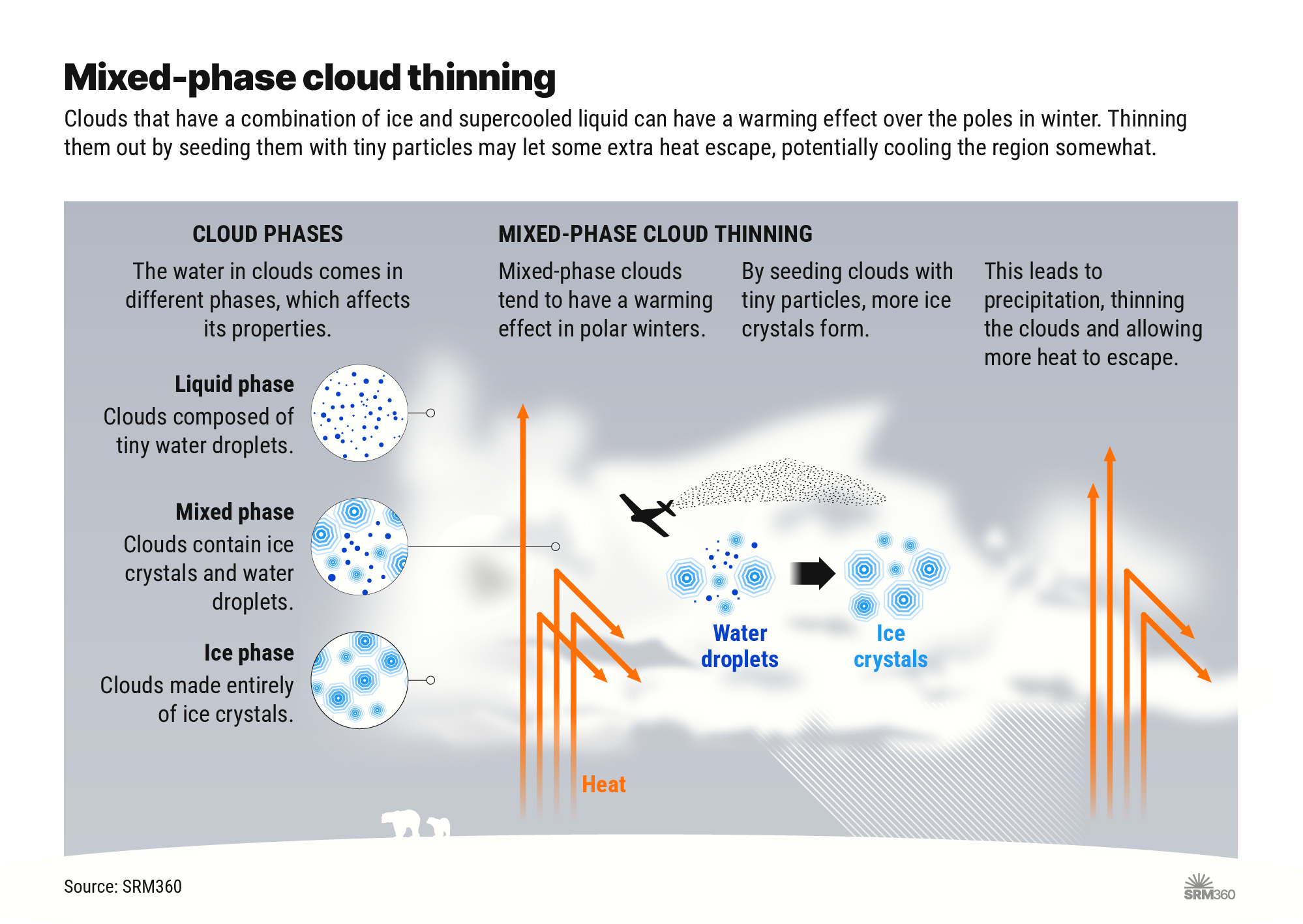
Clouds that have a combination of ice and supercooled liquid tend to have a warming effect over the poles in winter. Thinning them out by seeding them with tiny particles may let some extra heat escape, potentially cooling the region somewhat.
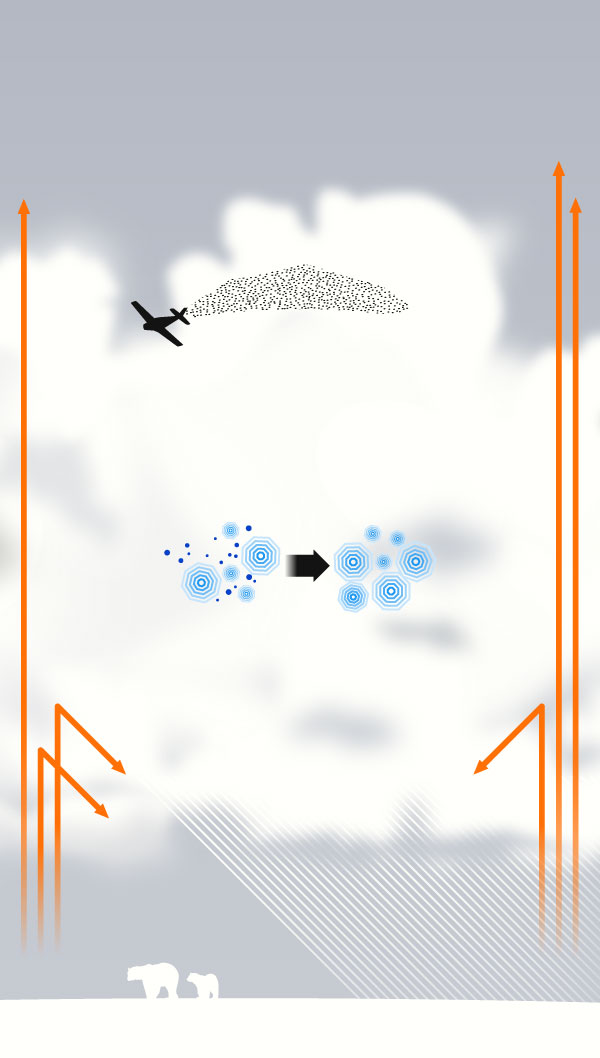
Mixed-phase clouds contain ice crystals and water droplets. They tend to have a warming effect in polar winters.
By seeding clouds with tiny particles, more ice crystals form.
Water droplets
Ice crystals
This leads to precipitation, thinning the clouds and allowing more heat to escape.
Heat
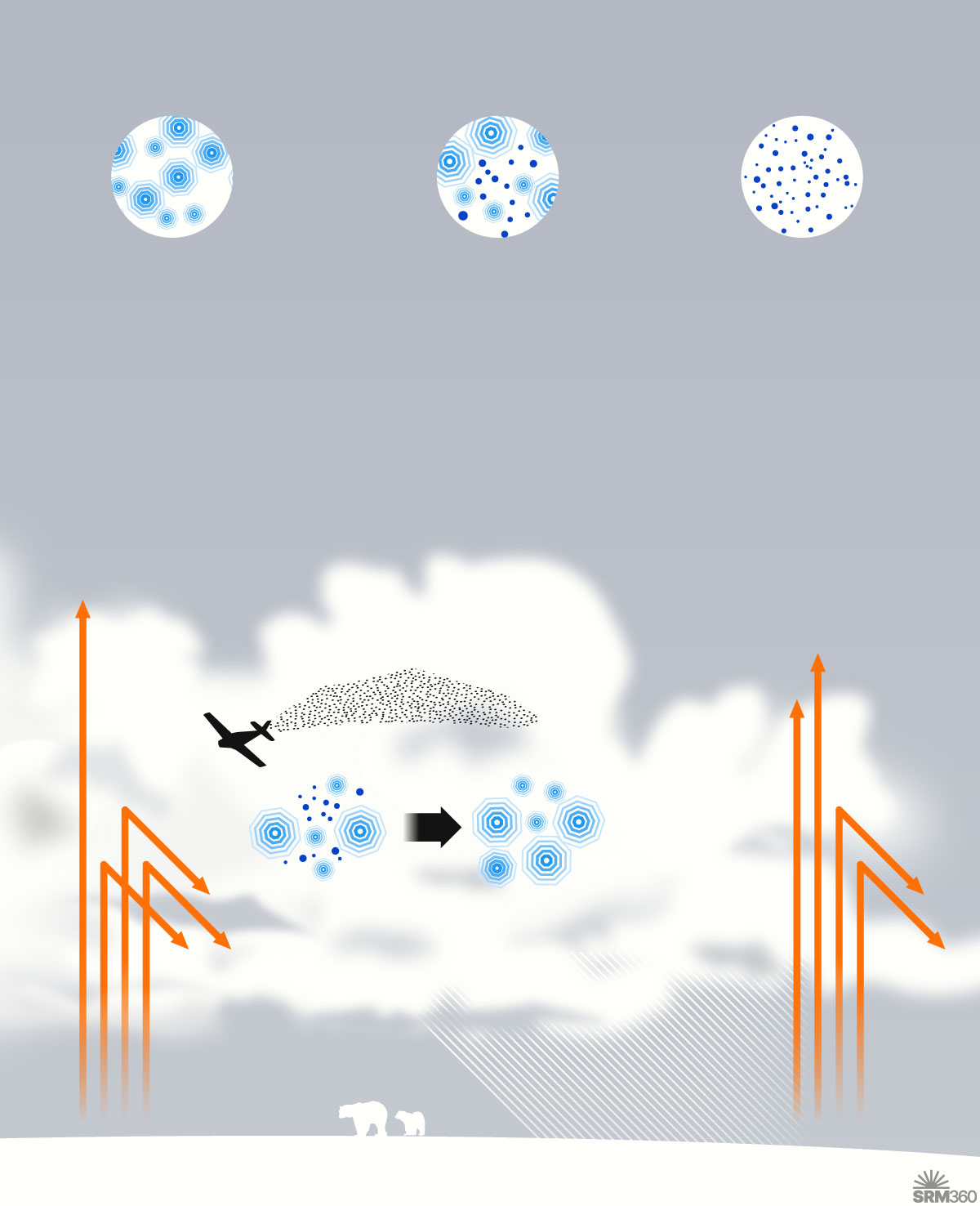
Cloud Phases
The water in clouds comes in different phases, which affects its properties.
Mixed phase
Clouds contain ice crystals and water droplets.
Ice phase
Clouds made entirely of ice crystals.
Liquid phase
Clouds composed of tiny water droplets.
MIXED-PHASE CLOUD THINNING
Mixed-phase clouds tend to have a warming effect in polar winters.
By seeding clouds with tiny particles, more ice crystals form.
This leads to precipitation, thinning the clouds and allowing more heat to escape.
Water droplets
Ice crystals
Heat
Source: SRM360
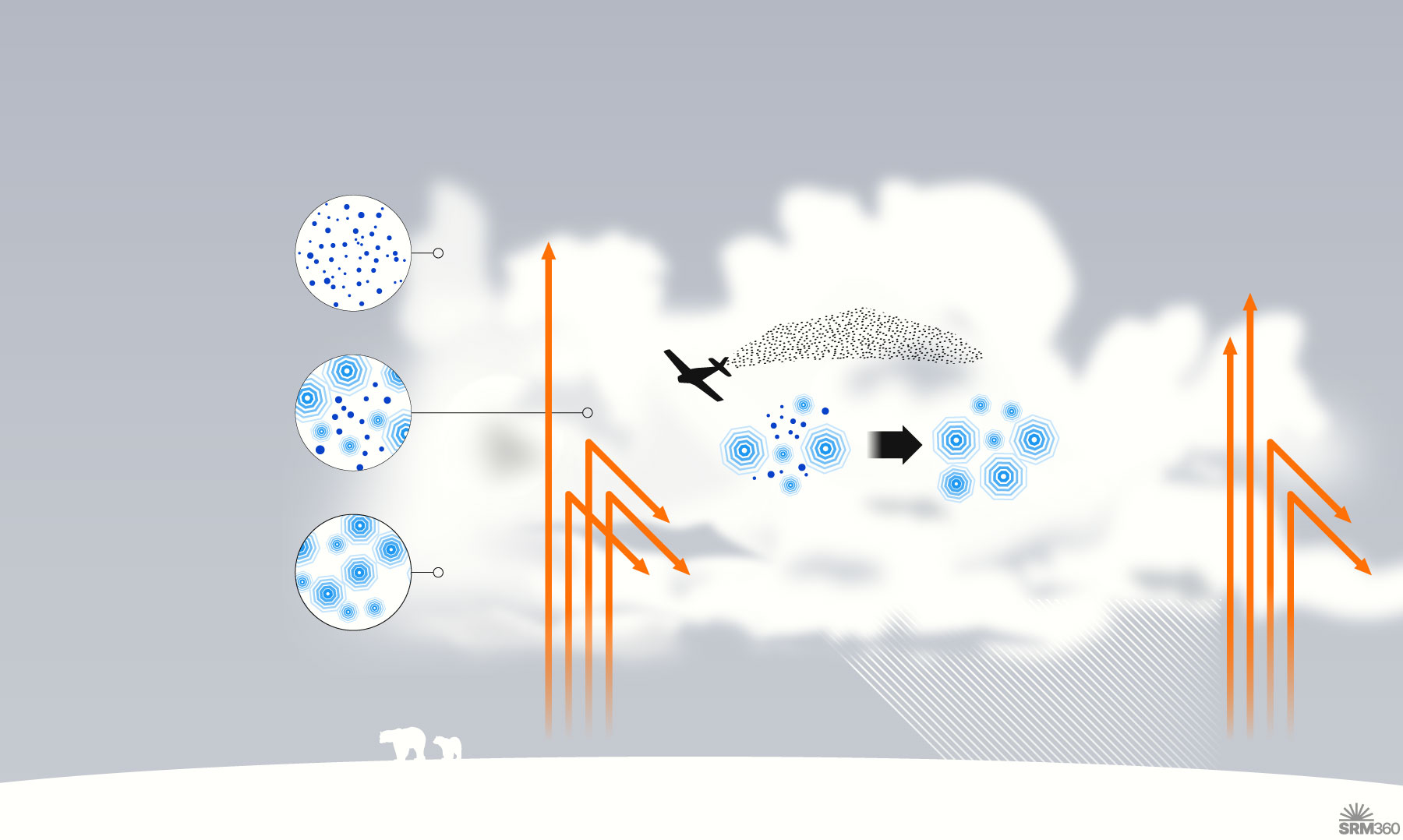
Cloud Phases
MIXED-PHASE CLOUD THINNING
The water in clouds comes in different phases, which affects its properties.
Mixed-phase clouds tend to have a warming effect in polar winters.
By seeding clouds with tiny particles, more ice crystals form.
This leads to precipitation, thinning the clouds and allowing more heat to escape.
Liquid phase
Clouds composed of tiny water droplets.
Mixed phase
Clouds contain ice crystals and water droplets.
Water droplets
Ice crystals
Ice phase
Clouds made entirely of ice crystals.
Heat
Source: SRM360
Mixed-phase clouds have varying climate effects
Different types of clouds can have different effects on the climate. For example, cirrus clouds are thin and exist high up in the atmosphere and generally act to trap heat below them. Lower down, marine stratocumulus clouds are thicker, and have a cooling effect by reflecting sunlight back into space.
As the name implies, mixed-phase clouds have varied compositions and effects, incorporating a mix of ice and water that can either trap or reflect more heat depending on a variety of factors. For most of the year, they have an overall cooling effect, but during polar winters, they have more of a warming effect.1
MCT joins a growing list of solar geoengineering approaches that could modify clouds as a way to lower temperatures and offset some of the impacts of warming. Thinning high cirrus clouds could allow more heat to escape, while marine cloud brightening could make low-lying ocean clouds reflect more sunlight back into space.
Researchers have suggested that seeding specifically those mixed-phase clouds that are trapping heat at the poles during the winter months could thin them out and produce a regional cooling effect.2 At scale, this might help reduce the loss of sea ice in the Arctic and around Antarctica.
Potential to offset Arctic and Antarctic warming
The polar regions are warming faster than the rest of the world – as much as four times faster in recent decades.3 Melting on the Greenland and Antarctic ice sheets has been accelerating, with the potential to raise global sea levels significantly. The ongoing melting of sea ice, meanwhile, drives a critical feedback loop: the darker ocean absorbs heat instead of reflecting it like the white ice, which means melting creates more warming, which leads to more melting, and so on.
By focusing on mixed-phase clouds over both the Arctic and the Southern Oceans, MCT might be able to limit polar climate change and its impacts. Compared to other solar geoengineering ideas like stratospheric aerosol injection, it could only offset a modest amount of warming, but it would target a key area.
One study estimated that an optimised MCT programme could offset a significant portion of the expected warming in the polar regions, helping to slow sea ice loss.2
Many unknowns remain
The primary challenge of MCT lies in the complexity of the clouds in question, which makes accurate computer models of their responses a critical and difficult issue. Studies have found that the ratio of ice and liquid, crucial to determining the efficacy of MCT, can vary significantly even inside a single cloud.4–6
Scientists’ understanding of mixed-phase clouds has improved in recent years, with field experiments like CLOUDLAB in Switzerland studying how the clouds respond to seeding. However, they are still more complex than other types of clouds, including the cirrus and low-lying marine clouds that could be targeted by other forms of solar geoengineering.
The variability of these clouds suggests that picking and choosing where to seed would be a critical part of any MCT programme, and more work still needs to be done on the clouds’ responses to seeding.7 There has also not yet been a detailed technical analysis of what MCT deployment would look like in practice: how would the particles be delivered into mixed-phase clouds, and at what cost to achieve substantial cooling?
Scientists are also still exploring which particles might be best suited for MCT. While silver iodide is widely used in cloud seeding efforts and could be applied, there are ecological concerns with its widespread application.8 Naturally occurring particles including mineral dust could also work, though the optimal particle is not yet clear.2
Even if these scientific and technical challenges can be resolved, MCT would be a relatively limited form of solar geoengineering. The total cooling possible is not nearly as large as other methods and the concept would likely work best only in the polar regions, though it may still play a useful role there.2
Research into MCT is at a relatively early stage and plenty of questions about its feasibility and consequences remain. More computer modelling research, outdoor experiments, observations of natural processes, and engineering assessments will be needed to determine whether MCT is a viable solar geoengineering approach.
Open questions
- Can the appropriate clouds for MCT be reliably identified given their variability?
- Could MCT’s effects be substantial enough to pursue a large-scale deployment?
- What impact might MCT have on local rain and snowfall?

Endnotes
- Matus AV, L’Ecuyer TS. (2017). The role of cloud phase in Earth’s radiation budget. Journal of Geophysical Research: Atmospheres. 122(5):2559-78. https://doi.org/10.1002/2016JD025951
- Villanueva D, Possner A, Neubauer D, et al. (2022). Mixed-phase regime cloud thinning could help restore sea ice. Environmental Research Letters, 17(11). https://doi.org/10.1088/1748-9326/aca16d
- Rantanen M, Karpechko AY, Lipponen A, et al. (2022). The Arctic has warmed nearly four times faster than the globe since 1979. Communications Earth & Environment, 3(168). https://doi.org/10.1038/s43247-022-00498-3
- D’Alessandro JJ, McFarquhar GM, Wu W, et al. (2021). Characterizing the occurrence and spatial heterogeneity of liquid, ice and mixed phase low-level clouds over the Southern Ocean using in situ observations acquired during SOCRATES. Journal of Geophysical Research: Atmospheres, 126, e2020JD034482. https://doi.org/10.1029/2020JD034482
- Dammann SLS, Schäfer B, David RO, Storelvmo T. (2025). Observations and model simulations of phase heterogeneity in Arctic clouds. Journal of Geophysical Research: Atmospheres, 130, e2024JD042714. https://doi.org/10.1029/2024JD042714
- Korolev A, Milbrandt J. (2022). How are mixed-phased clouds mixed? Geophysical Research Letters, 49(18). https://doi.org/10.1029/2022GL099578
- Eirund GK, Possner A, Lohmann U. (2019). Response of Arctic mixed-phase clouds to aerosol perturbations under different surface forcings. Atmospheric Chemistry and Physics. 19(15):9847-64. https://doi.org/10.5194/acp-19-9847-2019
- Fajardo C, Costa G, Ortiz LT, et al. (2016). Potential risk of acute toxicity induced by AgI cloud seeding on soil and freshwater biota. Ecotoxicology and environmental safety. 133:433-41. https://doi.org/10.1016/j.ecoenv.2016.06.028