News Article
Two Conferences Highlight a Transatlantic Divide on SRM
In Chicago and then Brussels, events on varying aspects of sunlight reflection methods (SRM), or solar geoengineering, demonstrated a degree of disconnect within the field. We asked some who were in both rooms what stood out and what it means.
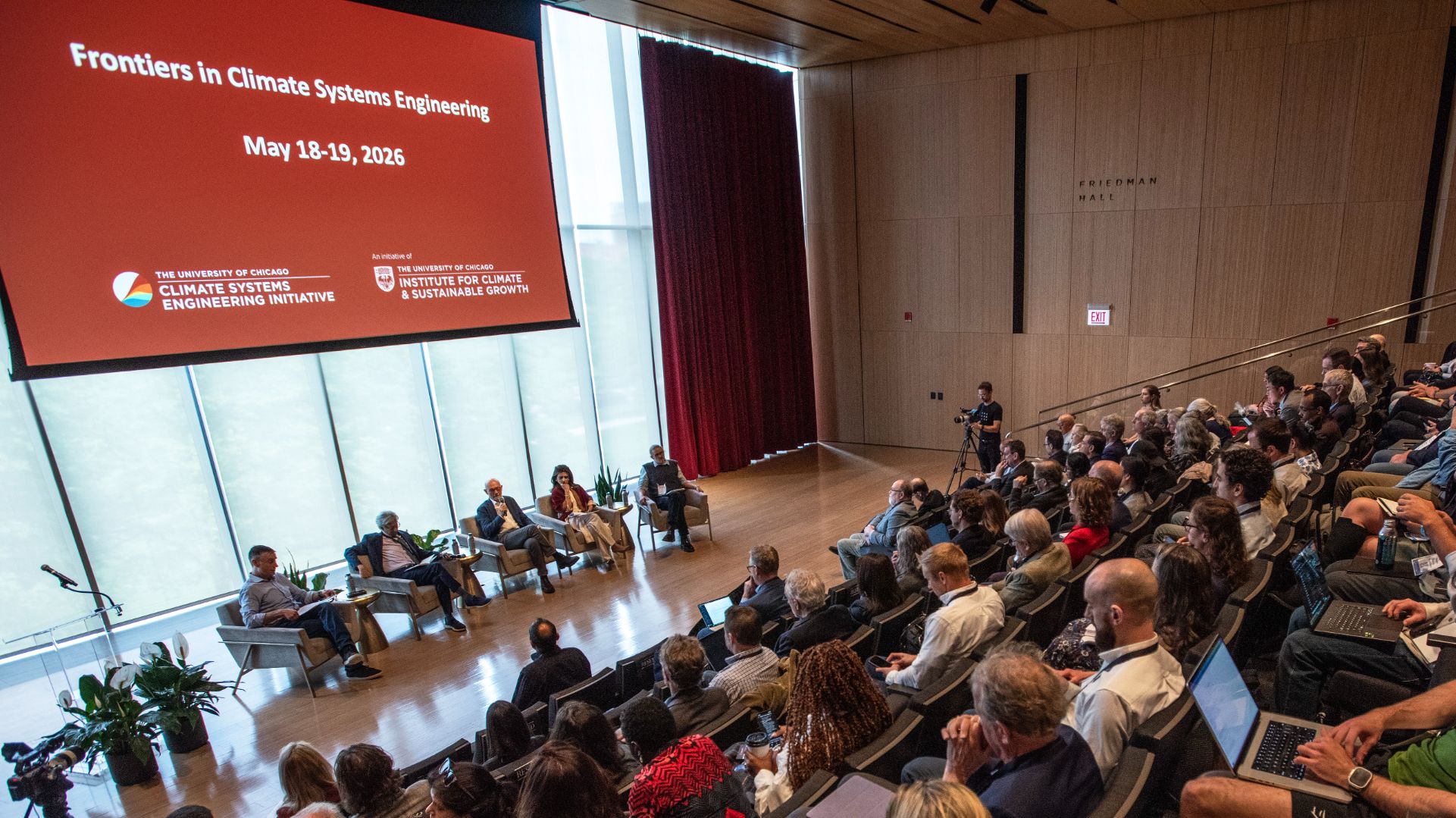
Photo: Lloyd Degrane
The field of SRM is growing. That growth is seen in terms of funding, planned experiments, organisations engaging with the topic – and events. Two conferences took place recently that brought many in the SRM world together, and according to some people who attended both, offered somewhat contrasting pictures of where things stand.
The first event was the inaugural Frontiers in Climate Systems Engineering conference, organised by the University of Chicago’s Climate Systems Engineering initiative (CSEi), held 18–19 May. CSEi is a large academic initiative aimed at improving the understanding of potential risks and benefits of several types of climate interventions; its event also featured discussion of other approaches beyond SRM, including carbon dioxide removal and glacial interventions.
A week later and across the Atlantic, the Co-CREATE Forum on Solar Radiation Modification Research Governance convened in Brussels from 27–29 May. Co-CREATE is a consortium of 12 institutions including universities, civil society groups, and others, funded by the European Commission to develop potential governance frameworks for SRM research.
“The mood change was quite striking”, said Cynthia Scharf, a senior fellow for climate interventions at the Centre for Future Generations. In Chicago, she said, the conversation was more about technical progress towards potential deployment of SRM, a sort of hands-on conversation about what may be possible. In Brussels, she added, the focus was on guardrails and the need to proceed with caution. The CSEi conference “just had a more ambitious kind of foot-on-the-accelerator vibe, whereas the other one felt like the foot was either on the brake or ready to be on the brake as soon as needed”.
The conferences in some ways reflect the difference between US and European approaches. The US has dominated SRM-related funding to date from both public and private sources, while the European Union has seen relatively limited funding allocation to the topic. Also, while new groups have started to engage with SRM in the US, the EU has moved tentatively towards a moratorium on SRM deployment.
Shuchi Talati, the founder and executive director of the non-profit Alliance for Just Deliberation on Solar Geoengineering (DSG), said that the two events were “jarringly different” in tone as well as content. “There were a variety of views in the room, but I would say broadly speaking, I think there was a deeper sense of comfort around the idea of deployment [of SRM] at the Chicago event.” The Co-CREATE event, she agreed, took much more of a cautious, risk-oriented view of the field.
Technical details and the for-profit presence
One of the take-home messages from the CSEi event was that at least in certain respects, the technical capabilities required for stratospheric aerosol injection (SAI) deployment may not be as far away as previously thought. There were panel discussions and presentations regarding some of those technical barriers, such as on the efficient dispersal of aerosols and on the feasibility of creating prototypes of high-altitude jets capable of SAI deployment within a mere 36 months. Though those discussions were prominent, other panels and talks did engage with governance issues and geopolitical questions as well.
Perhaps most notable in Chicago was the presence of several representatives from Stardust Solutions, the for-profit Israeli-US company that is developing SAI technology. The company recently revealed some details of its solid particle alternatives and dispersal technology in a series of preprint (not yet peer-reviewed) papers. In Chicago, CEO Yanai Yedvab participated in a panel along with Dakota Gruener, the CEO of the non-profit Reflective (and an SRM360 board member), to discuss the private and non-profit approaches to the technology.
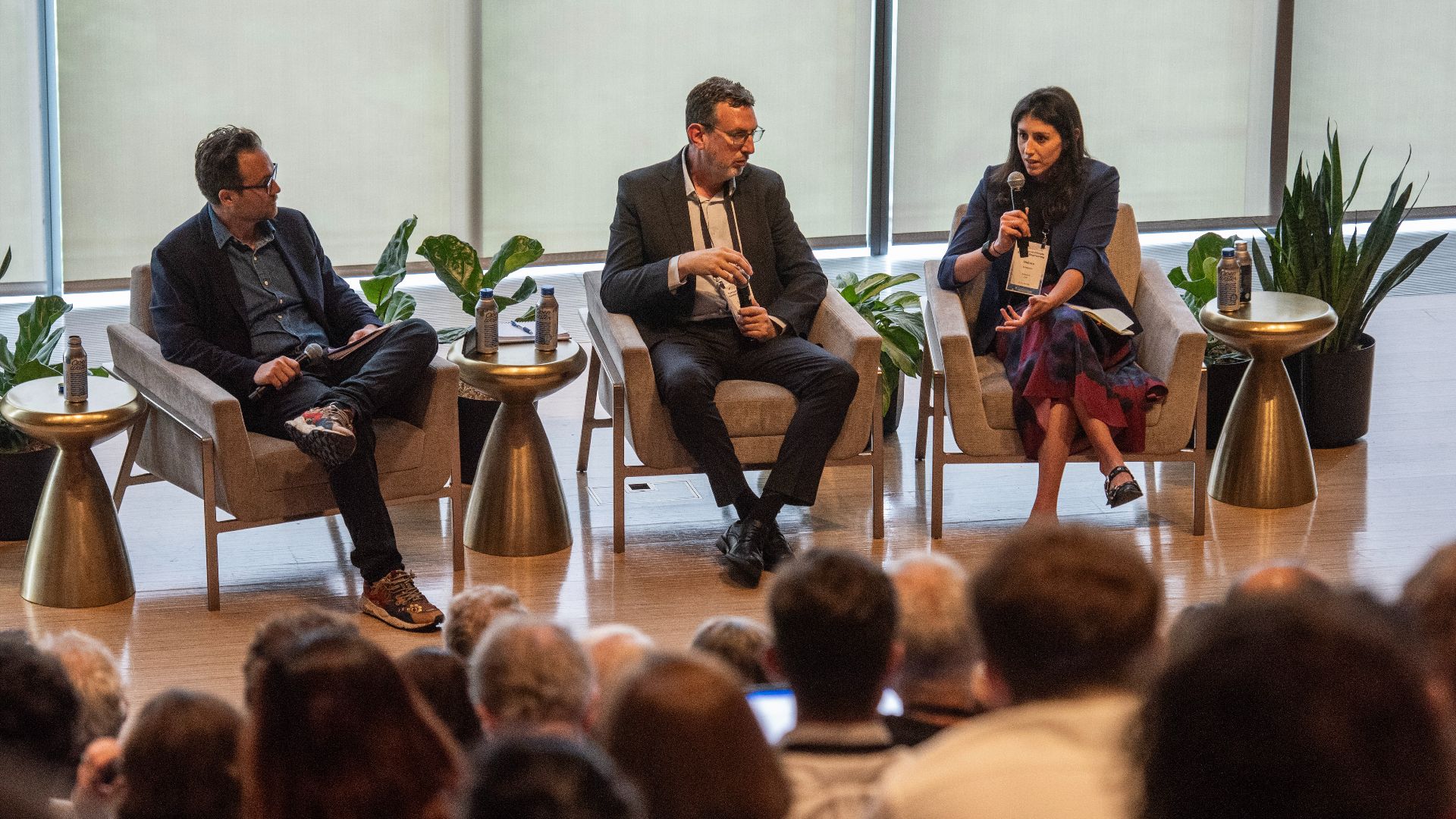
From left to right: David Wallace-Wells, Yanai Yedvab, and Dakota Gruener at CSEi’s event in Chicago (photo: Lloyd Degrane).
“That definitely contributed to the feeling that we are definitely in a new era where the private sector is going to be coming in as a strong player”, Scharf told SRM360. “I believe that Stardust is really only the first that we’re going to see.” Talati agreed that the company’s presence dominated off-stage conversations at the event.
Whiplash in Brussels
In Brussels, amid a record-shattering heatwave across much of Western Europe, the focus was much more on careful governance of SRM research. Pete Irvine, SRM360’s co-founder and Chief Scientist, was also at both events and presented at the Co-CREATE Forum. He described a sense of “whiplash” in going from the technical “how” questions in Chicago to more of a “should we” approach in Brussels.
“I have sympathy with both perspectives”, he said. “Climate change is rapidly destabilizing many of our planet’s key systems, imperilling societies and ecosystems across the world, and while solar geoengineering may help stabilize the physical climate system, it may also be highly – perhaps dangerously – disruptive to our social and geopolitical systems.”
The Co-CREATE Forum focused heavily on pathways towards good research governance, including the need to build trust and maintain transparency, among other things. The discussions on stage, however, did not necessarily reflect the full range of attitudes at the event.
“Whenever you go to a conference there are basically two or multiple conferences going on at the same time – you have the formal program and you have the informal conversations at the coffee table”, said Jeroen Oomen, an assistant professor at Utrecht University, during a closing plenary panel discussion. “And I don’t think I’ve ever been to a space where the disjuncture between the two felt so strong.” He explained that those background conversations reflected concerns over powerful actors, in particular in Silicon Valley and the venture capital world, who may be thinking about or approaching SRM from entirely different angles than the relatively familiar research and public policy approaches that were more evident on stage.
“This whole debate grew up in a time where there was a self-evidence to a liberal world order that just isn’t there anymore,” he said.
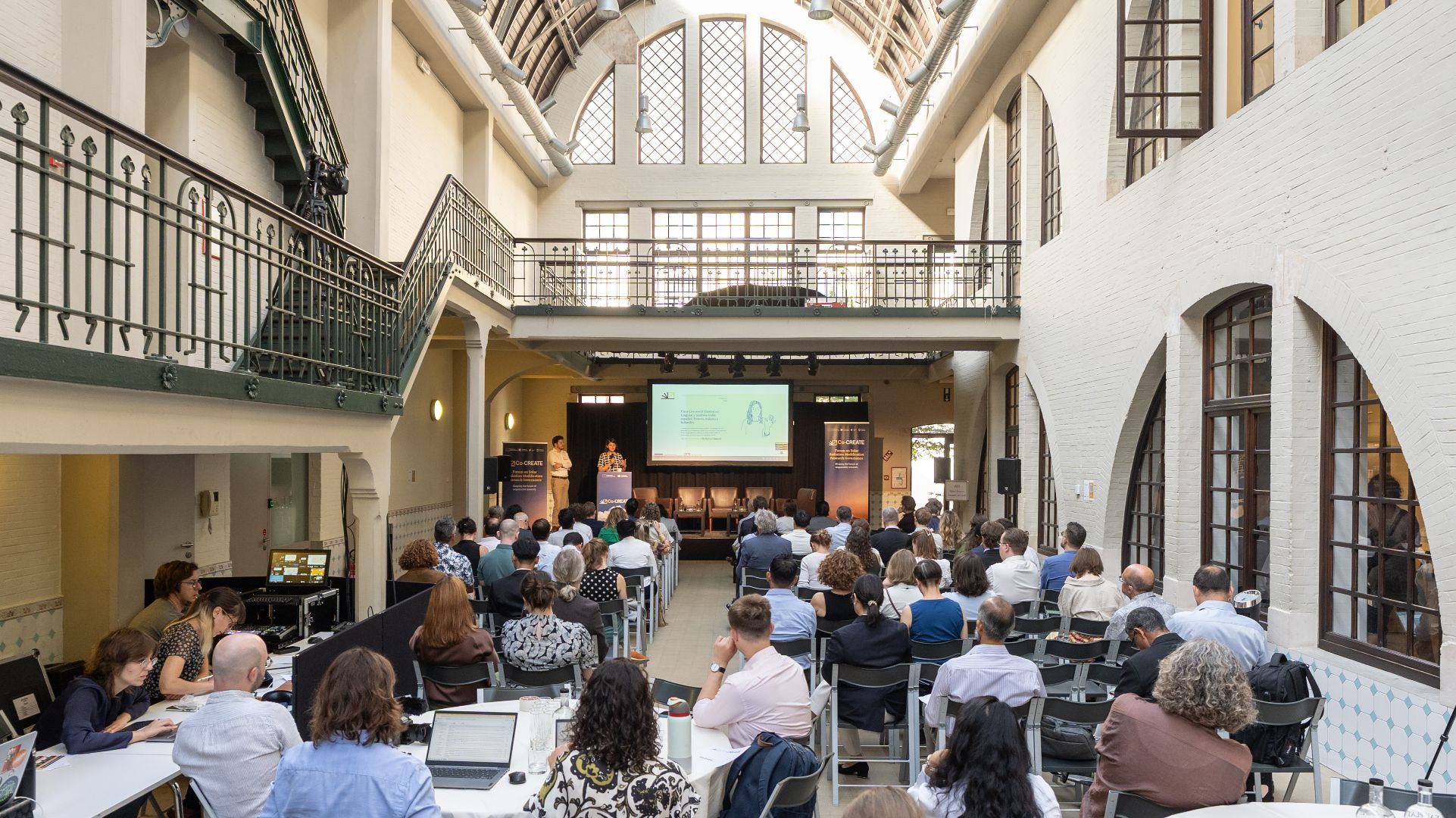
The Co-CREATE event in Brussels (photo: John Somers).
Funding and regional isolation
Talati found it notable that the CSEi panel featuring Stardust and Reflective – the for- and non-profit approaches – did not also include discussion of public funding. Co-CREATE itself is publicly funded by the European Union and UK Research and Innovation, and she said there was much more discussion in Brussels about the impacts of SRM funding decisions.
“Funding is a governance choice”, she said. “How you fund, what you fund, who funds – is part of how governance gets built and proceeds, good or bad.”
The contrast between two of the larger SRM events to date suggests the field is still distinctly regional, Talati went on, and largely separate, with differing attitudes dominating conversations in different parts of the world. American and European approaches appeared distinct at the CSEi and Co-CREATE events, and she noted that neither had significant involvement of other regions and the Global South. “How are we ever going to get to a place of legitimacy and durability in decision-making if these conversations continue to be so different and isolated from one another?”