News Article
Planes for SAI May Be Closer and Cheaper Than Previously Thought
Though technically feasible, the aircraft that could be used for large-scale stratospheric aerosol injection (SAI) have not yet been developed. A small aerospace company recently presented a roadmap to make one for less money and in less time than previous research suggested was possible.
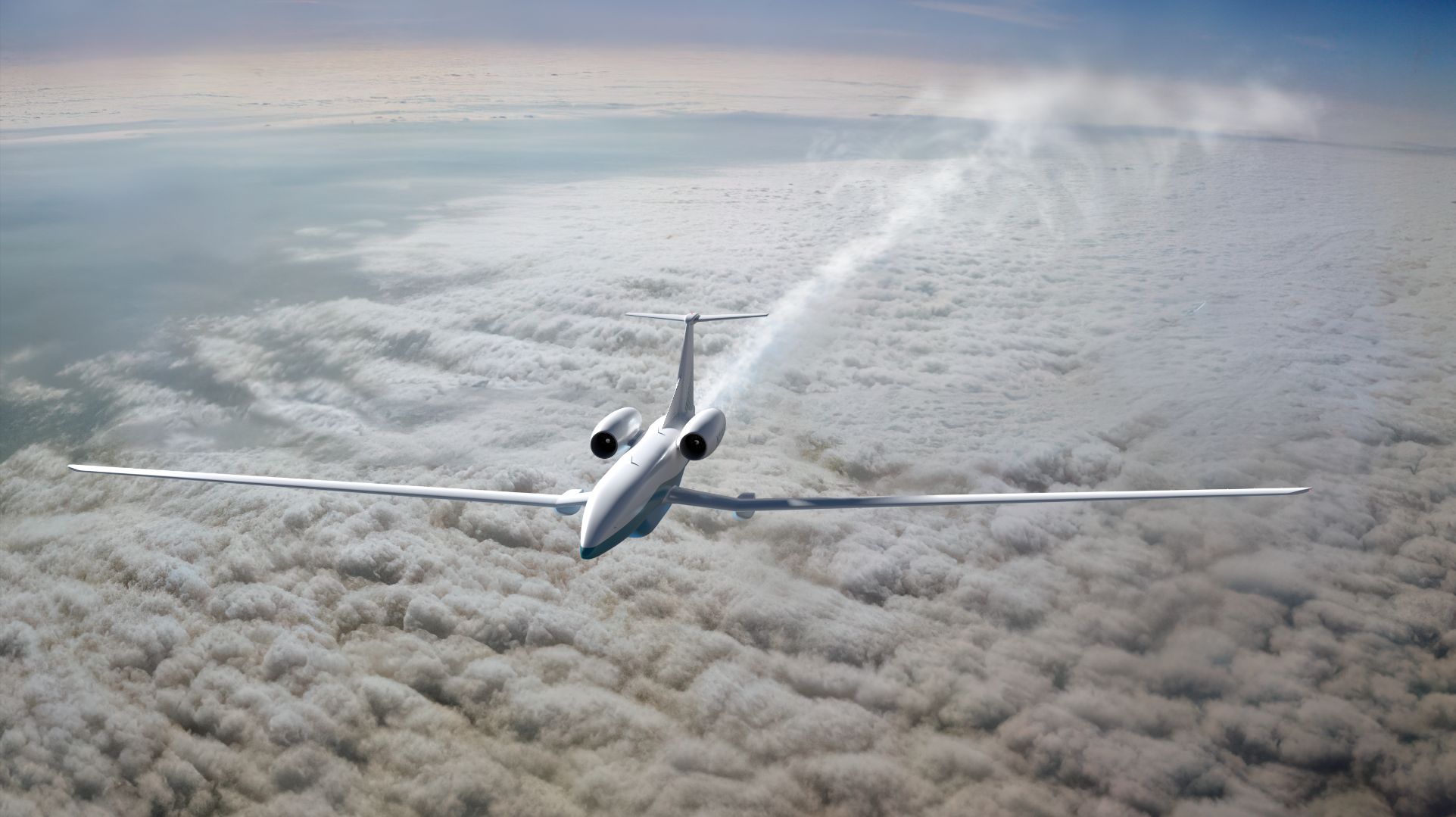
A rendering of the IR-1 design by Iris Aero

One of the primary technical barriers to a deployment of stratospheric aerosol injection (SAI) is right there in the name: the stratosphere. For the most commonly studied and cited SAI deployment scenarios, the material used to reflect a small percentage of sunlight back into space – most likely sulphate aerosols – would need to be hauled up to around 18 to 20 kilometres (about 59,000 to 65,000 feet) in altitude. Most of the world’s airplanes simply do not fly that high.
Though it has been widely accepted that this is a surmountable challenge, new work from a company called Iris Aero suggests the runway towards an SAI-capable aircraft might be substantially shorter and cheaper than previously assumed. According to Dr John Langford, an engineer and founder of several aeronautics companies including Iris Aero, two working prototypes of an aircraft that could feasibly be used for SAI deployment could be built within only three years for about $120 million.
“It can be done for significantly less money than some of the folks in the SRM field were coming to believe it was going to take”, he told SRM360. Previous estimates varied somewhat, but those numbers would chop at least a few years and a substantial number of dollars off the project.
Langford presented his company’s study on a plane design they call the IR-1 at the recent Frontiers in Climate Systems Engineering conference, hosted by the University of Chicago’s Climate Systems Engineering initiative (CSEi) in May. Over the course of about a year, funded by a grant from CSEi, his team sketched out the design of an unmanned aircraft, capable of bringing material up to the high altitudes required.
Some other experts seem persuaded that the timeline is realistic. “The IR-1 is another confirmation that this aircraft is reasonably buildable from technologies that already exist”, said Wake Smith, a lecturer at Yale School of the Environment who has studied aircraft and other technical details of SRM, during the CSEi panel discussion on SAI deployment technologies. “There aren’t big technological breakthroughs that would be required to do this.”
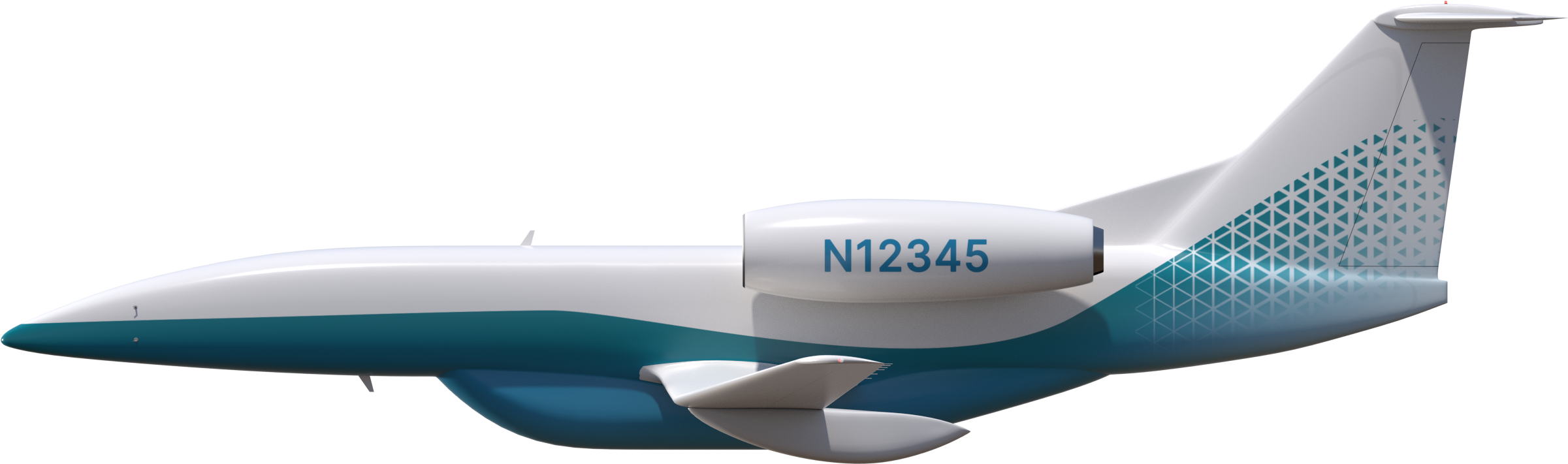
A rendering of the IR-1 design by Iris Aero
Details of the IR-1
A key reason the aircraft could be made so quickly is that it would use a commercially available engine – specifically, the Rolls Royce AE 3007H. This engine is capable of high-altitude flight, and is in use both for military applications and on some commercial and business jets.
“You’ve got to start with the engine, because if you’re trying to do something from scratch, it’s a totally different ballgame”, Langford said.
The IR-1 would be built of composite materials and feature two of those Rolls Royce engines, and would be capable of carrying 15,000 pounds (almost 7,000 kg) of material to the stratosphere. Importantly, that material and the mechanisms to disperse it would be contained in a swappable tank attached to the bottom of the fuselage. This would allow for more efficient and safer refilling between flights and means that changing the material or dispersal method would not require a redesign of the aircraft.
“It will be a little bit heavier for sure, but right now we think it’s probably a pretty big win, and is sort of a fundamental part of our concept at this stage”, Langford told SRM360. Because no crew would be on board, the plane would not need to be pressurised, reducing costs and weight. The team is preparing a paper detailing the IR-1’s design, likely to be published in early 2027.
Previous designs and other methods
There have been other aircraft designs for theoretical SAI deployments, such as the SAIL (Stratospheric Aerosol Injection Lofter). Described in a 2018 paper from Smith and Gernot Wagner, now at Columbia Business School, they imagined a 15-year development plan for the aircraft. This manned aircraft design would be substantially larger than the IR-1, weighing almost eight times as much, and would carry twice the payload. And critically, it would rely on an engine that is quite a bit harder to obtain.
The GE F118 is a military-only engine, and was designed to power the B-2 Spirit, commonly known as the stealth bomber. “The SAIL isn’t an aircraft that one could go out and build because the military likely won’t sell you that engine”, Smith said during the CSEi panel.
Notably, other recent research has shown that a form of SAI known as high-latitude low-altitude could also feasibly provide effective (though less efficient) global cooling. By dispersing the aerosols closer to the poles, the altitude requirements come down into ranges flown by existing aircraft, slashing the development timeline substantially.
Scaling up
How quickly could this design be scaled up to cool the planet?
The IR-1 planes would fly short, 90-minute missions up to around 18 km (60,000 feet) to disperse the material from their tanks before heading back to base to swap out the empties. With each plane flying twice per day for 250 days of the year, a fleet of 267 would be needed to get a million tons of material to the stratosphere, 7.5 tons at a time.
For about $120 million, Langford believes his company could produce the initial prototypes in three years; with a further $1 billion, a larger industry partner, and another three years, the design could be ready for mass production. How long it would take from then to scale up would depend on the goals of SAI deployment and the urgency with which they are pursued.
The one-megaton-per-year deployment that the Iris Aero study targeted is a relatively small deployment compared to commonly modelled scenarios that would involve upwards of 10 megatons in order to offset about 1°C of warming. David Keith, the founding faculty director of CSEi, said during the panel in Chicago that if the deployment was aiming for a larger amount of planetary cooling, “then it really is something that could easily take a couple decades to start.” But beginning the deployment more modestly? The planes, it seems, would not represent a significant barrier. “Then it really could start in just a couple of years.”
With around $1.1 billion of development costs, another $5.34 billion to procure the fleet of 267 IR-1 aircraft (at $20 million each), and an annual operating budget of around $930 million per year, it appears that the costs of the aircraft needed for a megaton-scale deployment are not a major obstacle.
That annual operating number, importantly, is focused only on flying the aircraft themselves and leaves many aspects of an SAI programme out. Other costs would include the building and maintaining of airbases in potentially remote locations, the payload itself and any infrastructure related to manufacturing and packaging it, and other issues like insurance.
Still, in comparison to climate change-related costs and the budgets of the governments that might consider undertaking SAI, the concept remains relatively cheap. As Smith wrote in a 2020 analysis of potential costs, “SAI continues to appear remarkably inexpensive, even if we extend our gaze out to the end of this century.”
No closer to deployment
The Iris Aero study suggests that beginning high-altitude SAI deployment is technically feasible on short time scales. Scaling it up to larger deployments to cool the planet further would require producing more planes, though once in mass production this also may not represent a large obstacle.
Still, the technical feasibility of either high-latitude low-altitude or more standard SAI with something like the IR-1 does not mean the world is any closer to deployment, as a wide variety of scientific, geopolitical, ethical, and other questions remain open. Governance of both SRM research and any potential future deployment remains a widely discussed and controversial subject, and the near-term availability of SAI-capable aircraft does not change that complicated sociopolitical context.
SRM360 contributor Josh Horton said in an email that these developments may alter the timeline, though they do not change the picture entirely. “From a geopolitical perspective, this research implies that the timeframe for fleet construction may be shorter than previously thought, say five years versus ten years”, he said. But, he added, because the company that makes the engine is still embedded within the defence industries of just a couple of countries – the US and the UK – it still would limit the number of actors capable of starting such a project.
“And it does not necessarily imply a shorter timeframe for large-scale deployment since implementation would also require the buildout of additional infrastructure”, Horton said.